Anyway, I got pretty LUCKY this week, because I got to fly into the Denver area, where my best friend lives. Cindy is an America West Airbus pilot
"We gain strength, and courage, and confidence by each experience in which we really stop to look fear in the face... we must do that which we think we cannot." Eleanor Roosevelt
Tuesday, September 09, 2008
Busy Week!
Anyway, I got pretty LUCKY this week, because I got to fly into the Denver area, where my best friend lives. Cindy is an America West Airbus pilot
Saturday, September 06, 2008
Trailing Link Landing Gear
Every successive airplane has gotten more complex, and the training facilities expect us less to understand HOW they work as opposed to how to PROGRAM them! Where we used to have to know how the ACM
There is also a lot of knowledge that people pick up along the way, depending upon their interest level, experience, mechanical ability, etc. The first jet I ever flew, I don't think I understood what the thrust reversers did until I was through with the course and a captain I was flying with noticed I wasn't using them appropriately. (I discussed TRs before in an earlier post. See Wikipedia for more info: Thrust reversal, also called reverse thrust, is the temporary diversion of an aircraft engine's exhaust or changing of propeller pitch so that the thrust produced is directed forward, rather than aft.)
Anyway, back to the gear. The Citation X has trailing link landing gear. I've heard about it in passing, especially after some of my poorer landings. For "whatever reason" it's pretty hard to have a hard landing in the X. So I decided to look up this gear and why it's less likely to have this airplane "slam" on the runway. There's not much to read online, so the captain walked me out to show me how this gear is different from every other previous airplane I've flown.
Basically the strut on the right, or forward, has a pivot point that allows the tires to sink a few inches when the airplane is off the ground and the gear is extended. When the tires touch the ground on landing, it's enough give so that when the second strut, the hydraulic one, comes into play, it's not as abrupt. It used to take a pilot's skill to make a smooth landing, now the gear does it for us!
Thursday, September 04, 2008
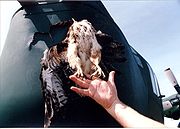
Bird Strike!
First, let me say that post-flights (done after flying) are just as important as a preflight. I myself have been caught missing something before turning over an airplane to someone else. We can never assume the previous pilot left us with a perfect airplane. And once a pilot signs for an airplane, the issues with the airplane can be transferred to the new pilot; which means also the responsibility and accountability. A story at one of my previous places of employment concerned a crew that had an extremely hard landing at night. They didn't report the damage to the company and the crew that took the airplane the next day started before dawn. It wasn't until it was light that they saw the damage. They were held accountable for flying that airplane with damage that they should have caught!
Bird strikes happen most often during take off or landing, or during low altitude flight. However, bird strikes have also been reported at high altitudes, some as high as 6000 to 9000 meters above ground level. The majority of bird collisions occur near or on airports (90%, according to the ICAO) during takeoff, landing and associated phases. According to the FAA wildlife hazard management manual for 2005, less than 8% of strikes occur above 900 meters and 61% occur at less than 30 m (100 feet).
A hawk stuck in the nosecone of a C-130
The point of impact is usually any forward-facing edge of the vehicle such as a wing leading edge, nose cone, jet engine cowling or engine inlet.
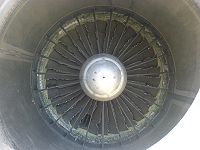
Jet engine ingestion is extremely serious due to the rotation speed of the engine fan and engine design. As the bird strikes a fan blade, that blade can be displaced into another blade and so forth, causing a cascading failure. Jet engines are particularly vulnerable during the takeoff phase when the engine is turning at a very high speed.
The force of the impact on an aircraft depends on the weight of the animal and the speed difference and direction at the impact. The energy of the impact increases with the square of the speed difference. Hence a low-speed impact of a small bird on a car windshield causes relatively little damage. High speed impacts, as with jet aircraft, can cause considerable damage and even catastrophic failure to the vehicle. However, according to the FAA only 15% of strikes (ICAO 11%) actually result in damage to the aircraft. The impact of a 5 kg (12 pound) bird at 240 km/h (150 mph) equals that of a 1/2 ton (1000 pound) weight dropped from a height of 3 meters (10 feet).
Bird strikes can damage vehicle components, or injure passengers. Flocks of birds are especially dangerous, and can lead to multiple strikes, and damage. Depending on the damage, aircraft at low altitudes or during take off and landing often cannot recover in time, and thus crash.
Wednesday, September 03, 2008
The September eZine is out!
Tuesday, September 02, 2008
Wing Scouts
The Wing Scout Program was a popular older girl Girl Scout program begun in 1941 for girls "interested in flying and wanting to learn enough about aviation to serve their country."1941 sounds pretty early, but would you believe the GS had an aviation badge in 1916!?! Makes you wonder why 92 years later we're still trying to get more women into aviation.
In 1959, Girl Scout Council in North San Mateo County was presented with an offer from United Airlines San Francisco Management Club President J. L. Burnside to start an aviation program for Senior Girl Scouts.
At that time, the council had been in search of a program that would challenge the interest of Senior Girl Scouts.
One of the highlights of the Wing Scout program was thecourtesy flight provide to Senior Girl Scouts using United Airlines' jets. For many of the girls, this was the first time they had flown in a plane.
The Wing Scout program was not for show, participating girls took it very seriously. As a result of their proficient training and ability, Senior Girl Scouts who had been in the program for three years were given the opportunity to take over the controls during flight in a small aircraft.
The program continued into the 70s, when it was discontinued after United Airlines experienced financial setbacks.
If you would like to volunteer to speak at Girl Scout or other school events, please visit http://girlswithwings.com/volunteer.html. See the calendar of events or make a request. Pictures on this post courtesy of Kate, my niece.
Wednesday, August 27, 2008
FBOs
In the aviation industry, a fixed base operator (also known as fixed base of operation), or FBO, is a service center at an airport that may be a private enterprise or may be a department of the municipality that the airport serves. At a minimum, most FBOs offer aircraft fuel, oil, and parking, along with access to washrooms and telephones. Some FBOs offer additional aircraft services such as hangar (indoor) storage, maintenance, aircraft charter or rental, flight training, deicing, and ground services such as towing and baggage handling. FBOs may also offer services not directly related to the aircraft, such as rental cars, lounges, and hotel reservations. Entire article at http://en.wikipedia.org/wiki/Fixed_base_operator (it's pretty
At my job we visit these FBOs regularly. Depending on the time of day, or how large their operation is, determines how many people are on duty. Some of the better ones meet you at the door asking you what your tail number is and what services you need. At this particular FBO, we have asked for our airplane to be towed around so that we could prep it for the day's flight. You can see the airplane through the windo
Tuesday, August 26, 2008
Cloud Phenomenon?
The Sun, Earth's main source of energy, continuously showers the planet with electromagnetic radiation. About 31% of this solar radiation is reflected back towards space, about 23% is absorbed by the atmosphere, and about 46% is absorbed by Earth's surface. Earth's surface re-emits some of this absorbed energy as infrared radiation, and this heat energy is then absorbed by greenhouse gases in the atmosphere. Energy is also radiated from the atmosphere and warms Earth.from: http://www.teachersdomain.org/resources/ess05/sci/ess/watcyc/convective/index.html
Air near the ground is also warmed by conduction — the direct transfer of energy between objects in contact by the collision of their molecules. However, air is not a very good conductor. A more efficient mode of energy
transfer within the atmosphere is convection — the transfer of heat through the movement of matter. As a region of surface air is warmed, the molecules move
faster and the air expands and becomes less dense. Less dense air rises through the cooler and denser air above it in the process of convection. These parcels of rising warm air, called thermals, can lead to the formation of cumulus clouds.
As air rises, it moves into an environment of lower atmospheric pressure, and as a result, it expands further and cools. When the temperature of the air drops below the dew point point, the rate at which invisible water vapor condenses onto cloud condensation nuclei — tiny particles in the air such as dust, sea spray, and industrial aerosols — exceeds the rate of evaporation of liquid water. Billions of these tiny water droplets or ice crystals may develop and collect to form a cloud. When the droplets or ice crystals grow too large to remain suspended in the air, they fall to the ground as precipitation.
Because warm air is less dense than cold air, and moist air is less dense than dry air, the warm and moist air of the tropics provides an ideal environment for convection. Along coastal locations in the tropics, convection is often easy to observe on a warm, sunny day. While cumulus clouds are found over both land and water, they tend to form over land earlier in the day than over water. This is because water has a higher heat capacity than land — it takes a lot more energy to raise the temperature of water than to raise the temperature of land. As a result, land warms more rapidly than water and is able to heat the surface air to a higher temperature.
Whether or not cumulus clouds bring about thunderstorms depends on the stability of the surrounding atmosphere. If the air around the cloud is stable, vertical air motion and cloud growth is inhibited. However, if the air around the cloud is unstable, vertical motion is enhanced and the cloud continues to grow, potentially into a
thunderhead.
Monday, August 25, 2008
Starting a new tour
Saturday, August 23, 2008
Acknowledging acknowledgements
The tip is timely because I was just telling me some people yesterday that a controller gave me a hard time on the radio for not responding back when he told me I had read back the clearance correctly. In other words, I had called up for my clearance, he read it to me, and I am required to read it back to make sure I had gotten it right, which I did. So he responded with my call sign and "readback correct." Should be end of story, right? Instead, he got on the radio and angrily said my call sign and "readback correct, OVER." (Over means the person on the radio is expecting a response.) So I said my call sign and "thanks?," not knowing what else he was looking for. After I told this story, a pilot took me to the side (in respect to any hurt feelings I might have, I guess) to let me know that sometimes the controllers like you to respond with your callsign so that they are reassured that you heard them.
I guess in smaller airports this would be ok. But in many larger airports, radio traffic is so crowded, they expect you to ONLY respond back with your callsign and your transponder code, unless you have questions with your clearance. Ultimately, though, pilots are supposed to be brief and to the point on the radio and avoid "unnecessary chatter." As a friend mentioned, there is nothing worse than flying toward a kind of airspace where you need specific clearance to enter, where another pilot gets on the frequency and starts telling their life story. Pilots do and have to turn around and circle til they get clearance into the airspace. Grr, huh?
So, in the end, would I have been wrong to respond to the controllers "readback correct" with yet another transmission? No. But he was wrong to growl at me on the radio demanding a unnecessary acknowledgement. All pilots and controllers need to be familiar with the publication described below so there are no (or fewer) misunderstandings!
Training Tips
'ACKNOWLEDGE!'Sometimes in busy airspace or on the ground at a bustling airport, you'll hear a controller fire off instructions followed by a command such as, "Hold short, 'acknowledge' hold." Why was "acknowledge" added to the transmission? What should the acknowledging pilot say?
The specific meaning of "acknowledge," given in the "Pilot/Controller Glossary" in the Aeronautical Information Manual (AIM), is "Let me know that you have received my message." That's always key to clear communications. So if a controller specifically requests that you "acknowledge," give an immediate, positive response.
"When talking to a controller, the general rule is that you must fully acknowledge all commands. Climbs, descents, turns, and clearances must be repeated so that the controller knows that you received the proper information. Acknowledging a descent clearance with just your call sign is not acceptable and can incur the wrath of the controllers, especially if they are busy and have to waste time getting you to do your job. Likewise, acknowledging a command without using your call sign is also a no-no, because the controller doesn't know which aircraft took the command," Chip Wright said in the May 2005 AOPA Flight Training feature "Talking the Talk." "On the ground, the most critical—but by no means the only—items to read back are hold-short commands, and it doesn't matter if the hold-short command is for a runway or a taxiway. If you don't properly read back the hold-short command, the controller is required to bug you until you do."
Acknowledging instructions is not the same as a "readback," in which you repeat the entire message to the controller, such as when receiving taxi instructions. The AIM explains:
"When taxi instructions are received from the controller, pilots should always read back:
(a) The runway assignment.(b) Any clearance to enter a specific runway.(c) Any instruction to hold short of a specific runway, or taxi into position and hold.
Controllers are required to request a readback of runway hold short assignment when it is not received from the pilot/vehicle."
These and other terms used by ATC are discussed in the "New Pilot's Guide to ATC Communications" article on AOPA Flight Training Online. Make it your mission to know how to respond.
Friday, August 22, 2008
Fundraising!
This was my first year helping, and let me say, it reinforced my belief that I am now a resolved cat person. Then again, I didn't see the best of the dogs. Like people, they are nervous, and it shows. Some of the piles were like cowpies. Blech.
The chapter has been very supportive of my Girls With Wings activities, so I have no complaint also helping them out. They even selected me as this year's Pilot of the Year. See their website: http://lakeerie99s.homestead.com/
Thursday, August 21, 2008
Air Traffic Controllers Convention and Scholarships
High Schools: November 5 Marriott Wardman Hotel, Washington, DC
10:00 am – 2:00 pm Contact Belinda.Bender@faa.gov
University students: November 3-5 Full access to technical sessions and exhibit area.
Contact Patricia.Watts@faa.gov
* The Air Traffic Control Association (ATCA) has invited our FAA Centers of Excellence universities and college students to attend the upcoming conference in Washington, DC. The invitation to attend November 3 - 5 is being extended to students who are registered at COE colleges and universities or those living in the tri-state area. In an attempt to attract students who are interested in aviation-related careers, with proper student identification, ATCA is waiving the usual Conference registration fee. This opportunity includes full access to the exhibit area and technical sessions led by some of the world's most recognized aviation leaders. College students may register on the ATCA website, http://www.atca.org/
* High School students must be accompanied by teachers, or parents with proper ID, and FAA personnel will be assigned to serve as chaperones through the exhibit area. High Schools may register for the ATCA exhibit tour and workshops by contacting belinda.bender@faa.gov by October 6. Space for High School students is limited; therefore, registration will be accepted on a first-come first-served basis.
- ATCA Scholarships Program
Air Traffic Control Association (ATCA) Scholarships are awarded to help support the financial needs of those deserving students who have chosen to seek higher education in the science of air traffic control and other aviation disciplines, as well as children of air traffic control specialists. Categories are as listed below. - Students enrolled half- to full-time in a two- to four-year air traffic control program at an institution approved and/or licensed by the Federal Aviation Administration as directly supporting the FAA's college and training initiative.
Students enrolled half- to full-time in a program leading to a bachelor's degree or higher in an aviation-related course of study. - Full-time employees enrolled in advanced study programs to improve their skills in air traffic control or an aviation discipline.
- U.S. citizen, children of air traffic control specialists enrolled half- to full-time in a program leading to a bachelor's degree or higher.
- Please see Terms of Reference for complete rules.
For additional information, please contact Carrie Rowe.
Wednesday, August 20, 2008
Good Friends are Priceless!
But Ken and I met when we were both pilots for a regional airline flying the Beech 1900s. Ken was my First Officer for a while - the best one I would say. He is a very proficient, professional pilot and an all around great guy. He had some time in the Cleveland area, so we met for lunch, at which time he made a very generous contribution to the Girls With Wings Scholarship in memory of his flight instructor, who just passed away recently. Look for more information to be posted on the scholarship page. Many thanks to Ken, his wife Laurie (also a pilot), and their son, James, for their support.
Whenever I think of Ken, I think of a funny story. In the 1900, the FO had to do the passenger briefing while the Captain sits up front and completes the paperwork, and for one particular leg, we only had one passenger. Ken was crawling into the seat so that we could crank the engines and go, and the passenger said to Ken (referring to me), "Oh, is she just learning to fly?" As if a pilot (even on a regional carrier) would be just starting out. Ken immediately replied, "No, she's the boss." The passenger, realizing now I was the Captain, tried to recover by saying, "Well, I figured because she was sitting in the left seat, and uh, well, uh...." We let the conversation just die out and we got on our way.
Tuesday, August 19, 2008
Today is National Aviation Day!
Ok, so what does this mean? Should I run out and buy a card at Hallmark? Who do I send it to? Orville isn't receiving mail anymore....
Well, on the big scale, according to the United States Code, TITLE 36, Subtitle I, Part A, CHAPTER 1, § 118:
The President may issue each year a proclamation
(1) designating August 19 as National Aviation Day;
(2) calling on United States Government officials to display the flag of the United States on all Government buildings on National Aviation Day; and
(3) inviting the people of the United States to observe National Aviation Day with appropriate exercises to further stimulate interest in aviation in the United States.
So, 1 has already been done. Check. 2, if you don't have a government building, is kind of hard. But 3. you could do things to celebrate National Aviation Day. For example, you could go build your own Wright Flyer.
Before breakfast. Blindfolded. No?How about:
Sporting your own Girls With Wings License Plate Frame? This picture is courtesy of Dan Kiser, Founder of Youth Aviation Adventure and an all around great supporter of Girls With Wings.
Don't have a car? That's ok, here's some alternate instructions from ehow.com.
Step1
Visit The Wright Brothers National Memorial in Kill Devil Hills, North Carolina, to see where the brothers got the first plane to work in 1903. The park has exhibits and reproductions of the 1902 glider and 1903 plane. Call (252) 441-7430 for more information on hours and events.
Step2
Go to Dayton Aviation Heritage National Historical Park in Dayton, Ohio, which hosts the Wright brothers' third airplane, as well as a restored print shop of the brothers. It holds free outdoor events for the whole family.
Step3
Read to a child. Teach your child the history of flight and the importance of the Wright brothers. Try Jane Yolen's "My Brothers' Flying Machine," or "First Flight" by George Shea.
Step4
Make crafts with family or at school. Draw images you might see out of the window of an airplane, make paper airplanes, or create collages of aviation images from magazines.
Step5
Celebrate National Aviation Day at the National Museum of the U.S. Air Force--the biggest and oldest military aviation museum. It is located in Springhill Pike, Ohio, and carries a large collection of aircraft exhibits.
From HolidaySpotPlus.com
WEBSITES AND ARTICLES ABOUT NATIONAL AVIATION DAY
National Aviation Hall of Fame (official): Information, history and facts about aviation.
National Aviation Day (Rumela's Web): History and Information on the holiday.
Wright Brothers National Memorial (Nat'l Park Service): Information and schedule events on the birthplace of aviation.
Aviation History Online Museum (official): Information, pictures and history of Aviation.
The History of Aviation and Modern Rocketry (TheSpacePlace): History of aviation through modern space flight.
History of Flight (AIAA): Information and history of flight from throughout the world.
This is not a traditional gift giving holiday. However, this day could be remembered though giving gifts with an aviation theme - airplanes, helicopters, balloons, gliders, spaceships or birds in flight.
GIFT IDEAS FOR NATIONAL AVIATION DAY
National Aviation Day Gift Ideas:
Airplane tickets to anywhere - just so you can fly
Local Hot Air Balloon or Helicopter trip
Model airplane or spaceship
Items emblazoned with things showing flight
Kites
Related Apparel
Training Books on How to Fly
Books & Magazines on Flying
Movies about flight
Monday, August 18, 2008
Flying and Alpacas
You're probably wondering what Alpacas have to do with flying. Well, first, the one of the captains I flew with last week was nice enough to let me take his picture in the cockpit up at altitude, preparing to eat his crew meal. I know I spend a lot of time talking about eating around here, so I figured I would show you how it looks to eat up in the cockpit. It's nothing fancy, that's for sure. Push your seat back as far as it'll go, open up your plastic food container, and dig in! If you're lucky, you won't get any of it on your shirt (or tie, or pants, etc.).Gary, the captain, lives on a farm in Kentucky and raises Alpacas in his free time. His website is http://www.captureyourheartalpacas.com/index.cfm. You'll notice he was kind enough to put up a link to Girls With Wings on his site. I fly with some pretty interesting and cool people!
Sunday, August 17, 2008
Adrienne, my pilot
So cool. After the flight I stopped at the front of the airplane to snap a picture with her. I think the other passengers thought we might have been a little goofy, but this kinda thing doesn't happen every day...Saturday, August 16, 2008
It is still August, right?
Thursday, August 14, 2008
Amy, another Girl With Wings
We’re still old school so we have an in-flight service, Oreo’s and apple juice on the tarmac if you please.
After a snack it’s time for a little nap, no extra charge for blankies. Who needs this pesky mic anyway, I’m am not talking to ATC.
Aha…. the sugar induced coma along with the hum of Lycoming IO-360, it doesn’t get any better than this. Is that a spec of Oreo on my bottom lip?
Even after landing and pushback into the hangar I am still out light a light. My daddy is such a smooth pilot.
The plane is a Vans RV8A we fly out of HFY in Indianapolis, I prefer flying with daddy as apposed to riding in the minivan with mommy. 
Cheers!
-Amy, with help from her dad, Brad.
p.s. if you would like to submit YOUR story, email us.
Wednesday, August 13, 2008
Educational Cab Ride

World's Most Powerful Particle Accelerator Set to Launch; Stretching 17 miles around, a mammoth machine that straddles the Swiss-Franco border will soon start launching the biggest experiments ever attempted in high-energy physics. The fear, he was saying, was that people were causing it a doomsday experiment, as written in this article: "Talk of the experiments triggering black holes has led to some sensational newspaper headlines about the collider leading to the end of the planet, but scientists at CERN say it's not the least bit dangerous."