Wednesday, January 07, 2009

Aviation Inspiration

In addition to working full time as a pilot, many of you know that I also do presentations for groups of girls. I have recently announced a new series of presentations being held through the Lakewood Community Recreation and Education Department: This is an interactive and inspirational event for girls (ages 5-12). Join a professional pilot (that's me) to hear about her training and career, and then learn “everything” you need to know about flying a plane with hands on instruction. We will end with a question and answer session. Classes are held January 24th, February 21st and March 21st from 10 am to 12 pm. Registration must be made through http://www.lakewoodrecreation.com/.

Don't forget that the GWW merchandise line funds the organization by offering the rarely found aircraft themed items designed to let everyone know “Yes, Girls Can Fly!” While some may view one of our products as just a t-shirt, we believe that it is in fact a statement about the potential of girls to be intimately connected with Aviation (and other Science, Technology, Engineering and Math based fields) from the time they are born. To this end, all profits from the aforementioned merchandise, by the way, will be are invested in developments to our educational program and scholarships. http://www.girlswithwings.com/

Monday, January 05, 2009

10 hour turns

Tomorrow I go back on the road, and despite the title of this blog, I may not post until I get home. It's not that there is nothing to talk about. I am taking pictures all the time of things I eventually would like to discuss. The problem is 10 hour turns...

For example, last tour I had a very busy 6 days, during which I didn't write any posts - there was absolutely no time to sit down and write something coherent - and you deserve the best. Many people don't know this but most airline contracts allow "10 hour turns" from landing to the next takeoff. Some more generous employers allow 1/2 hour to an hour for the crew to close up the airplane at night and to prepare before a flight, but not usually. So this ten hours (which may come after the maximum 14 hour duty day) must include packing up your things from the airplane, dealing with the FBO, calling the hotel van (and often waiting for it), traveling to the hotel, checking in, settling into your room, ironing your shirt for the next day, etc. With all that has to be done in the morning to get yourself ready and back to the airport, you can imagine that a 10 hour turn rarely allows for 8 hrs of sleep, much less logging for blog posts. It makes a little easier to understand those hardworking pilots that dozed off into the sun on their way to Hawaii not too long ago. Doesn't forgive it, but we all have felt their pain. See CNN story on NTSB findings: http://www.cnn.com/2008/US/06/10/sleepy.pilots/index.html?eref=ib_travel

I'm going to keep trying though! Let me know if there is something YOU want me to talk about.

Saturday, January 03, 2009

The Conclusion

Here's a picture of a fuel truck approaching that intersection we talked about earlier. I wouldn't want this vehicle to unload its contents into my airplane. This is a AVGAS (AViation GAS) truck, and jet engines require Jet Fuel. Avgas is currently available in several grades with differing maximum lead concentrations. 100LL Grade, spoken as "100 low lead", contains tetra-ethyl lead (TEL), a lead based anti-knock compound, but less than the "highly-leaded" 100/130 avgas it effectively replaced. Most piston aircraft engines require 100LL and a suitable replacement fuel has not yet been developed for these engines. While there are similar engines that burn non-leaded fuels, aircraft are often purchased with engines that use 100LL because many airports only have 100LL.
Because of the danger of confusing the fuel types, a number of precautions are taken to distinguish between AvGas and Jet Fuel beyond clearly marking all containers, vehicles, and piping. AvGas is treated with either a red, green, or blue dye, and is dispensed from nozzles with a diameter of 40 millimetres (49 millimetres in the USA). The aperture on fuel tanks of piston-engined aircraft cannot be greater than 60 millimetres in diameter. Jet Fuel is clear to straw in colour, and is dispensed from a special nozzle called a "J spout" that has a rectangular opening larger than 60 millimetres in diameter so as not to fit into AvGas ports. However, some jet and turbine aircraft, such as some models of the Astar helicopter, have a fuelling port too small for the J spout and thus require a smaller nozzle to be installed in order to be refuelled efficiently.
Just like that Diesel pump at the local Gas station, just in case you're not paying attention when you pull up to a pump!
Speaking of filling up, there are many websites to let pilots know where they can buy the gas they need (and at what price!). Relieved that prices are going down where you live? Look at these fuel prices:

Average Fuel Prices By Region
Updated 01-03-2009
_________Jet A___ 100LL
NC ______$4.35___ $4.37
NE ______$4.44___ $4.57
NW ______$4.23___ $4.70
SC _______$4.10___ $4.14
SE _______$4.22___ $4.20
SW_______$4.29___ $4.48
At least you can fly farther on a gallon than drive...

Thursday, January 01, 2009

The Girls With Wings January eZine

Read all about it!: Happy New Year from Girls With Wings!

Part 4 of 5

Finishing up with the runway, those white lights along the edge of the runway give the pilots information too. According to the pilot's "handbook," the Aeronautical Information Manual:

2-1-4. Runway Edge Light Systems
a. Runway edge lights are used to outline the edges of runways during periods of darkness or restricted visibility conditions. These light systems are classified according to the intensity or brightness they are capable of producing: they are the High Intensity Runway Lights (HIRL), Medium Intensity Runway Lights (MIRL), and the Low Intensity Runway Lights (LIRL). The HIRL and MIRL systems have variable intensity controls, whereas the LIRLs normally have one intensity setting.
b. The runway edge lights are white, except on instrument runways yellow replaces white on the last 2,000 feet or half the runway length, whichever is less, to form a caution zone for landings.
c. The lights marking the ends of the runway emit red light toward the runway to indicate the end of runway to a departing aircraft and emit green outward from the runway end to indicate the threshold to landing aircraft.

Believe it or not, if there is no tower personnel, so no one to turn on these lights, the pilots can do it for themselves (see chart).

Radio Control System

Key Mike____________Function
7 times within 5 seconds -Highest intensity available
5 times within 5 seconds -Medium or lower intensity (Lower REIL or REIL-off)
3 times within 5 seconds -Lowest intensity available (Lower REIL or REIL-off)
The control system consists of a 3-step control responsive to 7, 5, and/or 3 microphone clicks. This 3-step control will turn on lighting facilities capable of either 3-step, 2-step or 1-step operation. The 3-step and 2-step lighting facilities can be altered in intensity, while the 1-step cannot. All lighting is illuminated for a period of 15 minutes from the most recent time of activation and may not be extinguished prior to end of the 15 minute period (except for 1-step and 2-step REILs which may be turned off when desired by keying the mike 5 or 3 times respectively).

The green light you see there is from the airport beacon. Airport and heliport beacons have a vertical light distribution to make them most effective from one to ten degrees above the horizon; however, they can be seen well above and below this peak spread. The beacon may be an omnidirectional capacitor-discharge device, or it may rotate at a constant speed which produces the visual effect of flashes at regular intervals. Flashes may be one or two colors alternately. http://www.halibrite.com/Beacon_refb_24_inch802A.html

The colors and color combinations of beacons are:
White and Green- Lighted land airport.
White and Yellow- Lighted water airport.
Green, Yellow, and White- Lighted heliport.
You can see the satelite view of the airport and it looks pretty easy to pick out. Who needs a beacon, right? Well, it doesn't just need to be dark to be hard to pick out an airport. Hazy weather conditions, surrounding buildings and streets, unfamiliar landscapes and the different perspective from being at a strange angle at altitude make it tough to find even large airports sometimes. A controller might tell a pilot, "Airport at your 12 o'clock and ten miles," and darn it if we can't see it until we're nearly on top of it!

Part 3 in the Series

I'd like to talk some more about the runway, with thanks to this Virgin Atlantic Airbus 340. We are looking at 19L at KIAD. The 19, btw, refers to the compass heading looking down this runway, minus the last digit. 190 degrees is close enough. Here are the precise numbers. The L, or left, means there is a parallel runway, or 19R. It's designated below, Runway 1R/19L because if you were facing the other way, you'd be looking approximately 010 degrees and there is also a 1L, which is the same piece of concrete as 19R. Perfectly clear, huh?


Runway 1R/19L
Dimensions: 11500 x 150 ft. / 3505 x 46m
Surface: concrete/grooved, in good condition
Weight bearing capacity: Single wheel: 200.0 Double wheel: 250.0
Double tandem: 450.0 Dual double tandem: 875.0
Runway edge lights: high intensity

RUNWAY 19L Elevation: 293.2 ft.
Gradient: 0.2%
Traffic pattern: left
Runway heading: 191 magnetic, 181 true
Markings: precision, in good condition
Visual slope indicator: 4-light PAPI on left (3.00 degrees glide path)
RVR equipment: touchdown, midfield, rollout
Approach lights: MALSR: 1,400 foot medium intensity approach lighting system with runway alignment indicator lights
Centerline lights: yes
Touchdown point: yes, no lights
Instrument approach: ILS/DME
Obstructions: 38 ft. pole, 1900 ft. from runway, 720 ft. right of centerline, 44:1 slope to clear

This runway, according to the diagram in a previous post and the above description is approximately 11,500 feet long by 50 feet wide. The white number just behind the landing Airbus is a 9 in a black box, signifying that there is 9000 feet of runway remaining. Above it talks about "Touchdown point."


The handbook for pilots is the Aeronautical Information Manual. It is a lot easier to read than the FARs (the federal regulations for pilots shortened from Title 14 of the Code of Federal Regulations) and has so much interesting and valuable information. There is so much to know about flying that it's easy for some information to fall out as more is crammed in.


For this post, I am looking at Chapter 2. Aeronautical Lighting and Other Airport Visual Aids, specifically, Section 3. Airport Marking Aids and Signs. and finally, 2-3-3. Runway Markings. http://www.faa.gov/airports_airtraffic/air_traffic/publications/atpubs/aim/Chap2/aim0203.html


This would be the markings on this runway.


d. Runway Aiming Point Marking. The aiming point marking serves as a visual aiming point for a landing aircraft. These two rectangular markings consist of a broad white stripe located on each side of the runway centerline and approximately 1,000 feet from the landing threshold, as shown in FIG 2-3-1, Precision Instrument Runway Markings.


e. Runway Touchdown Zone Markers. The touchdown zone markings identify the touchdown zone for landing operations and are coded to provide distance information in 500 feet (150m) increments. These markings consist of groups of one, two, and three rectangular bars symmetrically arranged in pairs about the runway centerline, as shown in FIG 2-3-1, Precision Instrument Runway Markings. For runways having touchdown zone markings on both ends, those pairs of markings which extend to within 900 feet (270m) of the midpoint between the thresholds are eliminated.

So you could do the math and figure that this airplane touched down at 11,500 (the given length) - 9000 (the 9 on sign) = 2500 ft down the runway. Plenty of runway left! (I could get into a whole discussion of what runway length the regulations and specific aircraft manual requires based on airplane weight, runway conditions, wind, etc., but that would take another hour!)


Oh, and the airport diagrams come from http://www.airnav.com/. I had never noticed this information before, but it gives Airport Operational Statistics for the different airports.

Aircraft operations: avg 1673/day for 12-month period ending 30 June 2007
That's almost 70 an hour - more than 1 every minute!
59% commercial
30% air taxi
11% transient general aviation
<1%>
Aircraft based on the field: 78
Single engine airplanes: 3
Multi engine airplanes: 5
Jet airplanes: 67
Helicopters: 3

In comparison is the world's busiest airport, Atlanta, with avg 2959/day for 12-month period ending 28 February 2008. That's twice as many.

Tuesday, December 30, 2008

Another installment

Ok, moving the camera just slightly to the right, what do we see?


There is a string of telephone wires, but in front of that there are also some orange and white towers - you can just see them barely taller than the treeline. I have not had any luck finding out what exactly they are - radio reception towers most likely.

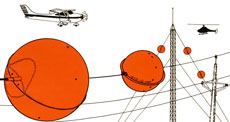
The orange and white paint scheme is a sure giveaway that you're near an airport. The aviation world has adopted these colors to promote awareness and safety. I'm sure you've seen those orange balls on the telephone wires before. Picture to left from Tana Wire Markers: Mark power lines, communication antennas, and guy wires at airport or helicopter areas, river and canyon crossings, overhead obstruction areas, construction sites, migratory waterfowl refuge areas, bird diversion, and more!


There is a whole FAA ADVISORY CIRCULAR AC 70/7460-1K on Obstruction Marking and Lighting. It says any temporary or permanent structure, including all appurtenances, that exceeds an overall height of 200feet (61m) above ground level (AGL) or exceeds any
obstruction standard contained in 14 CFR part 77, should normally be marked and/or lighted. It also specifies the patterns that objects should be painted in, for example:

a. Solid Pattern. Obstacles should be colored aviation orange if the structure has both horizontal
and vertical dimensions not exceeding 10.5 feet (3.2m).
b. Checkerboard Pattern. Alternating rectangles of aviation orange and white are normally displayed on the following structures:
1. Water, gas, and grain storage tanks.
2. Buildings, as required.
3. Large structures exceeding 10.5 feet (3.2m) across having a horizontal dimension that is equal to or greater than the vertical dimension.

Don't worry, I won't reproduce the whole manual here - it is extensive! If one had the time, they could know what size an obstruction is just by the type, location and intensity of the lights...

Monday, December 29, 2008

The Next Installment

Here is the next picture that I took that day. This is taken toward the runway and shows quite a few features on an airport. Starting from left, you can see the first of two flashlight looking things in the ground, then a stop sign, then a similar, but red, light. These are for vehicles driving on a roadway, which is past the ramp (the concrete in the foreground). The first lights are to alert the drivers to the upcoming intersection - you can see a stop bar painted on the asphalt. I cannot say for sure whether the red light is activated by an approaching or by a person monitoring. I will have to ask around, since I can't find the answer on the internet. I did find a guide for drivers that has some great information for anyone, driving or not: http://www.faa.gov/runwaysafety/asw/downloads/AGVO-guide.doc

Behind the lights, you'll see a sign with a J2 on a black background and a J on a yellow background. If you are facing this sign, it means you are on J (or Juliet) taxiway and J taxiway goes right and left at the intersection you are approaching. Look at this diagram to try and figure out where on the airport we were parked when I took this picture. http://204.108.4.16/d-tpp/0813/05100AD.PDF To the right of this sign (which is backlit so you can read it at night) you can see the back of another similar sign. The front of this sign would have the same two taxiways listed, but in reverse order. In other words, you would be on J taxiway, and the sign would tell you to turn right or left to enter J2 taxiway. By the way, the Air Traffic Controller working the "Ground" frequency would usually tell you which taxiway to take, but if they are not specific, you as the pilot are supposed to determine the most direct route.


You can probably see the blue lights everywhere along the taxiways. An airport at night is a beautiful thing. The lights are also turned on during inclement weather. Looking farther in the picture (you'll have to zoom), you can see the white lights that outline the runway (though there are red ones at the end of the runway). The white 9 on the black background tells pilots that they have 9000ft of runway left. Based on looking at the airport diagram, which runway is it? What other taxiway would you have to cross to get to the "Departure end" of this runway?


You can see the big white fuel tanks (the fuel "farm") I talked about previously, and an orange windsock. From Wikipedia:
A windsock is a conical textile tube designed to indicate wind direction and relative wind speed. Wind direction is the opposite of the direction in which the windsock is pointing (note that wind directions are conventionally specified as being the compass point from which the wind originates; so a windsock pointing due north indicates a southerly wind). Windspeed is indicated by the windsock's angle relative to the mounting pole; in low winds, the windsock droops; in high winds it flies horizontally. Per FAA standards, a 15 knot (17mph) wind will fully extend the windsock. A 3 knot (3.5mph) breeze will cause the windsock to orient itself according to the wind. At many airports windsocks are lighted at night, either by flood lights on top surrounding it or with one mounted on the pole shining inside it.
Well, that's probably enough for this edition. More next time!

Friday, December 26, 2008

Ongoing Saga


I've got a few pictures saved up from a day that I flew into Washington, D.C. I have a lot of things I'd like to point out in the pictures. First, note the icecubes flying past the door. The captain was getting rid of the excess from filling our cooler in the airplane!


This was not a good weather day, plus there was something going on in our nation's capitol that day (I can't remember what) so the ramp was packed! A ramp is a parking lot for airplanes.
Wikipedia: An Airport ramp or apron is part of an airport. It is usually the area where aircraft are parked, unloaded or loaded, refueled or boarded. Although the use of the apron is covered by regulations, such as lighting on vehicles, it is typically more accessible to users than the runway or taxiway. However, the apron is not usually open to the general public and a license may be required to gain access.


This airplane ended up being parked just barely off the taxiway, at the entrance to the ramp (it would be towed by a tug immediately after the passengers deplaned). As you can see, there's a pickup truck that brought the ramper out to the airplane, so he was able to marshall the airplane into a parking "space." He then walks out to the wingtips of the airplane and puts down traffic cones - just in case someone needs to be reminded of where the wings ended.


The shuttle is there to pick up the passengers and their luggage. At some airports, you can drive your car up to the airplane (or have someone bring it for you), but at a highly secured airport like DC, this is not possible. And though this airplane is not far from the door, it was raining!

Back to normal


Well, with Christmas over it's now time to get back to normal. For my holiday celebration, I took my nieces to a waterpark. Unforunately, I was planning to bring the 4 and 7 year old. The four year old was sick, so I brought the 3 year old. There was too much of a split in their ages, I think, since I had to stay constantly with the younger, and the older had to go off by herself to do anything at all. Then the seven year old fell ill while at the waterpark. Oh, well, the thought was there...
Posts will be back on schedule!

Monday, December 15, 2008

What's the forecast?

No, not the weather, the aviation industry.

It has been my "feeling" that the aviation industry (read: pilot hiring) is going to get better over the next few years. Why? Because right now the airline industry is struggling and a lot of pilots, getting frustrated, are leaving. Plus many pilots are nearing retirement age. And people are not going to stop flying.

So the demand is going to stay the same, or likely increase, while the demand goes down. Those pilots that stick it out during these tough times will benefit from their dedication.

That's my idea, anyway. I have looked several times for information supporting or debunking my theory, and find it hard to find. This morning I saw this article:

Good Opportunities In Aviation? It's A Tough Sell from AvWeb
With Boeing, Textron, Cessna, Cirrus, Piper and Mooney either cutting back workers, hours, or operations, it's hard to see beyond the recession to a time when skilled aviation personnel will be sorely needed, but advocates say that day is coming ... maybe sooner than you think. The trick is that the predicted drought isn't the result of an economic boom or bust, but has to do with a generational shift. "The aerospace and defense industry does not have nearly enough skilled workers, especially engineers, to replace the ones approaching retirement," according to an ABC, San Francisco, report. U.S. News Friday expanded that argument to include pilots, stating in its "Best Careers" section that the outlook for employment of aircraft pilots and flight engineers is expected to grow 13 percent through 2016, and keep pace with the average growth for occupations on the whole. The foundation of that article hinges on information provided by a publication by the Bureau of Labor Statistics that appears to have been collected prior to 2006 but, pilot retirements have long been expected by many industry analysts to be one driving force for a shift in supply and demand. Meanwhile, a recent article published by the Hartford Courant states that at least one flight school in the northeast "has seen an increase in demand for its services, particularly flying lessons" currently and in spite of the economic downturn. However, with that increase has come a shift. "There's been an increase in students over 50," the article states. No one should expect those new pilots to be seeking careers in the cockpit, so theoretically those future jobs created through airline restructuring, the expansion of regional services, the economics of smaller aircraft and air-taxi travel and the expansion of global shipping are all expected to contribute to demand. But there are some oddities in the numbers.

According to FAA statistics quoted by the Courant, there has been a 27 percent increase in student pilot starts over the past five years. It should be noted that for whatever reason, that increase has been limited to the Eastern United States. Nationwide, the number of pilots fell three percent over the same period suggesting a trend that would not be matched by any expansion of the aviation industry.


Unfortunately, I tried to search for both the ABC and US News articles, to no avail.

What are your thoughts? Make a comment here.

Saturday, December 13, 2008

Earth's Shadow

Last week while on tour, I had a perfect view of the shadow of the earth. Yeah, and I wasn't in outer space or anything!

We were flying from out west to the northeast, and as the sun set behind us, the shadow of the curve of the earth was reflected on the atmosphere above. Unfortunately, I didn't have my camera right there, even if I would have been able to make it work. So here's some pictures of what it looked like, courtesy of http://www.chitambo.com/clouds/cloudshtml/earthshadow.html. Believe it or not, there are still people who believe that the earth is flat!
See this response to a post with a picture of the shadow of the earth (like the above):

Observing Earth's shadow
Well, the "shadow of the Earth's curve" is a nice guess, but I don't think there's anything that can prove that it's actually the Earth's shadow. It could just as well be the sun reacting oddly to the rest of the sky. I mean, we see sunsets all different colors; seeing purple doesn't really prove to me that it's the Earth's shadow.
This is actually a very interesting site. Just go by their FAQ pages for assertations such as:
General / this forum
Q: "Is this site for real?"
A: This site is real. There are members who seriously believe the Earth is flat. However, there are also members who do not.
Q: "Why do you guys believe the Earth is flat?"
A: Well, it looks that way up close. In our local frame of reference, it appears to take a flat shape, ignoring obvious hills and valleys. Also, Samuel Rowbotham et al. performed a variety of experiments over a period of several years that show it must be flat. They are all explained in his book, which is linked at the top of this article.

Also:
The stars are about as far as San Francisco is from Boston. (3100 miles)
Q: "Please explain sunrises/sunsets."
A1: It's a perspective effect. Basically, the sun is just getting farther away; it looks like it disappears because everything gets smaller and eventually disappears as it gets farther away.
A2: As the warped light intersects with the earth, a spectator further away is too low to see the light rays that didn't hit the ground and cannot receive light through the Earth.
Q: "Why are other celestial bodies round but not the Earth?"
A: The Earth is not one of the other planets. The Earth is special and unlike the other bodies in numerous ways.

Tuesday, December 09, 2008

The Windy City (no, not Chicago)

This is the view outside of my hotel window yesterday morning. The sun was just coming up, and I was keeping an eye out for good weather conditions to go running by the river. However, the American Flag was my weather vane, and it was straight out due to winds. This would be a great tail wind going, but a 20 kt headwind returning! I ended up running on a cheap little treadmill. Bummer.

This is a picture I took at this same airport earlier in the year (when it was warmer!). Pretty neat view out of the window of my ride.


What aircraft is it? Hint: it's faster than my airplane.


Some specs:

General characteristics
Crew: 1
Length: 53 ft 4 in (16.26 m)
Wingspan: 57 ft 6 in (17.53 m)
Height: 14 ft 8 in (4.47 m)
Wing area: 506 ft² (47.0 m²)
Airfoil: NACA 6716 root, NACA 6713 tip
Empty weight: 24,959 lb (11,321 kg)
Loaded weight:
Standard: 30,384 lb (13,782 kg)
On CAS mission: 47,094 lb (21,361 kg)
On anti-armor mission: 42,071 lb (19,083 kg)
Max takeoff weight: 50,000 lb (23,000 kg)
Powerplant: 2× General Electric TF34-GE-100A turbofans, 9,065 lbf (40.32 kN) each


Sunday, December 07, 2008

The Big Hoax: Aircraft Loses Wing, Lands Safely

A video of an aircraft losing a wing and landing safely made the rounds many times over the last couple of weeks. I'll have to admit, although I looked at a bit skeptically at first, I thought to myself that many airshow pilots pull maneuvers I think are impossible so... But this video debunks the authenticity of this stunt.

I don't know why the videos aren't automatically loading, but just in case here's the link:
http://www.youtube.com/watch?v=I89EMDZ0dsc

And from the checkride post: http://www.youtube.com/watch?v=y7uzzh07YOY

Saturday, December 06, 2008

Mystery Picture


Ok, I give up. Usually I enjoying taking pictures of things and then researching their use/origins - I learn a lot this way. I can't get anything on this one, though. Other than assuming this protrusion is for a radar; what is this? Looks like Pinnochio!

Friday, December 05, 2008

What a pilot checkride is like...

One interpretation of the stress, akwardness and uncomfortable-ness of a checkride...

Wednesday, December 03, 2008

Congratulations, Amy!


Have you met Amy? She is the winner of the 2nd Annual Girls With Wings Scholarship - $1000 to use for flying lessons toward her private pilot's license! You can read her application essay, but let me just say, she nailed the pre-requisites. The deadline was November 1st, and Amy found out she'd gotten it via the Girls With Wings eZine. She was a little excited...
We received some incredible essays, which were to include a photo, stating why the applicant believes she is a role model for Girl With Wings™, to include her motivation, inspirations and future plans. Some essays captured this requirement with humor, some with a sad story; unfortunately some did not address this issue at all. Ultimately, the winning submission was judged on her willingness to be a superlative GWW role model. She shows potential to continue her interaction with the GWW organization, via the website and events, so she assists GWW in encouraging more young girls to have an interest in aviation. The only prerequisite was that applicants must not have yet received her private pilot's license.
Amy is 20 years old and also a junior at Dowling College, majoring in Aviation management with a professional pilot minor. "Anyone who knows me can assure you that I have a deep-rooted passion for Aviation. I think about it all the time. It is my first thought in the morning and my last thought as I close my eyes to rest at night." But besides this, she clinched it with "I also try to spark an interest in aviation in other people, not just girls, and share with them what a rewarding, interesting and amazing field it is." She signed herself up for the newsletter, a membership, the message board, in addition to following the application process exactly. Oh, and did we mention this part:
"I am so glad to have found Girls with Wings; it is a great website which unites women who share a passion for aviation and allows a venue for us women to give each other advice, motivation and also share stories.Whenever I am feeling insecure about being able to reach my goals I simply go to the website and I find myself once again motivated and prepared for the next day and all of the obstacles that stand in the way of reaching my goal which will one day prove to be well worth the effort."
A little flattery for the decision board never hurts your chances of success.
If you would like more tips on how to successfully apply for financial aid, please read general scholarship information. Sign up for the Girls With Wings eZine. Please donate to next year's scholarship so we can enable more people to achieve their full potential.

Tuesday, December 02, 2008

Simulator Flyin'

Ok, I promised a post on the training I did last week, so here goes...
Having been employed by NetJets for six months (actually, having flown the Citation X for six months), I was scheduled for recurrent training at Flight Safety. Depending on the employer, pilots may have to go to training twice or just once a year to keep their skills up. Trust me, there is so much to know about flying that we need a refresher. There are numerous federal and company regulations, weather that changes seasonally or geographically which impacts your flights, crew resource management classes (always a good thing to brush up on), airplane systems reviews, and maneuver practice, etc., etc. And, after all, isn't it better to practice emergencies such as rapid decompressions, engine fire and/or failures and the like while sitting in front of a large computer screen?


One of the contingencies we plan for is a loss of electrical power. On one of our training days (we spent four days in the simulator total), we lost our generators (one per engine, to include one on the APU). Now, I was just down to the standby instruments (a gyro, airspeed indicator, altimeter, and HSI - or horizontal situation indicator). Imagine going from this:


To this:


And not much else. If you look very closely at the Citation X panel, you can just make out the blue and brown gyro to the left of the captain's PFD or primary flight display. Yes, I know these are the instruments we learned to fly on so long ago, but the point is, that we don't use them anymore. We rely on our Flight Directors, a magenta 'V' bar that gives us guidance (whenever a pilot is slightly disoriented, we tell ourselves to "fly the V bar." Oh, and we use the autopilot a lot.


I actually asked to fly a ILS (instrument landing system) approach with only the standby instruments, and the simulator operator (usually a pilot and instructor) was kind enough to print out my results. The print out is at the top of this post. You can see I had to make major corrections to stay on course (lateral deviations) and glideslope (vertical deviations). Ok, so it wasn't pretty. That's why they call this an "emergency situation."


And there's no fudging on my performance, either. We can go to the debriefing room and see exactly what we did with the power and controls at every phase of the flight, courtesy of a computer monitor.

And yes, everything is topped off with a checkride. A pass/fail, do or die, highly stressful procedure where the check pilot can test you on anything - and since no one is perfect, can fail you at anytime... Luckily I passed, so I can relax - at least until next time!

Monday, December 01, 2008

Post Thanksgiving Push

Well, after a week at recurrent training and a few days with family, I am getting back on track. I will be posting information about the simulator training tomorrow, but for now, I wanted to share a couple of photos from my holiday celebration. To the left are my nieces and nephews, slowing getting out of control at the kids' table. Below is a picture of my brother and brother in law carving the turkeys (one oven baked, one fried). I highly recommend fried turkeys...
The food was delicious and spending time with family was fabulous. It is rare to be able to get 8 adults and 8 kids in the same time at the same place, and I wouldn't be surprised if it never is this good again! There were no fights, no one being grounded, etc., but of course, there are no teenagers yet. I have to go to work Christmas day, so I am happy to have been in town for this Thanksgiving.
I hope your holiday was happy as well. Best wishes for the upcoming season! Lynda

Wednesday, November 19, 2008

Girls With Wings Flying Video

Thanks to Kristine, a Girls With Wings role model, for putting together this video of preflight, takeoff, enroute, and landing portions of her flight. It's a great visual aid for talking to girls about being a pilot.

Oh, and did I mention that Kristine just passed her instrument checkride? Way to go Kristine!!

IF the video doesn't play properly, its also on the homepage of www.GirlsWithWings.com

Monday, November 17, 2008

Fuel Farm


I took this picture on the ramp of one of the FBOs we stopped at last week. As pilots, we usually call these Fuel Farms. I decided to find out what the heck we were calling it that for...

I found out (via Wikipedia, of course) that they're supposed to be called oil depots.

An oil depot (sometimes called a tank farm, installation or oil terminal) is an industrial facility for the storage of oil and/or petrochemical products and from which these products are usually transported to end users or further storage facilities. An oil depot typically has tankage, either above ground or underground, and gantries for the discharge of products into road tankers or other vehicles (such as barges) or pipelines.

Most airports also have their own dedicated oil depots (usually called "fuel farms") where aviation fuel (Jet A or 100LL) is stored prior to being discharged into aircraft fuel tanks. Fuel is transported from the depot to the aircraft either by road tanker or via a hydrant system.

How dangerous is it to have large quantities of fuel this close to airport operations? How are these fuel tanks inspected? Is fire an issue?

Here is an exerpt from a NTSB report on a major fuel fire at the old Denver airport:

EXECUTIVE SUMMARY

About 0915 mountain standard time, on Sunday, November 25, 1990, a fire erupted at a fuel storage and dispensing facility about 1.8 miles from the main terminal of Stapleton International Airport at Denver, Colorado. The facility, referred to as a fuel farm, was operated by United Airlines and Continental Airlines. From the time firefighting efforts were initiated immediately after the fire erupted until the fire was extinguished, a total of 634 firefighters, 47 fire units, and 4 contract personnel expended 56 million gallons of water and 28,000 gallons of foam concentrate. The fire burned for about 48 hours. Of the 5,185,000 gallons of fuel stored in tanks at the farm before the fire, about 3 million gallons were either consumed by the fire or lost as a result of leakage from the tanks. Total damage was estimated by United Airlines to have been between $15 and $20 million. No injuries or fatalities occurred as a result of the fire.

United Airlines' flight operations were disrupted because of the lack of fuel to prepare aircraft for flight. Airport facilities, other than the fuel farm, were not affected by the fire. The duration and intensity of the fire, however, raised concerns about the ability of airport and local firefighters to respond to a fuel fire of this magnitude. The origin of the fire also raised concerns about the safety oversight and inspection of fuel farm pumping operations.
According to FAA regulations:


22. Do fuel farms not located on airport property serving the airport need to be inspected for fire safety in accordance with Part 139.321? If so, how far away from the airport would this requirement apply?No. Part 139.321 fuel fire safety requirements are specific to fueling operations on the airport. Under Part 139.5, an airport is defined as 'an area of land or other hard surface, excluding water, that is used or intended to be used for the landing and takeoff of aircraft, including any buildings and facilities.' Buildings and facilities included in this definition are those adjacent landing and takeoff areas that support aircraft operations. While an off-airport fuel farm is a facility that supports aircraft operations, if it is off airport property, it is considered outside the scope of Part 139. However, any fueling trucks that use such off-airport fuel farms and come onto the airport must be inspected under Part 139.321.

Saturday, November 15, 2008

Interest in GA not dead!


I thought this was a great story (and promotion for the flight school!). I read it in my edition of AOPA ePilot, which can be found online. Here's a portion (and it can be read in its entirety by clicking the link above).

Radio listeners grab 100 flights in 60 seconds By Mike Collins

Would you believe that a flight school could book 100 introductory flights in 60 seconds? US Flight Academy in Denton, Texas, did just that in conjunction with Dallas radio station KLUV. A special promotion offered discovery flights in light sport aircraft to the station’s listeners for $40, half the normal price.

Justin Shelley, the academy’s director of sales, heard about the radio station’s half-price promotion and contacted the producer. Shelley agreed to take five of the station’s announcers up for discovery flights, which are intended to be the first lesson leading to a sport pilot certificate. Enthused about their flights, the announcers raved about them on the air. They positioned the flights as a bargain at $40 and promoted them heavily for several days.

Listeners were directed to a special Web page at a specified date and time, and the station’s webmaster confirmed that all 100 flights were booked in less than one minute--setting a record for the KLUV program, which has been running for nearly two years.

The radio station listed US Flight Academy on its Web site, along with the phone number, and an additional 50 flights were booked directly through the Academy. The first several people to show up at the airport with their certificates announced plans to pursue a sport pilot certificate, Shelly said.

US Flight Academy offers training for the sport pilot certificate, as well as training for advanced certificates and ratings.

Note that the rides were in a a Light Sport Aircraft. You might wonder how that is different than any other airplane (from Wikipedia):

Several different kinds of aircraft may be certificated as LSA. Airplanes (both powered and gliders), rotorcraft (gyroplanes only, not helicopters), powered parachutes, weight-shift control aircraft, and lighter-than-air craft (free balloons and airships) may all be certificated as LSA if they fall within the weight and other guidelines established by the FAA.

Light-sport aircraft, or LSA, is a classification of aircraft specific to the United States. The Federal Aviation Administration defines a light-sport aircraft as an aircraft with a maximum gross takeoff weight of less than 600 kilograms (1320 pounds) for aircraft designed to operate from land, 649 kilograms (1,430 pounds) for seaplanes; a maximum airspeed in level flight of 120 knots (222 km/h); a maximum stall speed of 45 knots (83 km/h); either one or two seats; fixed undercarriage and fixed-pitch or ground adjustable propeller; and a single electric motor or reciprocating engine, which includes diesel engines and Wankel engines.

Aircraft which qualify as LSA may be operated by holders of a Sport Pilot certificate, whether they are registered as Light Sport Aircraft or not. Pilots with a private, recreational, or higher pilot certificate may also fly LSA, even if their medical
certificates
have expired, so long as they have a valid driver's license to prove that they are in good enough health to fly. LSA also have less restrictive maintenance requirements and may be maintained and inspected by traditionally certificated Aircraft Maintenance Technicians, by individuals holding a Repairman: Light Sport certificate, and (in some cases) by their pilots and/or owners.

Friday, November 14, 2008

My Ride, My Job

Courtesy of Eaglesoft, Citation X flight simulator software promotional video. This is a very good representation of the airplane. Almost as good as a video I would take myself -pretty cool! Be sure to click the 'watch in high quality' option. http://www.youtube.com/watch?v=H4SHSLppIZs

Thursday, November 13, 2008

FOD: Foreign Object Damage

Previously I talked about bird strikes, which is a form of foreign object damage (FOD).

I was at an FBO in Louisiana this past week, and while we were waiting for our passengers, I saw this "street sweeper" cleaning up the ramp.

I have never seen this before. Although, again, just like cleaning the rubber off the runway, I assumed it was done. But why go to this trouble? Won't the airplanes just "blow" the FOD off the ramp? Why even bother?

Wikipedia: FOD costs the aerospace industry $4 billion USD per year[3] and causes expensive, significant damage every year to aircraft and parts and may cause death and injury to workers, pilots and passengers. It is estimated that FOD costs major airlines in the United States $26 per flight in aircraft repairs, plus such additional indirect costs as flight delays, plane changes and fuel inefficiencies.[4]

Foreign object damage or foreign object debris (FOD) is a substance, debris or article alien to the vehicle or system which would potentially cause damage.[1] Foreign object damage is any damage attributed to a foreign object that can be expressed in physical or economic terms that may or may not degrade the product's required safety and/or performance characteristics. Typically, FOD is an aviation term used to describe both the damage done to aircraft by foreign objects, and the foreign objects themselves (i.e. any object that has, or is likely to, cause damage.)[2]

"Internal FOD" is used to refer to damage or hazards caused by foreign objects inside the aircraft. For example, "Cockpit FOD" might be used to describe a situation where a clipboard, water bottle, or other item gets loose in the cockpit and jams or restricts the operation of the controls. "Tool FOD" is a serious hazard caused by tools left inside the aircraft after manufacturing or servicing. Tools or other items can get tangled in control cables, jam moving parts, short out electrical connections, or otherwise interfere with safe flight. Aircraft maintenance teams usually have strict tool control procedures including toolbox inventories to make sure all tools have been removed from an aircraft before it is released for flight. Tools used during manufacturing are tagged with a serial number so if they're found they can be traced.

Just FYI, Charles Brooks of Newark, New Jersey invented improvements to street sweeper trucks that he patented on March 17, 1896. His truck had revolving brushes attached to the front fender and the brushes were interchangeable with scrapers that could be used in winter for snow removal. http://inventors.about.com/library/inventors/blbrooks.htm


Monday, November 10, 2008

Veteran's Day

Last thursday I was honored to speak at the Holly Lane Elementary Veteran's Day Assembly in Westlake, Oh. They were recognizing "Women in Service" and Celebrating 20 Years of Honoring Veterans (November 7th, 2008). I served seven years active duty army after 2 years of ROTC in college and three years in the Ohio National Guard.

Along with my speech, the students of the school heard from Staff Sgt Kimberly Middleton, an Army Recruiter in my town of Lakewood, and Community Liason for Senator Sherrod Brown, Matthew Kaplan.

Believe me when I say that from the Viet Nam veteran color guard's posting the US Flag, to every grade's (1st - 4th) presentations of songs and flowers to attending veterans, I don't think I've ever seen a better behaved group of kids or more respectful program. Kudos to organizer Marilyn Lester).

Since I have resigned my commission, I am unable to wear my uniform, but I read exerpts from the following Commentary by Airman 1st Class Joshua Wilks 796th Civil Engineer Squadron to illustrate my ongoing respect for the uniform, and, of course, our country's military veterans.

When I dress in the morning, I try to remember I wear the uniform of a military that protects the greatest symbol of democracy and freedom in the world.
But sometimes, I forget.
I also try to remember people who dress as I do every morning, the ones who have dressed this way so many days before me, and those who will follow me.
But, sometimes, I forget.
I try to keep in mind just one of the fallen heroes who wore this very same uniform. The ones who lost their lives in it, and the one who still wear it as they lie in their final resting places in a national cemetery.
But sometimes, I forget.
Every morning, when I go to work, I try to remember to say good morning to my coworkers, military and civilian. I try to remember these people protect my freedom as I work beside them each day.
But sometimes, I forget.
I try to remember that my job is the greatest in the world.
But sometimes, I forget.
I try to remember that although this uniform may be a little too warm in the summer and just not warm enough in the winter, thousands of my comrades remain missing in action, and others were imprisoned for years on foreign soil, suffering torture and abuse inconceivable to humanity -- all this while wearing this uniform.
But sometimes, I forget.
During the day, when I think of all the other things I would rather be doing with my life, I try to remember the role I take part in while wearing this uniform. I try to remember this world is still a dangerous place, and we must work extremely hard to safeguard the freedom we take for granted so our children will know the freedom we have always known.
But sometimes, I forget.
I try to remember as I pledge my allegiance to Old Glory, this awe-inspiring symbol of freedom and democracy, that others entrust my comrades and me with her safekeeping.
But sometimes, I forget.
At bedtime, as I kneel in prayer before God, I try to remember the hundreds of thousands of families who lost their loved ones in the defense of this great land.
But sometimes, I forget.
I try to remember that I would die for this country, but I would much rather live for it.
But sometimes, I forget.
Yet at times like this, (of war) when I remember to take these things into account, there is no way I can explain the pride I feel and the honor I embrace while wearing this uniform and serving this country. And when I leave this world, my spirit will echo words known to me since childhood, "one nation, under God, indivisible, with liberty and justice for all."

Friday, November 07, 2008

Groovy, baby, yea!

If you were to fly into the Ft Lauderdale, FL, airport, or KFLL, you would see the following information about their longest runways:

RUNWAY 9L/27R Dimensions: 9000 X 150 ft. Runway Edge Lights High Intensity Surface: Asphalt / Grooved

So the runway is made out of asphalt, but it's grooved? What does that mean?
Runway pavement surface is prepared and maintained to maximise friction for wheel braking. To minimize hydroplaning following heavy rain, the pavement surface is usually grooved so that the surface water film flows into the grooves and the peaks between grooves will still be in contact with the aircraft tires. To maintain the macrotexturing built into the runway by the grooves, maintenance crews engage in Airfield rubber removal in order to meet required FAA friction levels. From Wikipedia.
Well, I have to admit I saw the hyperlink on Airfield rubber removal and didn't have a clue. I have never even thought about having to clean off those black "skid" marks on the runway (left because the tires aren't spinning when an airplane touches down). I learned something new, too. Which, in all honesty, is a lot of the reason I do this blog - I am still learning. The picture of the runway (below) is from my home base, Cleveland Hopkins International Airport.

Airfield rubber removal, also known as runway rubber removal, is the use of high pressure water, abrasives, chemicals and/or other mechanical means to remove the rubber that builds up on airport landing strips. The Federal Aviation Administration (FAA) specifies friction levels for safe operation of planes and measures friction coefficients for the evaluation of appropriate friction levels. Individual airports incorporate rubber removal into their maintenance schedules based on the number of take offs and landings that each airport experiences. Wikipedia.

Wednesday, November 05, 2008

Standing By

I've been spending some time sitting standby at an FBO in Florida. Since most of the FBOs have wireless, I can get a lot of online things done. Usually I don't sit in the crew lounge, since it's hard to be productive sitting in a La Z Boy in front of the TV. Sometimes I will see if I can't sit in a conference room - it's got a good environment for making me feel business-like and productive. However, I prefer the FBOs that have separate little workstations, kind of like phone booths with desks. Even better, like this FBO I've been hanging out at, with a view of the outside. Either overlooking the front door, like the one elsewhere in Florida where I've seen folks like Kenny Chesney, Shaq, Michael Jordan, etc. walking in (Note: these are not necessarily owners in the airline I fly for - so I'm not giving anything away here). Or I can get a view of the ramp, like in the picture above. Note my company's airplanes lined up on the ramp. I'm pretty proud of working for such an airline. You can't go anywhere without seeing another of our airplanes. Here in particular, you couldn't spit in the FBO without hitting one of our pilots (if that's what you wanted to do - I wouldn't recommend it). But it shows we're still doing well despite the currently poor economy. I know I did a good thing when I came here.

Tuesday, November 04, 2008

Sunny California

The Captain and I were discussing, on our way to California, how rare it is to see a thunderstorm in this part of the country. Well, weren't we proven wrong! There was a 6000ft ceiling when we flew in, with flash flood warnings issued for the area. Luckily, it only drizzled, and the view from yesterday looked much improved the next morning as the front moved through. In many parts of the country winter is characterized by increased rain, rather than snow, and meditteranean - like portions of the country near the Santa Ynez Mountains go from .03 in of rain in July to as much as 4.28 in of rain in February.

Conversly, the city we had flown from was in the northern, central US (and there it WAS sunny). They have more than 4 1/2 in of precip in the summer months, but in the winter, snow brings around an inch a month.
Read more about weather fronts on Wikipedia:
A weather front is a boundary separating two masses of air of different densities, and is the principal cause of meteorological phenomena. In surface weather analyses, fronts are depicted using various colored lines and symbols, depending on the type of front. The air masses separated by a front usually differ in temperature and humidity. Cold fronts may feature narrow bands of thunderstorms and severe weather, and may on occasion be preceded by squall lines or dry lines. Warm fronts are usually preceded by stratiform precipitation and fog. The weather usually clears quickly after a front's passage. Some fronts produce no precipitation and little cloudiness, although there is invariably a wind shift.[1]

Saturday, November 01, 2008

Wing Walkers

If I say wing walker, what do you think of? Well, you might think of a wing walker like Girl With Wings Jenny, who stands on top of a plane while it is flying and doing acrobatics. Jenny’s personal website. Jenny’s American Barnstormer team website.


The US Centennial of Flight Website has a great article on the origins of Wing Walkers.

Scholars generally credit Ormer Locklear as the first man to wing walk, or at the very least, the person most responsible for the growth of the phenomenon. Locklear was working as a carpenter and mechanic in Fort Worth, Texas, when he joined the U.S. Army Air Service in October 1917, just a few days short of his 26th birthday. Stationed at Barron Field, Texas, Pilot Cadet Locklear started climbing out onto his Jenny biplane's lower wing while in mid-air to resolve certain problems. His first trip out onto his wing occurred when he could not see some communications clearly that were being flashed at him from the ground because the plane's engine housing and wing were blocking his view. Because he needed to interpret the communication to pass one of his pilot's tests, Locklear decided to leave the plane in the hands of his instructor/copilot and climb out onto the wing and read the message. He passed
the test, but his instructor was less than happy with him.

Or you might think of this kind of wing walker: The kind that walks along the wings of an airplane as it is being towed or taxied around the ramp. Usually wing walkers are used for large commercial airliners squeaking into the gate. You might have noticed someone walking alongside your commercial flight holding a plastic orange wand. Raising the wand lets the rest of the crew know that the wing isn't going to hit anything. This is a pretty small airplane, so you might wonder why the tug operator needs two guys on either side of the airplane (I mean, can't he see the whole airplane??).

Well, kudos to the FBO we were visiting. They obviously were trained well and they are held to a high standard.

From Procedures and their Impact:

The key for hangarkeepers and FBOs is to follow industry practices and procedures for careful aircraft handling and employee training. It's a good way to win repeat customers and is also the right approach to zero in on costs, not just for damages but also for insurance. Underwriters pay careful attention to standardized aircraft movement procedures before issuing a policy. Running a clean operation pays off all around.

An example:

A G-IV aircraft was directed on the hangar's ramp with a marshal at the nose of the aircraft and left and right wing walkers. The aircraft was stopped and both wing walkers moved to the left side of the aircraft to move two of the FBO's vehicles blocking the path. Both wing walkers remained on the left side of the aircraft while the marshal signaled the pilot to continue taxiing. The right wingtip struck the rudder of a King Air parked near the hangar and in the FBO's care.

These and similar accidents are a constant concern for hangarkeepers and FBOs as well as aviation insurance carriers. The FlightSafety Foundation believes that the bill for all ground accidents involving aircraft, including the indirect costs associated with injuries and deaths, to be about $7 billion a year. Although figures aren't broken out separately for general aviation, the National Business Aviation Association (NBAA) estimates the cost of GA ground damage at about $100 million per year in direct costs.