Sunday, September 28, 2008

Seeing the World

I recently got to go on an exciting, exotic trip to Venice! You know, the land of canals and gondolas...? The Citation X has a range of 3070 nautical miles, so it has the capability to travel almost anywhere in the world. Ok, maybe not non stop on this trip (it's 3,874 nautical miles from my home city of Cleveland to Venice) but pretty close. See how far it is between any two cities in the world.

This is why I wanted to get into this airplane so badly - I miss flying overseas from my military days. Although I lived in Germany, I got to travel all over Europe and Southeast Asia. I also spent quite a bit of time in Central and South America. I love to travel, which is part of the reason I chose to stay a pilot after the original incentive had become irrelevant (some one told me it was the toughest job to get in the army... ha, a challenge!). We spend a lot of time going coast to coast (and at .92 mach or 525 ktas (972 km/h), it doesn't take long). We go into Canada quite a bit.

All right, any one who has been to Vegas knows this is actually the Venetian Hotel and Casino - I didn't actually go to Venice, Italy. The other pilot and I had quite a bit of time on the ground there so we walked around the "strip" as they call it. I'm not a gambler, so my interest was more in all of the amazing themed casinos. I'm sure you've heard of many of them, like the Stratosphere, which has rides on top (not for me), the Sahara, Circus Circus, Riviera, Stardust, Treasure Island, The Mirage, Flamingo, Caesars Palace, Bellagio, where we caught the big water show, and the MGM Grand Hotel and Casino, and many more.

Wikipedia: The Venetian Resort Hotel Casino is the largest AAA Five-Diamond rated Resort in the Americas. [1] This Venice-themed luxury hotel and casino is located on the Las Vegas Strip in Paradise, Nevada, on the site of the old Sands Hotel. The Venetian has 4,049 suites and a 120,000 square foot (11 000 m²) casino. Combined with the adjacent Sands Expo Convention Center and The Palazzo Hotel and Casino Resort, The Venetian is a part of the largest hotel and resort complex in the world --- featuring 7,128 hotel rooms and suites.[1]

I got to play tourist, taking pictures of one of the performers in the hotel. This italian statue was actually a man, who spends hours posing in the maze of stores in the casino. He switches poses every once in a while, but once posed, it's hard to tell this is a person! Except when I gave him a tip - he winked at me.

Yea, every once in a while we get lucky. We just spent the night in Milwaukee, which though not a tourist hotspot, has a very nice downtown.

Wednesday, September 24, 2008

Aircraft Fuel

You're probably wondering what I've been up to. Believe it or not (anyone who really knows me won't), I've been cleaning. I had a big mess to clean up a couple of weeks ago caused by a couple of cats I recently adopted. They didn't like my disappearing on them to go to work, and they took it out on my couch and rugs. I think I can get the smell out of the rugs, but the couch is a total loss...

I also have a 100 year old house, and I found evidence of some little critters in the cabinets. I set up some traps and cleaned up THEIR mess too. As a result, my kitchen made the rest of the house look bad. I spent about four days cleaning my house from top to bottom. The good news is, the cats and I have reached an understanding and after this last tour there were no presents awaiting my return. My dad also was in town, and we spent some time on the outside of the house. I'm grateful that typing allows my arms to rest on the desk. I have no more energy to lift them anymore.

But I have some pictures from a trip into Canada we took last week. Above is a picture of the fueling truck dispensing jet fuel, where they measure in liters, not gallons. So we pilots figure our fuel load in pounds, since weight is most critical to us, convert it into gallons, and then for the Canadians, into liters. Some one give me a calculator! We flew down to Arizona, chasing the sun the whole way.
We flew the same passengers out the next morning. You can compare this picture of a small single engine airplane getting 100LL (or low lead) fuel. The fuel truck is also correspondingly smaller. What's the difference in the fuel?

Wikipedia:
Aviation fuel is a specialized type of
petroleum-based fuel used to power aircraft. It is generally of a higher quality than fuels used in less critical applications such as heating or road
transport
, and often contains additives to reduce the risk of icing or explosion due to high temperatures, amongst other properties.

Most aviation fuels available for aircraft are kinds of
petroleum spirit used in engines with spark plugs i.e. piston engines and Wankel rotaries or fuel for jet turbine engines which is also used in diesel aircraft engines. Alcohol, alcohol mixtures and other alternative fuels may be used experimentally but are not generally available.

Avgas is sold in much lower volumes, but to many more individual aircraft, whereas Jet fuel is sold in high volumes to large aircraft operated typically by airlines, military
and large corporate aircraft.

100LL, spoken as "100 low lead", contains
tetra-ethyl lead (TEL), a lead based anti-knock compound, but less than the "highly-leaded" 100/130 avgas it effectively replaced. Most piston aircraft engines require 100LL and a suitable replacement fuel has not yet been developed for these engines. While there are similar engines that burn non-leaded fuels, aircraft are often purchased with engines that use 100LL because many airports only have 100LL. 100LL contains a maximum of 2 grams of lead per US gallon, or maximum 0.56 grams/litre and is the most commonly available and used aviation gasoline.


As I mentioned previously, we not only get fuel for our airplanes at the FBOs, we get fuel for our bodies. Here's a picture of our catering being brought out to the airplane. Yes, bags and bags of it...


Wednesday, September 17, 2008

Defueling Airplanes


Well, for the second time in my flying career, I had to have fuel taken OFF an airplane. The first time the fuelers forgot to mix PRIST into the jet fuel. The airplane I was flying at the time needed to be defueled at a service base as defueling couldn't be done with a fuel truck, so we had to fly a short distance (not getting high and cold) to get it defueled. Huh? What is Prist and why did we need it?

All turbine aircraft fuels contain some dissolved water. It cannot be extracted because it does not exist as particulate water. When an aircraft rises to flight altitude, the fuel cools and its capacity to retain dissolved water is reduced. Some of the dissolved water separates out as discrete water that can form into ice crystals or remain as a super-cooled liquid. When super-cooled water strikes a tubing bend or a filter, it can freeze quickly and block a fuel line or filter. If suspended ice crystals are present, they can also block a filter. Prist Hi-Flash anti-icing aviation fuel additive controls icing in aircraft fuel by depressing the freezing point of water.
But this time was because we had gotten too much fuel. The paperwork for the flight had assumed that it would be cooler than the actual temperature which limits our maximum takeoff weight for a given length of runway. PLUS, part of the runway was closed (the last 500 feet), which limited our takeoff weight even more. Since we couldn't lessen the aircraft any other way, we had to take off some fuel. We were actually dispatched with enough fuel not to need fuel at an interim stop to drop off one of our two passengers, so this just meant we had to get fuel at the next stop.

So, I got to see the fuelers take fuel off the airplane. It usually is a pretty simple process. Instead of the fuel truck dispensing the fuel, a lever is depressed so it just sucks it back in. However, it wasn't working, and the ground crew was clearly perplexed. Finally a supervisor came over and determined it wasn't working because there was no fuel IN the truck - so they had to go get fuel in the truck and come back to defuel.


In the interim, the passengers showed up, but luckily were hardly inconvenienced. Safety, after all, is the most important principal in aviation.

Monday, September 15, 2008

Back to work

Yea! I'm on the road again...

Yesterday I spent about five hours in the Cleveland Airport waiting for my commercial airline flight to take me to Michigan to start my tour. There was a mechanical problem with the airplane and the crew had to wait for the mechanic to come to the airplane and sign off the problem so the flight could go. "Sign off" means that the problem isn't going to affect the safety of the flight but it needs to be logged and fixed at a later date. I've talked about MEL's (or Minimum Equipment List) before, but real quick, the MEL is an FAA approved document that airlines must comply with when determining which items can be inoperative on a particular aircraft type during flight. In other words, the company can't decide that having one wing instead of two is ok just for a leg or two. It's often just for convenience or comfort items, but may be for items that are back up systems or needed for particular flight conditions, like flight into icing or nighttime.

On this flight, it was the air conditioning. The only passengers not moved to other flights to make connections were myself and another airline pilot riding along. When we got on the turboprop airplane it was HOT and muggy and we had to wait til the airplane was fueled before the crew could turn on the air - which turned out to be working in the cabin but not the cockpit. I didn't realize this during the flight.

We flew from Cleveland to Detroit at 6,000 feet through some very bumpy weather. I think the crew was more concerned about getting us straight to Detroit to make up some time and less concerned about the smoothness of the ride. I mention this because when people tell me they had a really bad flight with lots of turbulence, I tell them that although I don't know for sure what they felt, but I imagine it was probably in the category of "light" turbulence. When I tell them the categories are light, moderate, severe and extreme, I do so to give them an idea of how bad turbulence really CAN be and how much the airplane is designed to take.

So, as bad as it was for us in the cabin, when we landed in Detroit and the cockpit door was opened, a huge blast of warm air escaped. The poor flight crew had no fresh air for this hot, muggy, bumpy flight. Though it was a short flight, I can't believe they didn't lose their lunch! I have done such flights before without a good source of fresh air and trust me, they are not comfortable. Just another "glamorous" aspect of flying for a living...

Friday, September 12, 2008

Getting Home

It's seems like I just got home and here I am getting ready to go back on the road again!

I found some pictures that I took one night getting back from a tour. I now park my car at the train station right before the airport. I started doing this because I had been parking at the local FBO and tipping the driver $5 each way to take me to the commercial terminal. It always made me nervous, thinking that if I got to the FBO and everyone working there was out doing something else (refueling airplanes, marshalling aircraft, etc.), there might not be anyone to take me to the terminal and I might miss my flight.

So, not only was it cheaper to park at the train station ($1.75 each way), the train runs every 15 minutes, so I'm pretty well assured of making every flight. Plus, I only have to unload my bags once - get them out of the car and into the station. Although the station does have the slowest elevator ever built. I also enjoy going right from the flight into the train station, located in the terminal. There are always interesting characters taking the train as well.
The problem is, one night I came home to find 3 MAJOR scratches in the paint of my car. Not keyed, someone had to have used a screwdriver or some other such tool to scrape down to the bare metal. In retrospect, I wish I would have given myself the "insurance" by parking at the FBO.
These pictures actually weren't taken returning from my last tour. I was home by 5pm, when it was still light outside. It's such a bonus, getting home when there is still time to do something. Unfortunately, the movies that I rented sat unwatched while I cleaned up the messes that my newly adopted cats left for me. Sigh.

Thursday, September 11, 2008

Touching History, by Lynn Spencer

I have talked about Lynn's book before on this blog and I have included references to it in Lynn's bio on Girls With Wings. I only recently finished reading the book, full title, Touching History: The Untold Story of the Drama that Unfolded in the Skies over America on 9/11, recently, and I am so completely impressed with Lynn's work.

I am not doing Lynn a favor by writing a complimentary review of her book just because she's a great supporter of GWW. This is a phenomenal book and I recommend it without reservation. The description of it on her website is as follows:

Finally . . . the complete story. Simon & Schuster presents the gripping, inspiring minute-by-minute account of the heroic battle in the skies on 9/11.

The story of the astonishing drama that played out in the skies and in the military installations and air traffic control towers on 9/11 has never before been pieced together and portrayed in a vivid moment-to-moment drama.

In this riveting book, commercial pilot Lynn Spencer brilliantly brings that drama to pulse-quickening life. She went on a quest to interview the vast number of people caught on the front lines in an unprecedented air war in which thousands of commercial pilots with flights in the air, air traffic controllers, military commanders, and jet fighter pilots snapped into stirring action.

Calling on their exceptional preparedness and unflinching readiness to put their lives on the line, they improvised a defense against a shocking threat the nature and extent of which they could have no comprehension as the events unfolded.
Her sources include hundreds of key players, from Vice Chairman of the Joint Chiefs of Staff Richard Myers to the FAA's command chief, to the general in command of air defense for the United States, the controllers who tracked the hijacked flights, and the fighter pilot, who, with no weapons loaded on his jet, unquestioningly accepted an order to take down United 93 with his own plane.

Lynn Spencer has crafted a powerful and vital account of the unknown story of the pivotal day in American life.


I would like to second all of that. I do not feel that anyone could have written fiction as interesting as this true life book was to read. I was absolutely drawn in to the story and hated to put it down. From page 1, I was engrossed. I am embarrased to say that as a professional pilot, and as an Army National Guard officer on 9/11, I had no idea of all that was involved behind the scenes in the first hours after the hijackings and those days that followed in the aviation arena. Most coverage of the events covered the treatment of the injured, the reclamation of the dead, and the damage to the buildings and actions of the emergency personnel on the ground.

This book covers a short period of time in amazing detail, discussing the actions of airport employees, air traffic controllers, other civilian and military pilots, and the governmental organizations involved in getting planes down safely wherever they could. Lynn has interviewed those directly involved in the events, and their quotes and actions are described in the book in terms that the non-aviation enthusiast can understand.
She describes what it took to get our troops mobilized and military planes up into the skies to protect our nation from potential further attack. The book highlights weakenesses in our national defense and aviation procedures, most notably the communication infrastructure, but that what needed to be done happened because of people's dedication to accomplishing the mission.

I am so impressed with the research that I knew Lynn was doing, but she went far beyond what I would have thought possible. If one had the ability to be in numerous places at once so to have a thorough understanding of such a tragedy, Lynn was the one to give us a close approximation.

It is sad to think that it took a monstrous terrorist act to bring our country together and to give ourselves the opportunity to prove what we could do when we all work together. I hope the lessons of 9/11 will remain with us for many years to come.

In closing, I do have a limited number of copies of this book available. They will be distributed first come first serve - free of charge - to Girls With Wings crewmembers that order from our online store. You must identify yourself as a crewmember upon checkout to receive the book in your shipment.

Tuesday, September 09, 2008

Busy Week!

It has been a very busy tour this week, and so I have not been posting much on the blog for the last few days. Getting up before 4 or 5 am means I get to the hotel pretty tired at night. If I'm lucky, I have enough energy to work out, but then I'll have NO energy left to get on the computer!

Anyway, I got pretty LUCKY this week, because I got to fly into the Denver area, where my best friend lives. Cindy is an America West Airbus pilot and Girl With Wings who I used to work with at Air Midwest, the regional airline. Yes, I know that AM West merged with US Airways - but I prefer AMW. She got to see the inside of the Citation X and meet the captain I was flying with.
The Rocky Mountains are so cool to fly over (we also flew over the Grand Canyon, but I have yet to take a picture worth publishing - the Canyon is just too big and no picture does it justice).
Cindy is at right with her son Cody, because of whom (and a daughter, Sophia, 6) she is taking a leave of absense from the airline. When she was working she would fly for an overnight in Cleveland every once in a while and visit me, but now we rarely get to see each other. Her husband flies for FedEx, and they will soon be moving to Hong Kong. I wish we flew more international trips to Asia, but so far I've only gotten as far as Canada in the X. Bummer.

Saturday, September 06, 2008

Trailing Link Landing Gear

I'll be the first to admit, I don't know everything about airplanes. Not even close. The first aircraft I ever flew, the UH-1 Huey (a helicopter, at that), was the last and best vehicle for airborne transportation I ever knew in and out. Of course, it was also the simplest aircraft I ever flew. My flight school instructor made me recite the names of all the parts as I touched them on the preflight. I hated it then, but it made me pretty knowledgeable.

Every successive airplane has gotten more complex, and the training facilities expect us less to understand HOW they work as opposed to how to PROGRAM them! Where we used to have to know how the ACM (Air Cycle Machine) worked during an oral exam, now we just need to know that there is one. All of the knowledge in this aviation business builds on itself.

There is also a lot of knowledge that people pick up along the way, depending upon their interest level, experience, mechanical ability, etc. The first jet I ever flew, I don't think I understood what the thrust reversers did until I was through with the course and a captain I was flying with noticed I wasn't using them appropriately. (I discussed TRs before in an earlier post. See Wikipedia for more info: Thrust reversal, also called reverse thrust, is the temporary diversion of an aircraft engine's exhaust or changing of propeller pitch so that the thrust produced is directed forward, rather than aft.)

Anyway, back to the gear. The Citation X has trailing link landing gear. I've heard about it in passing, especially after some of my poorer landings. For "whatever reason" it's pretty hard to have a hard landing in the X. So I decided to look up this gear and why it's less likely to have this airplane "slam" on the runway. There's not much to read online, so the captain walked me out to show me how this gear is different from every other previous airplane I've flown.
Basically the strut on the right, or forward, has a pivot point that allows the tires to sink a few inches when the airplane is off the ground and the gear is extended. When the tires touch the ground on landing, it's enough give so that when the second strut, the hydraulic one, comes into play, it's not as abrupt. It used to take a pilot's skill to make a smooth landing, now the gear does it for us!


Thursday, September 04, 2008

Bird Strike!

Well, I got to work yesterday and met my new airplane. The captain, on his preflight (checking over the airplane to note any deficiencies), noticed a problem - besides the grey skies and sprinkling of rain! Why can't it rain in Cleveland? Save my lawn, please!

First, let me say that post-flights (done after flying) are just as important as a preflight. I myself have been caught missing something before turning over an airplane to someone else. We can never assume the previous pilot left us with a perfect airplane. And once a pilot signs for an airplane, the issues with the airplane can be transferred to the new pilot; which means also the responsibility and accountability. A story at one of my previous places of employment concerned a crew that had an extremely hard landing at night. They didn't report the damage to the company and the crew that took the airplane the next day started before dawn. It wasn't until it was light that they saw the damage. They were held accountable for flying that airplane with damage that they should have caught! Dark or not - use a flashlight!

Luckily, this was not a major bird strike. It can be a catastrophe when an airplane hits even a tiny bird. I assume the bird just glanced off the wing. It didn't look like much, but close up, you could see the feathers and gore. The airplane underwent an inspection to see if there was any damage.

How bad can an bird strike be? You wouldn't think so bad, since an airplane is so much bigger and more rigid than a bird. I'll never forget the first time I saw an airplane that had hit a turkey vulture on final approach to an airport in Texas (back in my army days). Even though this jet was slowing for landing, that bird hit and went into the vertical stabilizer (or tail). The neck of the bird was stuck about six-ten inches into the metal! I have never hit a bird, but they've scared me before.

Wikipedia: Event description

Bird strikes happen most often during take off or landing, or during low altitude flight. However, bird strikes have also been reported at high altitudes, some as high as 6000 to 9000 meters above ground level. The majority of bird collisions occur near or on airports (90%, according to the ICAO) during takeoff, landing and associated phases. According to the FAA wildlife hazard management manual for 2005, less than 8% of strikes occur above 900 meters and 61% occur at less than 30 m (100 feet).

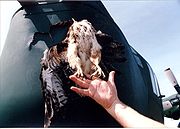
A hawk stuck in the nosecone of a C-130

The point of impact is usually any forward-facing edge of the vehicle such as a wing leading edge, nose cone, jet engine cowling or engine inlet.

Jet engine ingestion is extremely serious due to the rotation speed of the engine fan and engine design. As the bird strikes a fan blade, that blade can be displaced into another blade and so forth, causing a cascading failure. Jet engines are particularly vulnerable during the takeoff phase when the engine is turning at a very high speed.
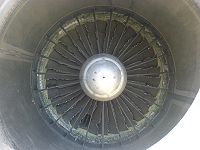
View of fan blades of JT8D Jet engine after a bird strike.

The force of the impact on an aircraft depends on the weight of the animal and the speed difference and direction at the impact. The energy of the impact increases with the square of the speed difference. Hence a low-speed impact of a small bird on a car windshield causes relatively little damage. High speed impacts, as with jet aircraft, can cause considerable damage and even catastrophic failure to the vehicle. However, according to the FAA only 15% of strikes (ICAO 11%) actually result in damage to the aircraft. The impact of a 5 kg (12 pound) bird at 240 km/h (150 mph) equals that of a 1/2 ton (1000 pound) weight dropped from a height of 3 meters (10 feet).

Bird strikes can damage vehicle components, or injure passengers. Flocks of birds are especially dangerous, and can lead to multiple strikes, and damage. Depending on the damage, aircraft at low altitudes or during take off and landing often cannot recover in time, and thus crash.

Wednesday, September 03, 2008

The September eZine is out!

Yes, the Girls With Wings September Newsletter is out - a bit late. I couldn't help it. I went camping again last weekend with another niece, Delaney, age 7. It's her fault! Forgive me for some more self serving pictures....

We found a campground via a local website, http://www.lakewoodbuzz.com/ asking for recommendations from people in the area. I wanted to find a place that would keep kids happy. We were pretty happy with the campground, because it was well wooded and relatively quiet; Delaney likes her sleep. I have to admit I needed some serious recovery time each night as well. I always plan to do too much; we stayed very busy. First picture shows Delaney is much like her Aunt Lynda. Is perfectly content inside reading than enjoying nature.

Wait, scratch that. There was a pool at the campground and I think we could have spent the entire weekend swimming. I brought along some goggles and a snorkel. A huge hit. Eventually I was able to get her out on the trail. It was her first time horseback riding, and I thought she did great.

We spent three nights at the campground. I'm still using the same tent my dad bought me years ago. The best thing I've ever purchased is one of those screened in gazebos. Delaney "helped" put it up (it's all about teamwork, after all). It was so helpful to be able to have everything set out in this tent. Like I've said before, I'm not much of a camp cook, so we had a place to put our cereal and cooler with sandwich fixings. All right, I admit, I succumbed to pressure and made hotdogs one night and hamburgers another. Next trip I might try bacon and eggs.

We also did a little water work. It was also her first time canoeing. She was a master with just a little instruction. We had a scary moment when a group of people in front of us dumped one of their three canoes in a bottleneck. The other two canoes stopped to help pick everything and everyone up, which made it impossible for us to navigate around the fallen trees. Luckily the group also helped us NOT dump. I don't know that Delaney would have liked that aspect of canoeing! Of course, I had a blast. Delaney can be quite the trooper. I can't think of anything I'd rather do on my time off than spend time with my nieces. It causes a logjam in Girls With Wings items, but it's a pretty good tradeoff.

Tuesday, September 02, 2008

Wing Scouts

I was trying to find a picture of the Brownie logo for a story in my eZine, and came across information about the Wing Scouts.

The Wing Scout Program was a popular older girl Girl Scout program begun in 1941 for girls "interested in flying and wanting to learn enough about aviation to serve their country."
1941 sounds pretty early, but would you believe the GS had an aviation badge in 1916!?! Makes you wonder why 92 years later we're still trying to get more women into aviation.

In 1959, Girl Scout Council in North San Mateo County was presented with an offer from United Airlines San Francisco Management Club President J. L. Burnside to start an aviation program for Senior Girl Scouts.

At that time, the council had been in search of a program that would challenge the interest of Senior Girl Scouts.

One of the highlights of the Wing Scout program was the courtesy flight provide to Senior Girl Scouts using United Airlines' jets. For many of the girls, this was the first time they had flown in a plane.

The Wing Scout program was not for show, participating girls took it very seriously. As a result of their proficient training and ability, Senior Girl Scouts who had been in the program for three years were given the opportunity to take over the controls during flight in a small aircraft.

The program continued into the 70s, when it was discontinued after United Airlines experienced financial setbacks.


If you would like to volunteer to speak at Girl Scout or other school events, please visit http://girlswithwings.com/volunteer.html. See the calendar of events or make a request. Pictures on this post courtesy of Kate, my niece.

Wednesday, August 27, 2008

FBOs

It occurred to me the other day that I always talk about FBOs, but having never shown anyone what one looks like, it may be hard to visualize. Again, an FBO is a Fixed base operator (From Wikipedia, the free encyclopedia)

In the aviation industry, a fixed base operator (also known as fixed base of operation), or FBO, is a service center at an airport that may be a private enterprise or may be a department of the municipality that the airport serves. At a minimum, most FBOs offer aircraft fuel, oil, and parking, along with access to washrooms and telephones. Some FBOs offer additional aircraft services such as hangar (indoor) storage, maintenance, aircraft charter or rental, flight training, deicing, and ground services such as towing and baggage handling. FBOs may also offer services not directly related to the aircraft, such as rental cars, lounges, and hotel reservations. Entire article at http://en.wikipedia.org/wiki/Fixed_base_operator (it's pretty interesting actually).

At my job we visit these FBOs regularly. Depending on the time of day, or how large their operation is, determines how many people are on duty. Some of the
better ones meet you at the door asking you what your tail number is and what services you need. At this particular FBO, we have asked for our airplane to be towed around so that we could prep it for the day's flight. You can see the airplane through the window in these pictures (and the sun coming up through the clouds - which is why the inside of the building appears so dark). The people at the desk ring up our bill and direct the line personnel to fuel our aircraft, get newspapers, ice (for the passengers' drinks) and coffee, and anything else we need. This particular morning we didn't have to leave for a while, so we got our breakfast and enjoyed it in the pilot lounge. When it was time to leave, the line personnel marshalled us out of our parking space and off the ramp to the taxiway!

Tuesday, August 26, 2008

Cloud Phenomenon?

On the first flight of this tour, we flew from the "mainland" USA to the one of the islands off the east coast. Enroute, I took a couple of pictures of clouds that had formed over the various islands we were passing over, but had not formed anywhere else over the water. I kind of assumed that it had something to do with land absorbing and staying warmer than the surrounding water...? So I typed in a search for "Cloud Formation over Islands" and found this great site, Teachers' Domain: Multimedia Resources for the Classroom and Professional Development. You can watch a video, too!


The Sun, Earth's main source of energy, continuously showers the planet with electromagnetic radiation. About 31% of this solar radiation is reflected back towards space, about 23% is absorbed by the atmosphere, and about 46% is absorbed by Earth's surface. Earth's surface re-emits some of this absorbed energy as infrared radiation, and this heat energy is then absorbed by greenhouse gases in the atmosphere. Energy is also radiated from the atmosphere and warms Earth.

Air near the ground is also warmed by conduction — the direct transfer of energy between objects in contact by the collision of their molecules. However, air is not a very good conductor. A more efficient mode of energy
transfer within the atmosphere is convection — the transfer of heat through the movement of matter. As a region of surface air is warmed, the molecules move
faster and the air expands and becomes less dense. Less dense air rises through the cooler and denser air above it in the process of convection. These parcels of rising warm air, called thermals, can lead to the formation of cumulus clouds.

As air rises, it moves into an environment of lower atmospheric pressure, and as a result, it expands further and cools. When the temperature of the air drops below the dew point point, the rate at which invisible water vapor condenses onto cloud condensation nuclei — tiny particles in the air such as dust, sea spray, and industrial aerosols — exceeds the rate of evaporation of liquid water. Billions of these tiny water droplets or ice crystals may develop and collect to form a cloud. When the droplets or ice crystals grow too large to remain suspended in the air, they fall to the ground as precipitation.

Because warm air is less dense than cold air, and moist air is less dense than dry air, the warm and moist air of the tropics provides an ideal environment for convection. Along coastal locations in the tropics, convection is often easy to observe on a warm, sunny day. While cumulus clouds are found over both land and water, they tend to form over land earlier in the day than over water. This is because water has a higher heat capacity than land — it takes a lot more energy to raise the temperature of water than to raise the temperature of land. As a result, land warms more rapidly than water and is able to heat the surface air to a higher temperature.
Whether or not cumulus clouds bring about thunderstorms depends on the stability of the surrounding atmosphere. If the air around the cloud is stable, vertical air motion and cloud growth is inhibited. However, if the air around the cloud is unstable, vertical motion is enhanced and the cloud continues to grow, potentially into a
thunderhead.
from: http://www.teachersdomain.org/resources/ess05/sci/ess/watcyc/convective/index.html

Monday, August 25, 2008

Starting a new tour


Hey All,

I am so sorry, but we've had some early mornings this tour and I am exhausted by the time I get to the hotel room. It makes it so hard to power up the computer to do a blog entry!

We started our tour in a maintenance base, so I included a picture of what one of these hangars look like. It is taken through the window of the airplane from the left seat - I have finally gotten enough hours in the X to be able to do empty legs from the left seat. Usually, as the SIC, or second in command, I sit in the right seat. When I have enough experience in the airplane I will be able to fly passenger occupied legs from the left seat.
You would be amazed at how different it is to fly from another seat. The yoke is the same, the view is pretty much the same, but the power controls are on the opposite side. I have to run the throttles, speedbrakes and thrust reversers with my right hand instead of the left. Plus, the X has pedal steering but it also has a tiller. There is a small wheel that is about the size of a drink cup lid that the pilot can turn to assist while taxiing. It is VERY sensitive, and I need a lot more work to make it smooth. I have to remind myself that you can't let it go - it centers very rapidly, which results in a jerking motion. The captain I'm flying with is pretty patient, but I wouldn't want passengers to have to suffer through this ride.

Saturday, August 23, 2008

Acknowledging acknowledgements

I was going through some old emails and found this Training Tip in an AOPA Newsletter. AOPA, as I have mentioned before, is the Aircraft Owners and Pilots Association. I have been a member since 1999.

The tip is timely because I was just telling me some people yesterday that a controller gave me a hard time on the radio for not responding back when he told me I had read back the clearance correctly. In other words, I had called up for my clearance, he read it to me, and I am required to read it back to make sure I had gotten it right, which I did. So he responded with my call sign and "readback correct." Should be end of story, right? Instead, he got on the radio and angrily said my call sign and "readback correct, OVER." (Over means the person on the radio is expecting a response.) So I said my call sign and "thanks?," not knowing what else he was looking for. After I told this story, a pilot took me to the side (in respect to any hurt feelings I might have, I guess) to let me know that sometimes the controllers like you to respond with your callsign so that they are reassured that you heard them.

I guess in smaller airports this would be ok. But in many larger airports, radio traffic is so crowded, they expect you to ONLY respond back with your callsign and your transponder code, unless you have questions with your clearance. Ultimately, though, pilots are supposed to be brief and to the point on the radio and avoid "unnecessary chatter." As a friend mentioned, there is nothing worse than flying toward a kind of airspace where you need specific clearance to enter, where another pilot gets on the frequency and starts telling their life story. Pilots do and have to turn around and circle til they get clearance into the airspace. Grr, huh?

So, in the end, would I have been wrong to respond to the controllers "readback correct" with yet another transmission? No. But he was wrong to growl at me on the radio demanding a unnecessary acknowledgement. All pilots and controllers need to be familiar with the publication described below so there are no (or fewer) misunderstandings!

Training Tips
'ACKNOWLEDGE!'Sometimes in busy airspace or on the ground at a bustling airport, you'll hear a controller fire off instructions followed by a command such as, "Hold short, 'acknowledge' hold." Why was "acknowledge" added to the transmission? What should the acknowledging pilot say?
The specific meaning of "acknowledge," given in the "Pilot/Controller Glossary" in the Aeronautical Information Manual (AIM), is "Let me know that you have received my message." That's always key to clear communications. So if a controller specifically requests that you "acknowledge," give an immediate, positive response.
"When talking to a controller, the general rule is that you must fully acknowledge all commands. Climbs, descents, turns, and clearances must be repeated so that the controller knows that you received the proper information. Acknowledging a descent clearance with just your call sign is not acceptable and can incur the wrath of the controllers, especially if they are busy and have to waste time getting you to do your job. Likewise, acknowledging a command without using your call sign is also a no-no, because the controller doesn't know which aircraft took the command," Chip Wright said in the May 2005 AOPA Flight Training feature "Talking the Talk." "On the ground, the most critical—but by no means the only—items to read back are hold-short commands, and it doesn't matter if the hold-short command is for a runway or a taxiway. If you don't properly read back the hold-short command, the controller is required to bug you until you do."
Acknowledging instructions is not the same as a "readback," in which you repeat the entire message to the controller, such as when receiving taxi instructions. The AIM explains:
"When taxi instructions are received from the controller, pilots should always read back:
(a) The runway assignment.(b) Any clearance to enter a specific runway.(c) Any instruction to hold short of a specific runway, or taxi into position and hold.
Controllers are required to request a readback of runway hold short assignment when it is not received from the pilot/vehicle."
These and other terms used by ATC are discussed in the "New Pilot's Guide to ATC Communications" article on AOPA Flight Training Online. Make it your mission to know how to respond.

Friday, August 22, 2008

Fundraising!

Today I helped my local 99s chapter, The Lake Erie 99s, with their only fundraising event: scooping poo at a local dog show. Yes, you read that correctly. Believe it or not, it's very profitable, so rather than selling candy bars door to door or some such activity, this is the only fundraiser they need. Even volunteer organizations need funds to keep running, and we are no exeption.

This was my first year helping, and let me say, it reinforced my belief that I am now a resolved cat person. Then again, I didn't see the best of the dogs. Like people, they are nervous, and it shows. Some of the piles were like cowpies. Blech.

The chapter has been very supportive of my Girls With Wings activities, so I have no complaint also helping them out. They even selected me as this year's Pilot of the Year. See their website: http://lakeerie99s.homestead.com/

Thursday, August 21, 2008

Air Traffic Controllers Convention and Scholarships

FIRST COME FIRST SERVED; ONLY 100 slots remaining!!

ATCA is looking for high school seniors and juniors with a 3.0-4.0 GPA with an interest in aviation and engineering to attend a conference at the Air Traffic Controllers Convention on Wednesday November 5th from 10am-2pm at the Marriott Wardman Hotel in Washington DC. All must be US citizens. College students are also invited to attend and register through the FAA Centers of Excellence website. The $995.00 registration fee and $3500.00 exhibitor fee has been waived for students. Large and small companies will be on siteto discuss coop agreements, scholarships, tuition assistance and potential jobs. More information is attached below. Please call or email if you are interested in volunteering as a chaperone and let me know if your school is available to attend.


Thank you Belinda R. Bender


Federal Aviation Administration


SUBJECT: Air Traffic Control Association 53rd Conference - Invitation
High Schools: November 5 Marriott Wardman Hotel, Washington, DC
10:00 am – 2:00 pm Contact Belinda.Bender@faa.gov

University students: November 3-5 Full access to technical sessions and exhibit area.
Contact Patricia.Watts@faa.gov

* The Air Traffic Control Association (ATCA) has invited our FAA Centers of Excellence universities and college students to attend the upcoming conference in Washington, DC. The invitation to attend November 3 - 5 is being extended to students who are registered at COE colleges and universities or those living in the tri-state area. In an attempt to attract students who are interested in aviation-related careers, with proper student identification, ATCA is waiving the usual Conference registration fee. This opportunity includes full access to the exhibit area and technical sessions led by some of the world's most recognized aviation leaders. College students may register on the ATCA website, http://www.atca.org/

* High School students must be accompanied by teachers, or parents with proper ID, and FAA personnel will be assigned to serve as chaperones through the exhibit area. High Schools may register for the ATCA exhibit tour and workshops by contacting belinda.bender@faa.gov by October 6. Space for High School students is limited; therefore, registration will be accepted on a first-come first-served basis.

Note: ATCA also has scholarship opportunities.


  • ATCA Scholarships Program
    Air Traffic Control Association (ATCA) Scholarships are awarded to help support the financial needs of those deserving students who have chosen to seek higher education in the science of air traffic control and other aviation disciplines, as well as children of air traffic control specialists. Categories are as listed below.
  • Students enrolled half- to full-time in a two- to four-year air traffic control program at an institution approved and/or licensed by the Federal Aviation Administration as directly supporting the FAA's college and training initiative.
    Students enrolled half- to full-time in a program leading to a bachelor's degree or higher in an aviation-related course of study.
  • Full-time employees enrolled in advanced study programs to improve their skills in air traffic control or an aviation discipline.
  • U.S. citizen, children of air traffic control specialists enrolled half- to full-time in a program leading to a bachelor's degree or higher.
  • Please see Terms of Reference for complete rules.
    For additional information, please contact Carrie Rowe.

Wednesday, August 20, 2008

Good Friends are Priceless!

Today I had a fabulous lunch at a Mexican restaurant (I love Mexican food!). Better yet, I got to have lunch with an old friend. Ken, who now lives in Phoenix, said the friends you make at the regional airlines are the good ones - once you get to the major airlines, you don't bond so much with pilots you fly with - you're always switching crews. With a major airline, like the one Ken flies for, your schedule will not be the same as the rest of the crews. So the whole crew can change from leg to leg!

But Ken and I met when we were both pilots for a regional airline flying the Beech 1900s. Ken was my First Officer for a while - the best one I would say. He is a very proficient, professional pilot and an all around great guy. He had some time in the Cleveland area, so we met for lunch, at which time he made a very generous contribution to the Girls With Wings Scholarship in memory of his flight instructor, who just passed away recently. Look for more information to be posted on the scholarship page. Many thanks to Ken, his wife Laurie (also a pilot), and their son, James, for their support.

Whenever I think of Ken, I think of a funny story. In the 1900, the FO had to do the passenger briefing while the Captain sits up front and completes the paperwork, and for one particular leg, we only had one passenger. Ken was crawling into the seat so that we could crank the engines and go, and the passenger said to Ken (referring to me), "Oh, is she just learning to fly?" As if a pilot (even on a regional carrier) would be just starting out. Ken immediately replied, "No, she's the boss." The passenger, realizing now I was the Captain, tried to recover by saying, "Well, I figured because she was sitting in the left seat, and uh, well, uh...." We let the conversation just die out and we got on our way.

Tuesday, August 19, 2008

Today is National Aviation Day!

Did you know that there is a National Aviation Day? Yes, National Aviation Day on August 19 of every year is a United States national observation that celebrates the development of human flight. The holiday was established by a presidential proclamation in 1939, which designated the anniversary of Orville Wright's birthday to be National Aviation Day.


Ok, so what does this mean? Should I run out and buy a card at Hallmark? Who do I send it to? Orville isn't receiving mail anymore....

Well, on the big scale, according to the United States Code, TITLE 36, Subtitle I, Part A, CHAPTER 1, § 118:
The President may issue each year a proclamation
(1) designating August 19 as National Aviation Day;
(2) calling on United States Government officials to display the flag of the United States on all Government buildings on National Aviation Day; and
(3) inviting the people of the United States to observe National Aviation Day with appropriate exercises to further stimulate interest in aviation in the United States.


So, 1 has already been done. Check. 2, if you don't have a government building, is kind of hard. But 3. you could do things to celebrate National Aviation Day. For example, you could go build your own Wright Flyer. Before breakfast. Blindfolded. No?

How about:
Sporting your own Girls With Wings License Plate Frame? This picture is courtesy of Dan Kiser, Founder of Youth Aviation Adventure and an all around great supporter of Girls With Wings.


Don't have a car? That's ok, here's some alternate instructions from ehow.com.

Step1

Visit The Wright Brothers National Memorial in Kill Devil Hills, North Carolina, to see where the brothers got the first plane to work in 1903. The park has exhibits and reproductions of the 1902 glider and 1903 plane. Call (252) 441-7430 for more information on hours and events.

Step2

Go to Dayton Aviation Heritage National Historical Park in Dayton, Ohio, which hosts the Wright brothers' third airplane, as well as a restored print shop of the brothers. It holds free outdoor events for the whole family.


Step3

Read to a child. Teach your child the history of flight and the importance of the Wright brothers. Try Jane Yolen's "My Brothers' Flying Machine," or "First Flight" by George Shea.


Step4

Make crafts with family or at school. Draw images you might see out of the window of an airplane, make paper airplanes, or create collages of aviation images from magazines.


Step5

Celebrate National Aviation Day at the National Museum of the U.S. Air Force--the biggest and oldest military aviation museum. It is located in Springhill Pike, Ohio, and carries a large collection of aircraft exhibits.


From HolidaySpotPlus.com
WEBSITES AND ARTICLES ABOUT NATIONAL AVIATION DAY

National Aviation Hall of Fame (official): Information, history and facts about aviation.
National Aviation Day (Rumela's Web): History and Information on the holiday.
Wright Brothers National Memorial (Nat'l Park Service): Information and schedule events on the birthplace of aviation.
Aviation History Online Museum (official): Information, pictures and history of Aviation.
The History of Aviation and Modern Rocketry (TheSpacePlace): History of aviation through modern space flight.
History of Flight (AIAA): Information and history of flight from throughout the world.
This is not a traditional gift giving holiday. However, this day could be remembered though giving gifts with an aviation theme - airplanes, helicopters, balloons, gliders, spaceships or birds in flight.


GIFT IDEAS FOR NATIONAL AVIATION DAY

National Aviation Day Gift Ideas:
Airplane tickets to anywhere - just so you can fly
Local Hot Air Balloon or Helicopter trip
Model airplane or spaceship
Items emblazoned with things showing flight
Kites
Related Apparel
Training Books on How to Fly
Books & Magazines on Flying
Movies about flight

Monday, August 18, 2008

Flying and Alpacas

You're probably wondering what Alpacas have to do with flying. Well, first, the one of the captains I flew with last week was nice enough to let me take his picture in the cockpit up at altitude, preparing to eat his crew meal. I know I spend a lot of time talking about eating around here, so I figured I would show you how it looks to eat up in the cockpit. It's nothing fancy, that's for sure. Push your seat back as far as it'll go, open up your plastic food container, and dig in! If you're lucky, you won't get any of it on your shirt (or tie, or pants, etc.).


Gary, the captain, lives on a farm in Kentucky and raises Alpacas in his free time. His website is http://www.captureyourheartalpacas.com/index.cfm. You'll notice he was kind enough to put up a link to Girls With Wings on his site. I fly with some pretty interesting and cool people!