Saturday, November 15, 2008

Interest in GA not dead!


I thought this was a great story (and promotion for the flight school!). I read it in my edition of AOPA ePilot, which can be found online. Here's a portion (and it can be read in its entirety by clicking the link above).

Radio listeners grab 100 flights in 60 seconds By Mike Collins

Would you believe that a flight school could book 100 introductory flights in 60 seconds? US Flight Academy in Denton, Texas, did just that in conjunction with Dallas radio station KLUV. A special promotion offered discovery flights in light sport aircraft to the station’s listeners for $40, half the normal price.

Justin Shelley, the academy’s director of sales, heard about the radio station’s half-price promotion and contacted the producer. Shelley agreed to take five of the station’s announcers up for discovery flights, which are intended to be the first lesson leading to a sport pilot certificate. Enthused about their flights, the announcers raved about them on the air. They positioned the flights as a bargain at $40 and promoted them heavily for several days.

Listeners were directed to a special Web page at a specified date and time, and the station’s webmaster confirmed that all 100 flights were booked in less than one minute--setting a record for the KLUV program, which has been running for nearly two years.

The radio station listed US Flight Academy on its Web site, along with the phone number, and an additional 50 flights were booked directly through the Academy. The first several people to show up at the airport with their certificates announced plans to pursue a sport pilot certificate, Shelly said.

US Flight Academy offers training for the sport pilot certificate, as well as training for advanced certificates and ratings.

Note that the rides were in a a Light Sport Aircraft. You might wonder how that is different than any other airplane (from Wikipedia):

Several different kinds of aircraft may be certificated as LSA. Airplanes (both powered and gliders), rotorcraft (gyroplanes only, not helicopters), powered parachutes, weight-shift control aircraft, and lighter-than-air craft (free balloons and airships) may all be certificated as LSA if they fall within the weight and other guidelines established by the FAA.

Light-sport aircraft, or LSA, is a classification of aircraft specific to the United States. The Federal Aviation Administration defines a light-sport aircraft as an aircraft with a maximum gross takeoff weight of less than 600 kilograms (1320 pounds) for aircraft designed to operate from land, 649 kilograms (1,430 pounds) for seaplanes; a maximum airspeed in level flight of 120 knots (222 km/h); a maximum stall speed of 45 knots (83 km/h); either one or two seats; fixed undercarriage and fixed-pitch or ground adjustable propeller; and a single electric motor or reciprocating engine, which includes diesel engines and Wankel engines.

Aircraft which qualify as LSA may be operated by holders of a Sport Pilot certificate, whether they are registered as Light Sport Aircraft or not. Pilots with a private, recreational, or higher pilot certificate may also fly LSA, even if their medical
certificates
have expired, so long as they have a valid driver's license to prove that they are in good enough health to fly. LSA also have less restrictive maintenance requirements and may be maintained and inspected by traditionally certificated Aircraft Maintenance Technicians, by individuals holding a Repairman: Light Sport certificate, and (in some cases) by their pilots and/or owners.

Friday, November 14, 2008

My Ride, My Job

Courtesy of Eaglesoft, Citation X flight simulator software promotional video. This is a very good representation of the airplane. Almost as good as a video I would take myself -pretty cool! Be sure to click the 'watch in high quality' option. http://www.youtube.com/watch?v=H4SHSLppIZs

Thursday, November 13, 2008

FOD: Foreign Object Damage

Previously I talked about bird strikes, which is a form of foreign object damage (FOD).

I was at an FBO in Louisiana this past week, and while we were waiting for our passengers, I saw this "street sweeper" cleaning up the ramp.

I have never seen this before. Although, again, just like cleaning the rubber off the runway, I assumed it was done. But why go to this trouble? Won't the airplanes just "blow" the FOD off the ramp? Why even bother?

Wikipedia: FOD costs the aerospace industry $4 billion USD per year[3] and causes expensive, significant damage every year to aircraft and parts and may cause death and injury to workers, pilots and passengers. It is estimated that FOD costs major airlines in the United States $26 per flight in aircraft repairs, plus such additional indirect costs as flight delays, plane changes and fuel inefficiencies.[4]

Foreign object damage or foreign object debris (FOD) is a substance, debris or article alien to the vehicle or system which would potentially cause damage.[1] Foreign object damage is any damage attributed to a foreign object that can be expressed in physical or economic terms that may or may not degrade the product's required safety and/or performance characteristics. Typically, FOD is an aviation term used to describe both the damage done to aircraft by foreign objects, and the foreign objects themselves (i.e. any object that has, or is likely to, cause damage.)[2]

"Internal FOD" is used to refer to damage or hazards caused by foreign objects inside the aircraft. For example, "Cockpit FOD" might be used to describe a situation where a clipboard, water bottle, or other item gets loose in the cockpit and jams or restricts the operation of the controls. "Tool FOD" is a serious hazard caused by tools left inside the aircraft after manufacturing or servicing. Tools or other items can get tangled in control cables, jam moving parts, short out electrical connections, or otherwise interfere with safe flight. Aircraft maintenance teams usually have strict tool control procedures including toolbox inventories to make sure all tools have been removed from an aircraft before it is released for flight. Tools used during manufacturing are tagged with a serial number so if they're found they can be traced.

Just FYI, Charles Brooks of Newark, New Jersey invented improvements to street sweeper trucks that he patented on March 17, 1896. His truck had revolving brushes attached to the front fender and the brushes were interchangeable with scrapers that could be used in winter for snow removal. http://inventors.about.com/library/inventors/blbrooks.htm


Monday, November 10, 2008

Veteran's Day

Last thursday I was honored to speak at the Holly Lane Elementary Veteran's Day Assembly in Westlake, Oh. They were recognizing "Women in Service" and Celebrating 20 Years of Honoring Veterans (November 7th, 2008). I served seven years active duty army after 2 years of ROTC in college and three years in the Ohio National Guard.

Along with my speech, the students of the school heard from Staff Sgt Kimberly Middleton, an Army Recruiter in my town of Lakewood, and Community Liason for Senator Sherrod Brown, Matthew Kaplan.

Believe me when I say that from the Viet Nam veteran color guard's posting the US Flag, to every grade's (1st - 4th) presentations of songs and flowers to attending veterans, I don't think I've ever seen a better behaved group of kids or more respectful program. Kudos to organizer Marilyn Lester).

Since I have resigned my commission, I am unable to wear my uniform, but I read exerpts from the following Commentary by Airman 1st Class Joshua Wilks 796th Civil Engineer Squadron to illustrate my ongoing respect for the uniform, and, of course, our country's military veterans.

When I dress in the morning, I try to remember I wear the uniform of a military that protects the greatest symbol of democracy and freedom in the world.
But sometimes, I forget.
I also try to remember people who dress as I do every morning, the ones who have dressed this way so many days before me, and those who will follow me.
But, sometimes, I forget.
I try to keep in mind just one of the fallen heroes who wore this very same uniform. The ones who lost their lives in it, and the one who still wear it as they lie in their final resting places in a national cemetery.
But sometimes, I forget.
Every morning, when I go to work, I try to remember to say good morning to my coworkers, military and civilian. I try to remember these people protect my freedom as I work beside them each day.
But sometimes, I forget.
I try to remember that my job is the greatest in the world.
But sometimes, I forget.
I try to remember that although this uniform may be a little too warm in the summer and just not warm enough in the winter, thousands of my comrades remain missing in action, and others were imprisoned for years on foreign soil, suffering torture and abuse inconceivable to humanity -- all this while wearing this uniform.
But sometimes, I forget.
During the day, when I think of all the other things I would rather be doing with my life, I try to remember the role I take part in while wearing this uniform. I try to remember this world is still a dangerous place, and we must work extremely hard to safeguard the freedom we take for granted so our children will know the freedom we have always known.
But sometimes, I forget.
I try to remember as I pledge my allegiance to Old Glory, this awe-inspiring symbol of freedom and democracy, that others entrust my comrades and me with her safekeeping.
But sometimes, I forget.
At bedtime, as I kneel in prayer before God, I try to remember the hundreds of thousands of families who lost their loved ones in the defense of this great land.
But sometimes, I forget.
I try to remember that I would die for this country, but I would much rather live for it.
But sometimes, I forget.
Yet at times like this, (of war) when I remember to take these things into account, there is no way I can explain the pride I feel and the honor I embrace while wearing this uniform and serving this country. And when I leave this world, my spirit will echo words known to me since childhood, "one nation, under God, indivisible, with liberty and justice for all."

Friday, November 07, 2008

Groovy, baby, yea!

If you were to fly into the Ft Lauderdale, FL, airport, or KFLL, you would see the following information about their longest runways:

RUNWAY 9L/27R Dimensions: 9000 X 150 ft. Runway Edge Lights High Intensity Surface: Asphalt / Grooved

So the runway is made out of asphalt, but it's grooved? What does that mean?
Runway pavement surface is prepared and maintained to maximise friction for wheel braking. To minimize hydroplaning following heavy rain, the pavement surface is usually grooved so that the surface water film flows into the grooves and the peaks between grooves will still be in contact with the aircraft tires. To maintain the macrotexturing built into the runway by the grooves, maintenance crews engage in Airfield rubber removal in order to meet required FAA friction levels. From Wikipedia.
Well, I have to admit I saw the hyperlink on Airfield rubber removal and didn't have a clue. I have never even thought about having to clean off those black "skid" marks on the runway (left because the tires aren't spinning when an airplane touches down). I learned something new, too. Which, in all honesty, is a lot of the reason I do this blog - I am still learning. The picture of the runway (below) is from my home base, Cleveland Hopkins International Airport.

Airfield rubber removal, also known as runway rubber removal, is the use of high pressure water, abrasives, chemicals and/or other mechanical means to remove the rubber that builds up on airport landing strips. The Federal Aviation Administration (FAA) specifies friction levels for safe operation of planes and measures friction coefficients for the evaluation of appropriate friction levels. Individual airports incorporate rubber removal into their maintenance schedules based on the number of take offs and landings that each airport experiences. Wikipedia.

Wednesday, November 05, 2008

Standing By

I've been spending some time sitting standby at an FBO in Florida. Since most of the FBOs have wireless, I can get a lot of online things done. Usually I don't sit in the crew lounge, since it's hard to be productive sitting in a La Z Boy in front of the TV. Sometimes I will see if I can't sit in a conference room - it's got a good environment for making me feel business-like and productive. However, I prefer the FBOs that have separate little workstations, kind of like phone booths with desks. Even better, like this FBO I've been hanging out at, with a view of the outside. Either overlooking the front door, like the one elsewhere in Florida where I've seen folks like Kenny Chesney, Shaq, Michael Jordan, etc. walking in (Note: these are not necessarily owners in the airline I fly for - so I'm not giving anything away here). Or I can get a view of the ramp, like in the picture above. Note my company's airplanes lined up on the ramp. I'm pretty proud of working for such an airline. You can't go anywhere without seeing another of our airplanes. Here in particular, you couldn't spit in the FBO without hitting one of our pilots (if that's what you wanted to do - I wouldn't recommend it). But it shows we're still doing well despite the currently poor economy. I know I did a good thing when I came here.

Tuesday, November 04, 2008

Sunny California

The Captain and I were discussing, on our way to California, how rare it is to see a thunderstorm in this part of the country. Well, weren't we proven wrong! There was a 6000ft ceiling when we flew in, with flash flood warnings issued for the area. Luckily, it only drizzled, and the view from yesterday looked much improved the next morning as the front moved through. In many parts of the country winter is characterized by increased rain, rather than snow, and meditteranean - like portions of the country near the Santa Ynez Mountains go from .03 in of rain in July to as much as 4.28 in of rain in February.

Conversly, the city we had flown from was in the northern, central US (and there it WAS sunny). They have more than 4 1/2 in of precip in the summer months, but in the winter, snow brings around an inch a month.
Read more about weather fronts on Wikipedia:
A weather front is a boundary separating two masses of air of different densities, and is the principal cause of meteorological phenomena. In surface weather analyses, fronts are depicted using various colored lines and symbols, depending on the type of front. The air masses separated by a front usually differ in temperature and humidity. Cold fronts may feature narrow bands of thunderstorms and severe weather, and may on occasion be preceded by squall lines or dry lines. Warm fronts are usually preceded by stratiform precipitation and fog. The weather usually clears quickly after a front's passage. Some fronts produce no precipitation and little cloudiness, although there is invariably a wind shift.[1]

Saturday, November 01, 2008

Wing Walkers

If I say wing walker, what do you think of? Well, you might think of a wing walker like Girl With Wings Jenny, who stands on top of a plane while it is flying and doing acrobatics. Jenny’s personal website. Jenny’s American Barnstormer team website.


The US Centennial of Flight Website has a great article on the origins of Wing Walkers.

Scholars generally credit Ormer Locklear as the first man to wing walk, or at the very least, the person most responsible for the growth of the phenomenon. Locklear was working as a carpenter and mechanic in Fort Worth, Texas, when he joined the U.S. Army Air Service in October 1917, just a few days short of his 26th birthday. Stationed at Barron Field, Texas, Pilot Cadet Locklear started climbing out onto his Jenny biplane's lower wing while in mid-air to resolve certain problems. His first trip out onto his wing occurred when he could not see some communications clearly that were being flashed at him from the ground because the plane's engine housing and wing were blocking his view. Because he needed to interpret the communication to pass one of his pilot's tests, Locklear decided to leave the plane in the hands of his instructor/copilot and climb out onto the wing and read the message. He passed
the test, but his instructor was less than happy with him.

Or you might think of this kind of wing walker: The kind that walks along the wings of an airplane as it is being towed or taxied around the ramp. Usually wing walkers are used for large commercial airliners squeaking into the gate. You might have noticed someone walking alongside your commercial flight holding a plastic orange wand. Raising the wand lets the rest of the crew know that the wing isn't going to hit anything. This is a pretty small airplane, so you might wonder why the tug operator needs two guys on either side of the airplane (I mean, can't he see the whole airplane??).

Well, kudos to the FBO we were visiting. They obviously were trained well and they are held to a high standard.

From Procedures and their Impact:

The key for hangarkeepers and FBOs is to follow industry practices and procedures for careful aircraft handling and employee training. It's a good way to win repeat customers and is also the right approach to zero in on costs, not just for damages but also for insurance. Underwriters pay careful attention to standardized aircraft movement procedures before issuing a policy. Running a clean operation pays off all around.

An example:

A G-IV aircraft was directed on the hangar's ramp with a marshal at the nose of the aircraft and left and right wing walkers. The aircraft was stopped and both wing walkers moved to the left side of the aircraft to move two of the FBO's vehicles blocking the path. Both wing walkers remained on the left side of the aircraft while the marshal signaled the pilot to continue taxiing. The right wingtip struck the rudder of a King Air parked near the hangar and in the FBO's care.

These and similar accidents are a constant concern for hangarkeepers and FBOs as well as aviation insurance carriers. The FlightSafety Foundation believes that the bill for all ground accidents involving aircraft, including the indirect costs associated with injuries and deaths, to be about $7 billion a year. Although figures aren't broken out separately for general aviation, the National Business Aviation Association (NBAA) estimates the cost of GA ground damage at about $100 million per year in direct costs.

Sunday, October 26, 2008

Aviation Scholarships

I get so many emails from people asking me for money so they can become a pilot. It is very expensive to get a private pilot's license (anywhere from $7000 to $10,000, depending on where you live and what you will be flying). So, becoming a pilot has to be in your blood. It's not usually something someone does just on a whim. People can work and save, take out a loan (which I don't usually recommend), and/or look for assistance in coming up with the cash.


Besides the incredible Girls With Wings scholarship (deadline November 1), there are so many scholarships out there - and those providing them are usually begging for qualified applicants!


One of the best sites I have found is: http://money2fly.googlepages.com/ (thanks to Dorothy!)

About FlightScholarship.info (from the website):
While pursuing my pilot certificates and ratings, I looked for and began to keep a listing of scholarships that I could apply for to help fund my flight training. Over time it grew and grew so I created a site and posted them on the internet to try and help others find money to fly too. Being female, I placed a special focus on cataloging grants for women. As such, much of my list contains awards for females only but there are some that are open to men as well.

Each scholarship has its own application deadline

Amounts may vary from year to year

Some awards may not be given every year

Contact the issuer for application or more info

The scholarships listed on this site are mostly one time awards of $250-$3,000 to help defray the cost of flight training for a pilot certificate or rating. The awards on this page are not restricted to collegiate aviation students only, hence are a resource for those pilot who cannot tap into all the money available to such students. This type of list was the goal of my scholarships website which I began to compile as I flight trained towards my goal of becoming an airline pilot.

Friday, October 24, 2008

A and P

Girls With Wings is a site for women in ALL areas of aviation, but it's predominately pilots now. We need more A&Ps represented on the website!! They have a support network of their own already. Here's a couple of examples.

Wait, what's an A&P, you ask? It's an aircraft maintenance technician:

A person who fulfills the necessary requirements is issued a Mechanic certificate with either an Airframe or Powerplant rating, or both. It is these ratings which together account for the common practice of referring to mechanics as "A&P's." Until 1952, instead of the Powerplant rating, an Engine rating was issued, so the abbreviation "A&E" may appear in older documents.

There is a better description at http://www.avjobs.com/careers/detail.asp?RecID=95.

There are organizations specific to women who do these jobs.

One has a mentoring program: "Jet Ahead, women mentoring women, is a mentor program for women A&P students around the country. Our main goal in this program is to bring the students together with a mentor who has been out in the field and can answer questions and help alleviate concerns. This is a program designed to be flexible in meeting the needs of A&P schools as well as their students. This is a great networking tool for your school, and yourself. So if you are interested in this program, whether you are a student, a mentor or a school, please let us know."


Another has a scholarship (deadline November 21):
Association for Women in Aviation Maintenance
MISSION STATEMENT
"We are a nonprofit organization formed for the purpose of championing women's professional growth and enrichment in the aviation maintenance fields by providing opportunities for sharing information and networking, education, fostering a sense of community and increasing public awareness of women in the industry."


Medical Deficiencies

I'm back on the road again, after taking three sick days at the beginning of a tour. I do not like being sick. 1. Only have a limited number of sick days (what if I really get sick?) 2. I don't like admitting I'm sick ("I'll be fine, really!"). Ultimately, the FAA says that I have a responsibility NOT to go to work if I have a medical deficiency:


Am I prohibited from exercising the privileges of my pilot certificate during medical deficiency?
Yes. You are prohibited from acting as pilot-in-command or as a required pilot flight crewmember during any medical deficiency that would be disqualifying or may interfere with the safe operation of an aircraft.
A simple problem such as a cold, a broken arm, or an abscessed tooth may require nothing more than the appropriate treatment and a little time before you can safely return to the skies. A more complicated problem or the development or change of a chronic illness may necessitate consultation with an AME or the FAA before resuming flying. New medical conditions do not need to be reported to the FAA until you wish to return to flying.
The actual regulation that I must abide by:
e-CFR Data is current as of October 22, 2008
Title 14: Aeronautics and Space PART 61—CERTIFICATION: PILOTS, FLIGHT INSTRUCTORS, AND GROUND INSTRUCTORS Subpart A—General
§ 61.53 Prohibition on operations during medical deficiency.
(a) Operations that require a medical certificate. Except as provided for in paragraph (b) of this section, a person who holds a current medical certificate issued under part 67 of this chapter shall not act as pilot in command, or in any other capacity as a required pilot flight crewmember, while that person:
(1) Knows or has reason to know of any medical condition that would make the person unable to meet the requirements for the medical certificate necessary for the pilot operation; or
(2) Is taking medication or receiving other treatment for a medical condition that results in the person being unable to meet the requirements for the medical certificate necessary for the pilot operation.
So, an extra three days at home. Just wish I could have enjoyed them...

Friday, October 17, 2008

Presidential Decisions

I have advocated membership in AOPA: Airplane Owners and Pilots Association for all general aviation pilots. They have published a great overview of how the presidential candidates stand on the issues important to GA.

You know where they stand on the war in Iraq, taxes, and healthcare. But do you know where Sens. Barack Obama and John McCain stand on general aviation issues?

“With all of the excitement surrounding this year’s presidential election, AOPA members have been asking me, ’Who should I vote for president?’” said AOPA President Phil Boyer. “Rather than endorsing a candidate, we asked the campaigns where they stand on GA.”

Each campaign was given the same eight questions that touched on FAA funding, air traffic control, GA security, and the environment. AOPA’s intent is to help you become more informed on where these candidates stand on GA before you head to the polls.

Two days after the Nov. 4 election, AOPA will host a hard-hitting discussion among several Washington, D.C., aviation insiders about what the results mean for GA. You can be a part of the discussion at AOPA Expo in San Jose, Calif., during the Nov. 6 general session. AOPA encourages members who will be traveling to Expo on Election Day to request an absentee ballot in advance.

Most of the national attention centers on the race for the White House, however, the congressional races will have a crucial impact on issues of interest for general aviation. Congress is important because this group of 535 elected officials must approve the policy legislation that sets the course for the government.

To learn more about General aviation’s allies in the 2008 election click here.

Thursday, October 16, 2008

Need some inspiration?


Being born without arms didn't keep Jessica Cox of Tucson, AZ from meeting the challenge of earning a Sport Pilot certificate. The Able Flight Scholarship winner passed her checkride Friday October 10th after several months of training with instructor Parrish Traweek in his Ercoupe 415C. With its unique control system, the Ercoupe proved to be the right airplane for her to fly using only her feet (she does not use prosthetic arms).


Jessica's path to becoming the first person born without arms to be certified as a pilot began in Florida when Glen Davis provided her first hours of instruction in his Ercoupe. But since his was not an LSA version, she would have to wait until a suitable LSA model could be located. Enter Parrish Traweek of PC Aircraft Maintenance/Flight Services in the little town of San Manuel to the north of Tucson.

Of her experience in becoming a pilot, Jessica said, "I highly encourage people with disabilities to consider flying. It not only empowers you but also helps others realize that people with disabilities are adept at attaining privileges that a small percentage of society takes part in. It helps reverse the stereotype that people with disabilities are powerless into the belief that they are powerful and capable of setting high goals and achieving them. What is most incredible about Able Flight is the relentless faith and support not only from the board but also from the other pilots who have succeeded in the program. The camaraderie is exceptional. Thank you Able Flight for helping me make history as the first licensed pilot to fly with only her feet!" To learn more about Jessica, visit http://www.rightfooted.com/.

Wednesday, October 15, 2008

Rocky Mountain High

Look closely at this picture. Do you see, right down there, an airport? You can pick out the runway if you look...

The name of the airport is Telluride Regional Airport, and it is well known to pilots who fly business jets (which people also fly, obviously, for pleasure). At an elevation of 9,078 feet (2767 m) above sea level, it is the highest commercial airport in North America. We go into a lot of airports near ski resorts; Aspen, Vail, Tahoe, etc.

These mountainous airports can be quite tricky. Some employers make their pilots go through special training to be "checked out" for mountainous operations. Jeppessen, the makers of the airport charts and diagrams, have special full color pages dedicated to operating in and around these airports. Why? Well, first of all, the higher altitude makes takeoff and landing operations different that what we're used to closer to field elevation. The airplane, for example, takes longer to slow down. So any extra speed being carried on final may not be removable on landing, carrying the airplane farther down the runway, toward/past (!) the departure end...

Wikipedia:
Telluride Regional Airport has one runway designated 9/27 which measures 6,870 by 100 feet (2,094 by 30 m). Located on a plateau, the airport's single runway literally dips slightly in the center. The runway can be a very challenging approach for pilots, particularly those operating commuter aircraft or business jets. During winter months, approximately 20% of the scheduled commuter airline flights end up having to divert to other nearby airports because of abruptly adverse landing conditions. Pilots must contend with high terrain exceeding 14,000 feet at all quadrants, as well as the airport's location on a plateau where 3 sides (including both ends of the runway) plunge about 1,000 ft to the San Miguel River below.

Pilots must exercise great caution whenever southerly winds exceed 15 knots (some say as little as 8 knots), and be aware of rotors, strong turbulence and down-drafts associated with the plateau cliffs during the approach. Most approaches into Telluride come from the west onto Runway 9, from the direction of Placerville and Sawpit. Pilots must stay on the right side of the valley on approach, to avoid potential traffic conflicts. In addition to all this, touch and go landings are prohibited at TEX, and the minimum traffic pattern altitude for the Telluride area is 10,500 ft MSL (1,500 ft AGL). Residential areas located to the east of the airport are generally avoided by arriving and departing aircraft, for both safety and noise abatement purposes.

Tuesday, October 14, 2008

Wildfires

I had to run on the "dread"mill this morning. *sigh* I was so excited when I checked into this hotel and asked for a running route. They handed me a premade card with a 7 mile route on it along the river! Yea! Got up this morning and it was cold, wet, and rainy. I didn't have any gear for this weather and didn't really want to carry wet shoes around either. Oh, and didn't want to catch a cold. I went down to the fitness center in the morning and I couldn't believe it! Every cardio machine had a person on it (well, except for a stationary bike - I love bike riding, but a stationary bike to me seems like the epitome of futility; I never feel like I've worked out).
Luckily the treadmills were awesome, nice cushy platforms and there were TVs in the consoles. Very cool. I was watching CNN and they talked about the California Wildfires. This was quite a coincidence because I had taken pictures there on the second day of my tour. Obviously they have gotten worse. As we flew into Van Nuys, it was pretty clear, but as we got closer to the airport, we could see the smoke coming off the hills. It wasn't on the approach side of the airport, so it didn't affect our ability to get in. On the ground, you could smell the smoke, kind of like a campfire. And you can see how thick the smoke is over the hangars. As we departed, I took pictures (after we were above 10,000feet!). Here is the whole CNN story: http://www.cnn.com/2008/US/10/14/calif.wildfires/index.html?section=cnn_latest

Monday, October 13, 2008

Home Suite Home

I am pretty lucky in that I am not a picky sleeper. I can usually sleep anywhere. I find it very easy to doze off when I'm a passenger in a car or airplane (I said passenger!), and I can catch a power nap in the crew lounge of the FBOs by curling up in a la-z-boy. I can have my batteries almost fully recharged with 10 minutes of shuteye. The only time I can't do this is if I have a list of things to do and number 3 is take a nap. I keep thinking of tasks 4,5, and 6, and so on. After a few minutes of that, I'll just get up and keep moving.

A lot of people can't sleep in hotels because they are accustomed to their bed. Although I have a great bed at home, I find almost any bed comfortable enough to sleep in, unless it's so soft it's suffocating. It is a bit annoying to get into a hotel bed that is dipped so low on one side (usually the side with the alarm clock) that it takes no effort to get out of the bed because you can just slide on down to the floor. This is why mattresses need flipping and rotating! I don't mind all of the pillows that hotels have, as long as they're not the ones filled with little squares of foam. I like having them all piled up. I especially like that Hampton Inns include a lap tray in their rooms. And MOST hotels have nice enough sheets, too, not scratchy or thin - but I don't like when they don't have a fitted sheet, so that the bottom flat sheet comes untucked from the mattress, and wrinkles up under me. Luckily, my employer puts us up in high enough quality hotels so these items are usually standard. Some of the rooms are suites, which means there are two rooms, one "living room" off the hallway, and the bedroom, which you get to by going through a hallway - farther away from the interior of the hotel and usually quieter.

I try to ask for the top floor, so I don't have Big Foot pounding on my ceiling. I also prefer rooms away from the elevator, because most people continue their conversations coming out of the elevator and quiet down as they get to their room. Oh, and the ice machine can get pretty noisy, too. Some people listen to their tvs amazingly loud. Earplugs block out most of these sounds, as does turning on the room fan. Every once in a while I need to call the front desk and ask if they can have some one come up to request that the guest can tone it down.


Well, sometimes there's little that anyone can do, especially this tour when I stayed at a Palm Springs hotel right next to their Bike Week festivities. These are pictures taken from my hotel room balcony. There's not much hope for blocking out the vibrations from a loud set of pipes on a Harley. Add to it the entertainment of loud music and a stunt biker riding in a metal sphere, and you're pretty much up the whole night.

You can see the hills, mountains, ?, in the background. I went looking for a place to run in the evening and was told there was a hiking trail I could run on. Unfortunately, this trail was pretty much vertical and had much sand and loose rocks. It was too dangerous to run, so I walked, but the trails started to get less obvious. I'm not found of my bones being found out in the desert, so I turned around and ran on the streets instead.

So I was pretty tired by the time I had to turn in. The noise hardly bothered me at all and I was well awake by the time the alarm went off at 4am. Ok, I am used to eastern time zone which is three hours ahead, but you get the point...

Thursday, October 09, 2008

Park it!

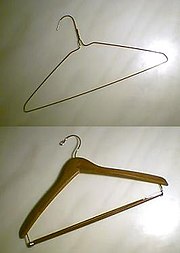
Definition of Hanger: A clothes hanger, or coat hanger, is a device in the shape of human shoulders designed to facilitate the hanging of a coat, jacket, sweater, shirt, blouse or dress in a manner that prevents wrinkles, with a lower bar for the hanging of trousers or skirts.

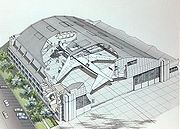
Let us distinguish that from Hangar (commonly misspelled as above): an enclosed structure to hold aircraft in protective storage. Most hangars are built of metal, but wood and concrete are other materials used. The word hangar comes from a northern French dialect, and means "cattle pen." Hangars protect aircraft from weather and ultraviolet light. Hangars may be used as an enclosed repair shop or, in some cases, an assembly area. Additionally, hangars keep secret aircraft hidden from satellites or spyplanes.

Usually my company will get "hangar space" for us overnight if there is a storm on the way. High winds and hail may damage the aircraft, but we also get a hangar (rented from the FBO where we are staying), in order to prevent the aircraft from being subject to the elements during the winter. It is more desirable to have the airplane in a warm hangar overnight to avoid the airplane getting snowed on, or worse, icing over. We may negate the need for getting deiced in the morning - which is costly - and we may also prevent the soda cans from freezing and exploding! Plus, the aircraft batteries may need to be removed and kept warm. All in all, we'd rather park it inside.

But hangars are used for other than their intended purpose. The above picture shows a hangar we are parked in front of with a truck offering aircraft cleaning services. If you look inside the partially closed hangar door, though, you can see what all is parked inside of this particular facility. Hey, the cars need protection from the elements too! Given that this was southern California, I'm not so sure this was so critical...

Wednesday, October 08, 2008

Winglets

I traveled home last night and got a "pop quiz" from a fellow passenger getting ready to board my airline flight. There was an advertising poster hung on the jetway featuring a picture of an airplane. The passenger pointed to the winglets and asked me 1. what they were. I haven't flown an airplane with winglets for years and was happy that I still remembered! 2. And were they on airplanes from every manufacturer? The airplane pictures I found on the website didn't have any winglets, which leads me to believe they are, as the passenger asked, and at least for this airline, 3. a "new thing."

So here are the answers:

1. Winglets, or wingtip devices, are usually intended to improve the efficiency of fixed-wing aircraft.[1] There are several types of devices, and though they function in different manners, the intended effect is to reduce the aircraft's drag by altering the flow near the wingtips. Wingtip devices can also improve aircraft handling characteristics, and enhance safety for following aircraft. Such devices increase the effective aspect ratio of a wing, with less added wingspan. An extension of span would lower lift-induced drag, but would increase parasitic drag, and would require boosting the strength and weight of the wing. At some point there is no net benefit from further increased span. There may also be operational considerations that limit the allowable wingspan.

The wingtip devices increase the lift generated at the wingtip, and reduce the lift-induced drag caused by wingtip vortices, improving lift-to-drag ratio. This increases fuel efficiency in powered aircraft, and cross-country speed in gliders, in both cases increasing range.[1]

2. Wing fences, are a winglet variant with surfaces extending both upward and downward from the wingtip. Both surfaces are shorter than or equivalent to a winglet possessing similar aerodynamic benefits.
Wingtip fences are the preferred wingtip device of Airbus, employed on all their airliners except for the A330 and A340 families. The Airbus A350 will also make use of winglets rather than wingtip fences.

3. Blended winglets

A blended winglet is intended to reduce interference drag at the wing/winglet junction. A sharp interior angle in this region can interact with the boundary layer flow causing a drag inducing vortex, negating some of the benefit of the winglet. The blended winglet is used on business jets and sailplanes, where individual buyer preference is an important marketing aspect.
Blended winglets have been offered as an aftermarket retrofit for Boeing 737,[1] 757 and Raytheon Hawker 800 with winglets series aircraft by Aviation Partners Inc., and the 737 version is now standard on the Boeing Business Jet derivative.

Many operators have retrofitted their fleets with these for the fuel cost savings. Aviation Partners has also developed winglets for the 767-300ER with American Airlines being the first customer. Airbus tested similar blended winglets designed by Winglet Technology for the A320 series,[12] but determined that their benefits did not warrant further development.

The Citation X I am flying now doesn't have wingtips. But [w]inglets are also applied to many other business jets to reduce take-off distance, enabling operation out of smaller secondary airports, or allowing higher cruise altitudes for overflying bad weather, valuable operational benefits for corporate travel. In addition to factory installed winglets on new aircraft, aftermarket vendors developed retrofit kits for popular jets and turboprops, to improve both aerodynamics and appearance.


Monday, October 06, 2008

Mysterious Fuel

I have talked before about the fuel trucks used to refuel aircraft, but some people may be asking themselves, "How come I never see these trucks when I'm on a commercial flight?" Could you imagine a fleet of fuel trucks trying to fuel all of those commercial airlines at a major airport? It would be a logistical nightmare - and also pretty dangerous. We would not want a collision between a full airplane and a full fuel truck.
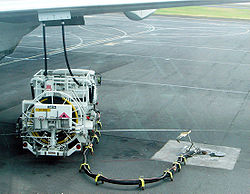
I decided to take this picture to the left as my flight to Los Angeles pulled into the gate. The line personnel were already ready to get the plane unloaded, fueled and turned. I thought I would explain that weird contraption under the wing.

Well, here I find again that Wikipedia has beaten me to the punch: At some airports, underground fuel pipes allow refuelling without the need for tank trucks. Trucks (or just a cart) just carry the necessary hoses and pressure apparatus, but no fuel.

Next time you fly into a commercial terminal, look for the covers that designate where the large underground fuel tanks. You can also see similar covers at your local gas station. Of course you know that all the fuel coming out of the pump isn't stored right in the box with the pump handle, it has to be stored underground. It's a pretty good idea, huh? No trucks maneuvering around taxiing aircraft, and no need for the trucks to have to continuously refill themselves. The pumps on the carts are portable, to allow for the different configurations of the airplanes.


Wednesday, October 01, 2008

One of five shocking paychecks


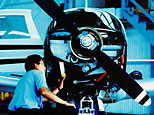
As I sit down to look at my email today, Yahoo has a picture of an aviation mechanic featured on the front page with a link to "Jobs with Surprising Pay!"

Number 5 is Aviation Mechanic:

A vocational school training program can land you a solid living as an aircraft mechanic. The $40,000 to $80,000 earnings range reflects the specialized training required to perform avionics repair and maintenance. Aircraft mechanics inspect landing gear, instruments, cabin pressurizing systems, aviation electronics, and more.

The Lowdown: The FAA certifies 170 trade schools to train aircraft mechanics in the craft. Most programs take 19 to 24 months to complete, although some schools offer 2- and 4-year degrees in avionics or aviation technology. Average Salary: $49,670
(BLS, 2007)

Not bad - and it's a great way to get your start in aviation. Plus, having all of this knowledge if you continue on to be a pilot comes in real handy!