Sunday, October 26, 2008

Aviation Scholarships

I get so many emails from people asking me for money so they can become a pilot. It is very expensive to get a private pilot's license (anywhere from $7000 to $10,000, depending on where you live and what you will be flying). So, becoming a pilot has to be in your blood. It's not usually something someone does just on a whim. People can work and save, take out a loan (which I don't usually recommend), and/or look for assistance in coming up with the cash.


Besides the incredible Girls With Wings scholarship (deadline November 1), there are so many scholarships out there - and those providing them are usually begging for qualified applicants!


One of the best sites I have found is: http://money2fly.googlepages.com/ (thanks to Dorothy!)

About FlightScholarship.info (from the website):
While pursuing my pilot certificates and ratings, I looked for and began to keep a listing of scholarships that I could apply for to help fund my flight training. Over time it grew and grew so I created a site and posted them on the internet to try and help others find money to fly too. Being female, I placed a special focus on cataloging grants for women. As such, much of my list contains awards for females only but there are some that are open to men as well.

Each scholarship has its own application deadline

Amounts may vary from year to year

Some awards may not be given every year

Contact the issuer for application or more info

The scholarships listed on this site are mostly one time awards of $250-$3,000 to help defray the cost of flight training for a pilot certificate or rating. The awards on this page are not restricted to collegiate aviation students only, hence are a resource for those pilot who cannot tap into all the money available to such students. This type of list was the goal of my scholarships website which I began to compile as I flight trained towards my goal of becoming an airline pilot.

Friday, October 24, 2008

A and P

Girls With Wings is a site for women in ALL areas of aviation, but it's predominately pilots now. We need more A&Ps represented on the website!! They have a support network of their own already. Here's a couple of examples.

Wait, what's an A&P, you ask? It's an aircraft maintenance technician:

A person who fulfills the necessary requirements is issued a Mechanic certificate with either an Airframe or Powerplant rating, or both. It is these ratings which together account for the common practice of referring to mechanics as "A&P's." Until 1952, instead of the Powerplant rating, an Engine rating was issued, so the abbreviation "A&E" may appear in older documents.

There is a better description at http://www.avjobs.com/careers/detail.asp?RecID=95.

There are organizations specific to women who do these jobs.

One has a mentoring program: "Jet Ahead, women mentoring women, is a mentor program for women A&P students around the country. Our main goal in this program is to bring the students together with a mentor who has been out in the field and can answer questions and help alleviate concerns. This is a program designed to be flexible in meeting the needs of A&P schools as well as their students. This is a great networking tool for your school, and yourself. So if you are interested in this program, whether you are a student, a mentor or a school, please let us know."


Another has a scholarship (deadline November 21):
Association for Women in Aviation Maintenance
MISSION STATEMENT
"We are a nonprofit organization formed for the purpose of championing women's professional growth and enrichment in the aviation maintenance fields by providing opportunities for sharing information and networking, education, fostering a sense of community and increasing public awareness of women in the industry."


Medical Deficiencies

I'm back on the road again, after taking three sick days at the beginning of a tour. I do not like being sick. 1. Only have a limited number of sick days (what if I really get sick?) 2. I don't like admitting I'm sick ("I'll be fine, really!"). Ultimately, the FAA says that I have a responsibility NOT to go to work if I have a medical deficiency:


Am I prohibited from exercising the privileges of my pilot certificate during medical deficiency?
Yes. You are prohibited from acting as pilot-in-command or as a required pilot flight crewmember during any medical deficiency that would be disqualifying or may interfere with the safe operation of an aircraft.
A simple problem such as a cold, a broken arm, or an abscessed tooth may require nothing more than the appropriate treatment and a little time before you can safely return to the skies. A more complicated problem or the development or change of a chronic illness may necessitate consultation with an AME or the FAA before resuming flying. New medical conditions do not need to be reported to the FAA until you wish to return to flying.
The actual regulation that I must abide by:
e-CFR Data is current as of October 22, 2008
Title 14: Aeronautics and Space PART 61—CERTIFICATION: PILOTS, FLIGHT INSTRUCTORS, AND GROUND INSTRUCTORS Subpart A—General
§ 61.53 Prohibition on operations during medical deficiency.
(a) Operations that require a medical certificate. Except as provided for in paragraph (b) of this section, a person who holds a current medical certificate issued under part 67 of this chapter shall not act as pilot in command, or in any other capacity as a required pilot flight crewmember, while that person:
(1) Knows or has reason to know of any medical condition that would make the person unable to meet the requirements for the medical certificate necessary for the pilot operation; or
(2) Is taking medication or receiving other treatment for a medical condition that results in the person being unable to meet the requirements for the medical certificate necessary for the pilot operation.
So, an extra three days at home. Just wish I could have enjoyed them...

Friday, October 17, 2008

Presidential Decisions

I have advocated membership in AOPA: Airplane Owners and Pilots Association for all general aviation pilots. They have published a great overview of how the presidential candidates stand on the issues important to GA.

You know where they stand on the war in Iraq, taxes, and healthcare. But do you know where Sens. Barack Obama and John McCain stand on general aviation issues?

“With all of the excitement surrounding this year’s presidential election, AOPA members have been asking me, ’Who should I vote for president?’” said AOPA President Phil Boyer. “Rather than endorsing a candidate, we asked the campaigns where they stand on GA.”

Each campaign was given the same eight questions that touched on FAA funding, air traffic control, GA security, and the environment. AOPA’s intent is to help you become more informed on where these candidates stand on GA before you head to the polls.

Two days after the Nov. 4 election, AOPA will host a hard-hitting discussion among several Washington, D.C., aviation insiders about what the results mean for GA. You can be a part of the discussion at AOPA Expo in San Jose, Calif., during the Nov. 6 general session. AOPA encourages members who will be traveling to Expo on Election Day to request an absentee ballot in advance.

Most of the national attention centers on the race for the White House, however, the congressional races will have a crucial impact on issues of interest for general aviation. Congress is important because this group of 535 elected officials must approve the policy legislation that sets the course for the government.

To learn more about General aviation’s allies in the 2008 election click here.

Thursday, October 16, 2008

Need some inspiration?


Being born without arms didn't keep Jessica Cox of Tucson, AZ from meeting the challenge of earning a Sport Pilot certificate. The Able Flight Scholarship winner passed her checkride Friday October 10th after several months of training with instructor Parrish Traweek in his Ercoupe 415C. With its unique control system, the Ercoupe proved to be the right airplane for her to fly using only her feet (she does not use prosthetic arms).


Jessica's path to becoming the first person born without arms to be certified as a pilot began in Florida when Glen Davis provided her first hours of instruction in his Ercoupe. But since his was not an LSA version, she would have to wait until a suitable LSA model could be located. Enter Parrish Traweek of PC Aircraft Maintenance/Flight Services in the little town of San Manuel to the north of Tucson.

Of her experience in becoming a pilot, Jessica said, "I highly encourage people with disabilities to consider flying. It not only empowers you but also helps others realize that people with disabilities are adept at attaining privileges that a small percentage of society takes part in. It helps reverse the stereotype that people with disabilities are powerless into the belief that they are powerful and capable of setting high goals and achieving them. What is most incredible about Able Flight is the relentless faith and support not only from the board but also from the other pilots who have succeeded in the program. The camaraderie is exceptional. Thank you Able Flight for helping me make history as the first licensed pilot to fly with only her feet!" To learn more about Jessica, visit http://www.rightfooted.com/.

Wednesday, October 15, 2008

Rocky Mountain High

Look closely at this picture. Do you see, right down there, an airport? You can pick out the runway if you look...

The name of the airport is Telluride Regional Airport, and it is well known to pilots who fly business jets (which people also fly, obviously, for pleasure). At an elevation of 9,078 feet (2767 m) above sea level, it is the highest commercial airport in North America. We go into a lot of airports near ski resorts; Aspen, Vail, Tahoe, etc.

These mountainous airports can be quite tricky. Some employers make their pilots go through special training to be "checked out" for mountainous operations. Jeppessen, the makers of the airport charts and diagrams, have special full color pages dedicated to operating in and around these airports. Why? Well, first of all, the higher altitude makes takeoff and landing operations different that what we're used to closer to field elevation. The airplane, for example, takes longer to slow down. So any extra speed being carried on final may not be removable on landing, carrying the airplane farther down the runway, toward/past (!) the departure end...

Wikipedia:
Telluride Regional Airport has one runway designated 9/27 which measures 6,870 by 100 feet (2,094 by 30 m). Located on a plateau, the airport's single runway literally dips slightly in the center. The runway can be a very challenging approach for pilots, particularly those operating commuter aircraft or business jets. During winter months, approximately 20% of the scheduled commuter airline flights end up having to divert to other nearby airports because of abruptly adverse landing conditions. Pilots must contend with high terrain exceeding 14,000 feet at all quadrants, as well as the airport's location on a plateau where 3 sides (including both ends of the runway) plunge about 1,000 ft to the San Miguel River below.

Pilots must exercise great caution whenever southerly winds exceed 15 knots (some say as little as 8 knots), and be aware of rotors, strong turbulence and down-drafts associated with the plateau cliffs during the approach. Most approaches into Telluride come from the west onto Runway 9, from the direction of Placerville and Sawpit. Pilots must stay on the right side of the valley on approach, to avoid potential traffic conflicts. In addition to all this, touch and go landings are prohibited at TEX, and the minimum traffic pattern altitude for the Telluride area is 10,500 ft MSL (1,500 ft AGL). Residential areas located to the east of the airport are generally avoided by arriving and departing aircraft, for both safety and noise abatement purposes.

Tuesday, October 14, 2008

Wildfires

I had to run on the "dread"mill this morning. *sigh* I was so excited when I checked into this hotel and asked for a running route. They handed me a premade card with a 7 mile route on it along the river! Yea! Got up this morning and it was cold, wet, and rainy. I didn't have any gear for this weather and didn't really want to carry wet shoes around either. Oh, and didn't want to catch a cold. I went down to the fitness center in the morning and I couldn't believe it! Every cardio machine had a person on it (well, except for a stationary bike - I love bike riding, but a stationary bike to me seems like the epitome of futility; I never feel like I've worked out).
Luckily the treadmills were awesome, nice cushy platforms and there were TVs in the consoles. Very cool. I was watching CNN and they talked about the California Wildfires. This was quite a coincidence because I had taken pictures there on the second day of my tour. Obviously they have gotten worse. As we flew into Van Nuys, it was pretty clear, but as we got closer to the airport, we could see the smoke coming off the hills. It wasn't on the approach side of the airport, so it didn't affect our ability to get in. On the ground, you could smell the smoke, kind of like a campfire. And you can see how thick the smoke is over the hangars. As we departed, I took pictures (after we were above 10,000feet!). Here is the whole CNN story: http://www.cnn.com/2008/US/10/14/calif.wildfires/index.html?section=cnn_latest

Monday, October 13, 2008

Home Suite Home

I am pretty lucky in that I am not a picky sleeper. I can usually sleep anywhere. I find it very easy to doze off when I'm a passenger in a car or airplane (I said passenger!), and I can catch a power nap in the crew lounge of the FBOs by curling up in a la-z-boy. I can have my batteries almost fully recharged with 10 minutes of shuteye. The only time I can't do this is if I have a list of things to do and number 3 is take a nap. I keep thinking of tasks 4,5, and 6, and so on. After a few minutes of that, I'll just get up and keep moving.

A lot of people can't sleep in hotels because they are accustomed to their bed. Although I have a great bed at home, I find almost any bed comfortable enough to sleep in, unless it's so soft it's suffocating. It is a bit annoying to get into a hotel bed that is dipped so low on one side (usually the side with the alarm clock) that it takes no effort to get out of the bed because you can just slide on down to the floor. This is why mattresses need flipping and rotating! I don't mind all of the pillows that hotels have, as long as they're not the ones filled with little squares of foam. I like having them all piled up. I especially like that Hampton Inns include a lap tray in their rooms. And MOST hotels have nice enough sheets, too, not scratchy or thin - but I don't like when they don't have a fitted sheet, so that the bottom flat sheet comes untucked from the mattress, and wrinkles up under me. Luckily, my employer puts us up in high enough quality hotels so these items are usually standard. Some of the rooms are suites, which means there are two rooms, one "living room" off the hallway, and the bedroom, which you get to by going through a hallway - farther away from the interior of the hotel and usually quieter.

I try to ask for the top floor, so I don't have Big Foot pounding on my ceiling. I also prefer rooms away from the elevator, because most people continue their conversations coming out of the elevator and quiet down as they get to their room. Oh, and the ice machine can get pretty noisy, too. Some people listen to their tvs amazingly loud. Earplugs block out most of these sounds, as does turning on the room fan. Every once in a while I need to call the front desk and ask if they can have some one come up to request that the guest can tone it down.


Well, sometimes there's little that anyone can do, especially this tour when I stayed at a Palm Springs hotel right next to their Bike Week festivities. These are pictures taken from my hotel room balcony. There's not much hope for blocking out the vibrations from a loud set of pipes on a Harley. Add to it the entertainment of loud music and a stunt biker riding in a metal sphere, and you're pretty much up the whole night.

You can see the hills, mountains, ?, in the background. I went looking for a place to run in the evening and was told there was a hiking trail I could run on. Unfortunately, this trail was pretty much vertical and had much sand and loose rocks. It was too dangerous to run, so I walked, but the trails started to get less obvious. I'm not found of my bones being found out in the desert, so I turned around and ran on the streets instead.

So I was pretty tired by the time I had to turn in. The noise hardly bothered me at all and I was well awake by the time the alarm went off at 4am. Ok, I am used to eastern time zone which is three hours ahead, but you get the point...

Thursday, October 09, 2008

Park it!

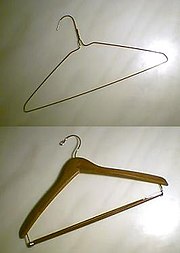
Definition of Hanger: A clothes hanger, or coat hanger, is a device in the shape of human shoulders designed to facilitate the hanging of a coat, jacket, sweater, shirt, blouse or dress in a manner that prevents wrinkles, with a lower bar for the hanging of trousers or skirts.

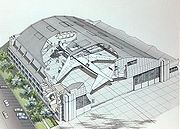
Let us distinguish that from Hangar (commonly misspelled as above): an enclosed structure to hold aircraft in protective storage. Most hangars are built of metal, but wood and concrete are other materials used. The word hangar comes from a northern French dialect, and means "cattle pen." Hangars protect aircraft from weather and ultraviolet light. Hangars may be used as an enclosed repair shop or, in some cases, an assembly area. Additionally, hangars keep secret aircraft hidden from satellites or spyplanes.

Usually my company will get "hangar space" for us overnight if there is a storm on the way. High winds and hail may damage the aircraft, but we also get a hangar (rented from the FBO where we are staying), in order to prevent the aircraft from being subject to the elements during the winter. It is more desirable to have the airplane in a warm hangar overnight to avoid the airplane getting snowed on, or worse, icing over. We may negate the need for getting deiced in the morning - which is costly - and we may also prevent the soda cans from freezing and exploding! Plus, the aircraft batteries may need to be removed and kept warm. All in all, we'd rather park it inside.

But hangars are used for other than their intended purpose. The above picture shows a hangar we are parked in front of with a truck offering aircraft cleaning services. If you look inside the partially closed hangar door, though, you can see what all is parked inside of this particular facility. Hey, the cars need protection from the elements too! Given that this was southern California, I'm not so sure this was so critical...

Wednesday, October 08, 2008

Winglets

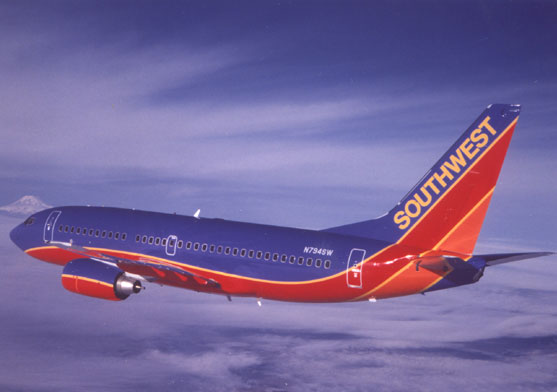
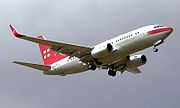
I traveled home last night and got a "pop quiz" from a fellow passenger getting ready to board my airline flight. There was an advertising poster hung on the jetway featuring a picture of an airplane. The passenger pointed to the winglets and asked me 1. what they were. I haven't flown an airplane with winglets for years and was happy that I still remembered! 2. And were they on airplanes from every manufacturer? The airplane pictures I found on the website didn't have any winglets, which leads me to believe they are, as the passenger asked, and at least for this airline, 3. a "new thing."

So here are the answers:

1. Winglets, or wingtip devices, are usually intended to improve the efficiency of fixed-wing aircraft.[1] There are several types of devices, and though they function in different manners, the intended effect is to reduce the aircraft's drag by altering the flow near the wingtips. Wingtip devices can also improve aircraft handling characteristics, and enhance safety for following aircraft. Such devices increase the effective aspect ratio of a wing, with less added wingspan. An extension of span would lower lift-induced drag, but would increase parasitic drag, and would require boosting the strength and weight of the wing. At some point there is no net benefit from further increased span. There may also be operational considerations that limit the allowable wingspan.

The wingtip devices increase the lift generated at the wingtip, and reduce the lift-induced drag caused by wingtip vortices, improving lift-to-drag ratio. This increases fuel efficiency in powered aircraft, and cross-country speed in gliders, in both cases increasing range.[1]

2. Wing fences, are a winglet variant with surfaces extending both upward and downward from the wingtip. Both surfaces are shorter than or equivalent to a winglet possessing similar aerodynamic benefits.
Wingtip fences are the preferred wingtip device of Airbus, employed on all their airliners except for the A330 and A340 families. The Airbus A350 will also make use of winglets rather than wingtip fences.

3. Blended winglets

A blended winglet is intended to reduce interference drag at the wing/winglet junction. A sharp interior angle in this region can interact with the boundary layer flow causing a drag inducing vortex, negating some of the benefit of the winglet. The blended winglet is used on business jets and sailplanes, where individual buyer preference is an important marketing aspect.
Blended winglets have been offered as an aftermarket retrofit for Boeing 737,[1] 757 and Raytheon Hawker 800 with winglets series aircraft by Aviation Partners Inc., and the 737 version is now standard on the Boeing Business Jet derivative.

Many operators have retrofitted their fleets with these for the fuel cost savings. Aviation Partners has also developed winglets for the 767-300ER with American Airlines being the first customer. Airbus tested similar blended winglets designed by Winglet Technology for the A320 series,[12] but determined that their benefits did not warrant further development.

The Citation X I am flying now doesn't have wingtips. But [w]inglets are also applied to many other business jets to reduce take-off distance, enabling operation out of smaller secondary airports, or allowing higher cruise altitudes for overflying bad weather, valuable operational benefits for corporate travel. In addition to factory installed winglets on new aircraft, aftermarket vendors developed retrofit kits for popular jets and turboprops, to improve both aerodynamics and appearance.


Monday, October 06, 2008

Mysterious Fuel

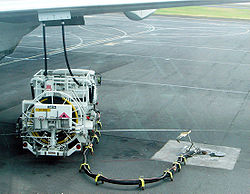
I have talked before about the fuel trucks used to refuel aircraft, but some people may be asking themselves, "How come I never see these trucks when I'm on a commercial flight?" Could you imagine a fleet of fuel trucks trying to fuel all of those commercial airlines at a major airport? It would be a logistical nightmare - and also pretty dangerous. We would not want a collision between a full airplane and a full fuel truck.
I decided to take this picture to the left as my flight to Los Angeles pulled into the gate. The line personnel were already ready to get the plane unloaded, fueled and turned. I thought I would explain that weird contraption under the wing.

Well, here I find again that Wikipedia has beaten me to the punch: At some airports, underground fuel pipes allow refuelling without the need for tank trucks. Trucks (or just a cart) just carry the necessary hoses and pressure apparatus, but no fuel.

Next time you fly into a commercial terminal, look for the covers that designate where the large underground fuel tanks. You can also see similar covers at your local gas station. Of course you know that all the fuel coming out of the pump isn't stored right in the box with the pump handle, it has to be stored underground. It's a pretty good idea, huh? No trucks maneuvering around taxiing aircraft, and no need for the trucks to have to continuously refill themselves. The pumps on the carts are portable, to allow for the different configurations of the airplanes.


Wednesday, October 01, 2008

One of five shocking paychecks


As I sit down to look at my email today, Yahoo has a picture of an aviation mechanic featured on the front page with a link to "Jobs with Surprising Pay!"

Number 5 is Aviation Mechanic:

A vocational school training program can land you a solid living as an aircraft mechanic. The $40,000 to $80,000 earnings range reflects the specialized training required to perform avionics repair and maintenance. Aircraft mechanics inspect landing gear, instruments, cabin pressurizing systems, aviation electronics, and more.

The Lowdown: The FAA certifies 170 trade schools to train aircraft mechanics in the craft. Most programs take 19 to 24 months to complete, although some schools offer 2- and 4-year degrees in avionics or aviation technology. Average Salary: $49,670
(BLS, 2007)

Not bad - and it's a great way to get your start in aviation. Plus, having all of this knowledge if you continue on to be a pilot comes in real handy!

Sunday, September 28, 2008

Seeing the World

I recently got to go on an exciting, exotic trip to Venice! You know, the land of canals and gondolas...? The Citation X has a range of 3070 nautical miles, so it has the capability to travel almost anywhere in the world. Ok, maybe not non stop on this trip (it's 3,874 nautical miles from my home city of Cleveland to Venice) but pretty close. See how far it is between any two cities in the world.

This is why I wanted to get into this airplane so badly - I miss flying overseas from my military days. Although I lived in Germany, I got to travel all over Europe and Southeast Asia. I also spent quite a bit of time in Central and South America. I love to travel, which is part of the reason I chose to stay a pilot after the original incentive had become irrelevant (some one told me it was the toughest job to get in the army... ha, a challenge!). We spend a lot of time going coast to coast (and at .92 mach or 525 ktas (972 km/h), it doesn't take long). We go into Canada quite a bit.

All right, any one who has been to Vegas knows this is actually the Venetian Hotel and Casino - I didn't actually go to Venice, Italy. The other pilot and I had quite a bit of time on the ground there so we walked around the "strip" as they call it. I'm not a gambler, so my interest was more in all of the amazing themed casinos. I'm sure you've heard of many of them, like the Stratosphere, which has rides on top (not for me), the Sahara, Circus Circus, Riviera, Stardust, Treasure Island, The Mirage, Flamingo, Caesars Palace, Bellagio, where we caught the big water show, and the MGM Grand Hotel and Casino, and many more.

Wikipedia: The Venetian Resort Hotel Casino is the largest AAA Five-Diamond rated Resort in the Americas. [1] This Venice-themed luxury hotel and casino is located on the Las Vegas Strip in Paradise, Nevada, on the site of the old Sands Hotel. The Venetian has 4,049 suites and a 120,000 square foot (11 000 m²) casino. Combined with the adjacent Sands Expo Convention Center and The Palazzo Hotel and Casino Resort, The Venetian is a part of the largest hotel and resort complex in the world --- featuring 7,128 hotel rooms and suites.[1]

I got to play tourist, taking pictures of one of the performers in the hotel. This italian statue was actually a man, who spends hours posing in the maze of stores in the casino. He switches poses every once in a while, but once posed, it's hard to tell this is a person! Except when I gave him a tip - he winked at me.

Yea, every once in a while we get lucky. We just spent the night in Milwaukee, which though not a tourist hotspot, has a very nice downtown.

Wednesday, September 24, 2008

Aircraft Fuel

You're probably wondering what I've been up to. Believe it or not (anyone who really knows me won't), I've been cleaning. I had a big mess to clean up a couple of weeks ago caused by a couple of cats I recently adopted. They didn't like my disappearing on them to go to work, and they took it out on my couch and rugs. I think I can get the smell out of the rugs, but the couch is a total loss...

I also have a 100 year old house, and I found evidence of some little critters in the cabinets. I set up some traps and cleaned up THEIR mess too. As a result, my kitchen made the rest of the house look bad. I spent about four days cleaning my house from top to bottom. The good news is, the cats and I have reached an understanding and after this last tour there were no presents awaiting my return. My dad also was in town, and we spent some time on the outside of the house. I'm grateful that typing allows my arms to rest on the desk. I have no more energy to lift them anymore.

But I have some pictures from a trip into Canada we took last week. Above is a picture of the fueling truck dispensing jet fuel, where they measure in liters, not gallons. So we pilots figure our fuel load in pounds, since weight is most critical to us, convert it into gallons, and then for the Canadians, into liters. Some one give me a calculator! We flew down to Arizona, chasing the sun the whole way.
We flew the same passengers out the next morning. You can compare this picture of a small single engine airplane getting 100LL (or low lead) fuel. The fuel truck is also correspondingly smaller. What's the difference in the fuel?

Wikipedia:
Aviation fuel is a specialized type of
petroleum-based fuel used to power aircraft. It is generally of a higher quality than fuels used in less critical applications such as heating or road
transport
, and often contains additives to reduce the risk of icing or explosion due to high temperatures, amongst other properties.

Most aviation fuels available for aircraft are kinds of
petroleum spirit used in engines with spark plugs i.e. piston engines and Wankel rotaries or fuel for jet turbine engines which is also used in diesel aircraft engines. Alcohol, alcohol mixtures and other alternative fuels may be used experimentally but are not generally available.

Avgas is sold in much lower volumes, but to many more individual aircraft, whereas Jet fuel is sold in high volumes to large aircraft operated typically by airlines, military
and large corporate aircraft.

100LL, spoken as "100 low lead", contains
tetra-ethyl lead (TEL), a lead based anti-knock compound, but less than the "highly-leaded" 100/130 avgas it effectively replaced. Most piston aircraft engines require 100LL and a suitable replacement fuel has not yet been developed for these engines. While there are similar engines that burn non-leaded fuels, aircraft are often purchased with engines that use 100LL because many airports only have 100LL. 100LL contains a maximum of 2 grams of lead per US gallon, or maximum 0.56 grams/litre and is the most commonly available and used aviation gasoline.


As I mentioned previously, we not only get fuel for our airplanes at the FBOs, we get fuel for our bodies. Here's a picture of our catering being brought out to the airplane. Yes, bags and bags of it...


Wednesday, September 17, 2008

Defueling Airplanes


Well, for the second time in my flying career, I had to have fuel taken OFF an airplane. The first time the fuelers forgot to mix PRIST into the jet fuel. The airplane I was flying at the time needed to be defueled at a service base as defueling couldn't be done with a fuel truck, so we had to fly a short distance (not getting high and cold) to get it defueled. Huh? What is Prist and why did we need it?

All turbine aircraft fuels contain some dissolved water. It cannot be extracted because it does not exist as particulate water. When an aircraft rises to flight altitude, the fuel cools and its capacity to retain dissolved water is reduced. Some of the dissolved water separates out as discrete water that can form into ice crystals or remain as a super-cooled liquid. When super-cooled water strikes a tubing bend or a filter, it can freeze quickly and block a fuel line or filter. If suspended ice crystals are present, they can also block a filter. Prist Hi-Flash anti-icing aviation fuel additive controls icing in aircraft fuel by depressing the freezing point of water.
But this time was because we had gotten too much fuel. The paperwork for the flight had assumed that it would be cooler than the actual temperature which limits our maximum takeoff weight for a given length of runway. PLUS, part of the runway was closed (the last 500 feet), which limited our takeoff weight even more. Since we couldn't lessen the aircraft any other way, we had to take off some fuel. We were actually dispatched with enough fuel not to need fuel at an interim stop to drop off one of our two passengers, so this just meant we had to get fuel at the next stop.

So, I got to see the fuelers take fuel off the airplane. It usually is a pretty simple process. Instead of the fuel truck dispensing the fuel, a lever is depressed so it just sucks it back in. However, it wasn't working, and the ground crew was clearly perplexed. Finally a supervisor came over and determined it wasn't working because there was no fuel IN the truck - so they had to go get fuel in the truck and come back to defuel.


In the interim, the passengers showed up, but luckily were hardly inconvenienced. Safety, after all, is the most important principal in aviation.

Monday, September 15, 2008

Back to work

Yea! I'm on the road again...

Yesterday I spent about five hours in the Cleveland Airport waiting for my commercial airline flight to take me to Michigan to start my tour. There was a mechanical problem with the airplane and the crew had to wait for the mechanic to come to the airplane and sign off the problem so the flight could go. "Sign off" means that the problem isn't going to affect the safety of the flight but it needs to be logged and fixed at a later date. I've talked about MEL's (or Minimum Equipment List) before, but real quick, the MEL is an FAA approved document that airlines must comply with when determining which items can be inoperative on a particular aircraft type during flight. In other words, the company can't decide that having one wing instead of two is ok just for a leg or two. It's often just for convenience or comfort items, but may be for items that are back up systems or needed for particular flight conditions, like flight into icing or nighttime.

On this flight, it was the air conditioning. The only passengers not moved to other flights to make connections were myself and another airline pilot riding along. When we got on the turboprop airplane it was HOT and muggy and we had to wait til the airplane was fueled before the crew could turn on the air - which turned out to be working in the cabin but not the cockpit. I didn't realize this during the flight.

We flew from Cleveland to Detroit at 6,000 feet through some very bumpy weather. I think the crew was more concerned about getting us straight to Detroit to make up some time and less concerned about the smoothness of the ride. I mention this because when people tell me they had a really bad flight with lots of turbulence, I tell them that although I don't know for sure what they felt, but I imagine it was probably in the category of "light" turbulence. When I tell them the categories are light, moderate, severe and extreme, I do so to give them an idea of how bad turbulence really CAN be and how much the airplane is designed to take.

So, as bad as it was for us in the cabin, when we landed in Detroit and the cockpit door was opened, a huge blast of warm air escaped. The poor flight crew had no fresh air for this hot, muggy, bumpy flight. Though it was a short flight, I can't believe they didn't lose their lunch! I have done such flights before without a good source of fresh air and trust me, they are not comfortable. Just another "glamorous" aspect of flying for a living...

Friday, September 12, 2008

Getting Home

It's seems like I just got home and here I am getting ready to go back on the road again!

I found some pictures that I took one night getting back from a tour. I now park my car at the train station right before the airport. I started doing this because I had been parking at the local FBO and tipping the driver $5 each way to take me to the commercial terminal. It always made me nervous, thinking that if I got to the FBO and everyone working there was out doing something else (refueling airplanes, marshalling aircraft, etc.), there might not be anyone to take me to the terminal and I might miss my flight.

So, not only was it cheaper to park at the train station ($1.75 each way), the train runs every 15 minutes, so I'm pretty well assured of making every flight. Plus, I only have to unload my bags once - get them out of the car and into the station. Although the station does have the slowest elevator ever built. I also enjoy going right from the flight into the train station, located in the terminal. There are always interesting characters taking the train as well.
The problem is, one night I came home to find 3 MAJOR scratches in the paint of my car. Not keyed, someone had to have used a screwdriver or some other such tool to scrape down to the bare metal. In retrospect, I wish I would have given myself the "insurance" by parking at the FBO.
These pictures actually weren't taken returning from my last tour. I was home by 5pm, when it was still light outside. It's such a bonus, getting home when there is still time to do something. Unfortunately, the movies that I rented sat unwatched while I cleaned up the messes that my newly adopted cats left for me. Sigh.

Thursday, September 11, 2008

Touching History, by Lynn Spencer

I have talked about Lynn's book before on this blog and I have included references to it in Lynn's bio on Girls With Wings. I only recently finished reading the book, full title, Touching History: The Untold Story of the Drama that Unfolded in the Skies over America on 9/11, recently, and I am so completely impressed with Lynn's work.

I am not doing Lynn a favor by writing a complimentary review of her book just because she's a great supporter of GWW. This is a phenomenal book and I recommend it without reservation. The description of it on her website is as follows:

Finally . . . the complete story. Simon & Schuster presents the gripping, inspiring minute-by-minute account of the heroic battle in the skies on 9/11.

The story of the astonishing drama that played out in the skies and in the military installations and air traffic control towers on 9/11 has never before been pieced together and portrayed in a vivid moment-to-moment drama.

In this riveting book, commercial pilot Lynn Spencer brilliantly brings that drama to pulse-quickening life. She went on a quest to interview the vast number of people caught on the front lines in an unprecedented air war in which thousands of commercial pilots with flights in the air, air traffic controllers, military commanders, and jet fighter pilots snapped into stirring action.

Calling on their exceptional preparedness and unflinching readiness to put their lives on the line, they improvised a defense against a shocking threat the nature and extent of which they could have no comprehension as the events unfolded.
Her sources include hundreds of key players, from Vice Chairman of the Joint Chiefs of Staff Richard Myers to the FAA's command chief, to the general in command of air defense for the United States, the controllers who tracked the hijacked flights, and the fighter pilot, who, with no weapons loaded on his jet, unquestioningly accepted an order to take down United 93 with his own plane.

Lynn Spencer has crafted a powerful and vital account of the unknown story of the pivotal day in American life.


I would like to second all of that. I do not feel that anyone could have written fiction as interesting as this true life book was to read. I was absolutely drawn in to the story and hated to put it down. From page 1, I was engrossed. I am embarrased to say that as a professional pilot, and as an Army National Guard officer on 9/11, I had no idea of all that was involved behind the scenes in the first hours after the hijackings and those days that followed in the aviation arena. Most coverage of the events covered the treatment of the injured, the reclamation of the dead, and the damage to the buildings and actions of the emergency personnel on the ground.

This book covers a short period of time in amazing detail, discussing the actions of airport employees, air traffic controllers, other civilian and military pilots, and the governmental organizations involved in getting planes down safely wherever they could. Lynn has interviewed those directly involved in the events, and their quotes and actions are described in the book in terms that the non-aviation enthusiast can understand.
She describes what it took to get our troops mobilized and military planes up into the skies to protect our nation from potential further attack. The book highlights weakenesses in our national defense and aviation procedures, most notably the communication infrastructure, but that what needed to be done happened because of people's dedication to accomplishing the mission.

I am so impressed with the research that I knew Lynn was doing, but she went far beyond what I would have thought possible. If one had the ability to be in numerous places at once so to have a thorough understanding of such a tragedy, Lynn was the one to give us a close approximation.

It is sad to think that it took a monstrous terrorist act to bring our country together and to give ourselves the opportunity to prove what we could do when we all work together. I hope the lessons of 9/11 will remain with us for many years to come.

In closing, I do have a limited number of copies of this book available. They will be distributed first come first serve - free of charge - to Girls With Wings crewmembers that order from our online store. You must identify yourself as a crewmember upon checkout to receive the book in your shipment.

Tuesday, September 09, 2008

Busy Week!

It has been a very busy tour this week, and so I have not been posting much on the blog for the last few days. Getting up before 4 or 5 am means I get to the hotel pretty tired at night. If I'm lucky, I have enough energy to work out, but then I'll have NO energy left to get on the computer!

Anyway, I got pretty LUCKY this week, because I got to fly into the Denver area, where my best friend lives. Cindy is an America West Airbus pilot and Girl With Wings who I used to work with at Air Midwest, the regional airline. Yes, I know that AM West merged with US Airways - but I prefer AMW. She got to see the inside of the Citation X and meet the captain I was flying with.
The Rocky Mountains are so cool to fly over (we also flew over the Grand Canyon, but I have yet to take a picture worth publishing - the Canyon is just too big and no picture does it justice).
Cindy is at right with her son Cody, because of whom (and a daughter, Sophia, 6) she is taking a leave of absense from the airline. When she was working she would fly for an overnight in Cleveland every once in a while and visit me, but now we rarely get to see each other. Her husband flies for FedEx, and they will soon be moving to Hong Kong. I wish we flew more international trips to Asia, but so far I've only gotten as far as Canada in the X. Bummer.

Saturday, September 06, 2008

Trailing Link Landing Gear

I'll be the first to admit, I don't know everything about airplanes. Not even close. The first aircraft I ever flew, the UH-1 Huey (a helicopter, at that), was the last and best vehicle for airborne transportation I ever knew in and out. Of course, it was also the simplest aircraft I ever flew. My flight school instructor made me recite the names of all the parts as I touched them on the preflight. I hated it then, but it made me pretty knowledgeable.

Every successive airplane has gotten more complex, and the training facilities expect us less to understand HOW they work as opposed to how to PROGRAM them! Where we used to have to know how the ACM (Air Cycle Machine) worked during an oral exam, now we just need to know that there is one. All of the knowledge in this aviation business builds on itself.

There is also a lot of knowledge that people pick up along the way, depending upon their interest level, experience, mechanical ability, etc. The first jet I ever flew, I don't think I understood what the thrust reversers did until I was through with the course and a captain I was flying with noticed I wasn't using them appropriately. (I discussed TRs before in an earlier post. See Wikipedia for more info: Thrust reversal, also called reverse thrust, is the temporary diversion of an aircraft engine's exhaust or changing of propeller pitch so that the thrust produced is directed forward, rather than aft.)

Anyway, back to the gear. The Citation X has trailing link landing gear. I've heard about it in passing, especially after some of my poorer landings. For "whatever reason" it's pretty hard to have a hard landing in the X. So I decided to look up this gear and why it's less likely to have this airplane "slam" on the runway. There's not much to read online, so the captain walked me out to show me how this gear is different from every other previous airplane I've flown.
Basically the strut on the right, or forward, has a pivot point that allows the tires to sink a few inches when the airplane is off the ground and the gear is extended. When the tires touch the ground on landing, it's enough give so that when the second strut, the hydraulic one, comes into play, it's not as abrupt. It used to take a pilot's skill to make a smooth landing, now the gear does it for us!