Friday, April 15, 2011

Lest I get too cocky…


Old style steam gauges
For three days I’ve been practicing in the flight school’s 172SPs. It is probably the newest airplane I’ve ever flown in – a 2008 model with Garmin 1000. If you’re not familiar with general aviation aircraft, you might not know what a big deal this is. Even I, who has been flying “glass” for years, had a transition from the steam gauges to the fancy new avionics.

Training courtesy of the Kings
I even kind of pooh-poohed the suggestion that I complete a computer training course before using it. How hard could it be? Well, first there are some really handy tricks to this thing (dare I say that even the Citation X didn’t have?) and I’m just not used to flying glass. What little flying I’ve been doing has been in round gauges. Main benefit to that, my new instructor Eric says, no parallax. In other words, the instruments are in front of the person in the left seat. As an instructor I’ll sit in the right. Looking over to the gauges means that for me to fly at 80 knots, the gauge should look to me as if it’s reading 83. Not that big of a deal, but I like not having to worry about it. Of course I’ll get spoiled flying these and have to revert once I start flying other airplanes without the geewhiz avionics.

Barry and I being silly
Main disadvantage to it? Distraction. I went out to fly in the 172 on a windy afternoon in South Texas. It was bumpy and gusty and I kept having to spend a long time looking inside to confirm information – like my altitude. So here I am doing a steep turn – supposed to be a visual maneuver, yet I was leaning inside (to block out the sun – don’t see that in Cleveland) and then peering back outside. Inside, outside. Inside, outside. Inside…. Out….side…. Ugh. Made myself sick. Not a very productive first day. And embarrassing. But thanks to Barry's aerobatic instructionat AcroCamp, I knew what the signs were for impending upchucking and stopped the training before I actually did so.

Day 2. Better. This time I went over to Victoria Airport and flew their other 182. This airport has, gosh, a tower. It’s funny how you get used to your environment so quickly in some things, and not so much in others. For example, I’ve been flying around non-towered airports so much I’ve gotten used to just making calls in the blind – or to self announce. For example, “Calhoun County Airport, Skyhawk 578AC taxiing from parking to the departure end of 32 for right closed traffic, Calhoun County.” Saying the airport name twice lets everyone on the frequency know to which airport you refer, in case they missed it the first time. Many airports in the same area use the same UNICOM (Universal Communication) frequency, because there are only a few:
  • 122.700 MHz
  • 122.725 MHz
  • 122.800 MHz
  • 122.950 MHz
  • 122.975 MHz
  • 123.000 MHz
  • 123.050 MHz
  • 123.075 MHz

But now I had to figure out how to talk to Air Traffic Controllers without sounding like a total noob. I mean, I’ve been talking plenty to towers over the last decades, but not as a VFR pilot. “Victoria Ground, Cessna 248AC at Victoria Flyers with information Xray, requesting taxi for VFR departure (I forgot the direction mid stream, so I just said) to the practice area.” Luckily, or maybe not always so, the controllers learn what tail numbers are used for the tenant flight school and so are willing to cut a little slack. Then I had multiple runways to deal with, so I had to find my way to the correct one and call tower when I was ready. Additionally, this airport has no radar, so I had to call clear of the Class D airspace. Whew. I mean, I AM a pilot, right?

This time we went out and practiced some of the commercial maneuvers, like chandelles and lazy eights. Even though these are ground reference maneuvers, I still spent a lot of time inside because of 1. Haze and clouds obstructing the horizon, and 2. Lack of section lines.
Section lines in the United States are one mile (1.6 km) apart. When surveyors originally mapped an area, for instance a township, it was their custom to divide the new township into 36 1-square-mile sections. Property ownership often followed this layout. A section is a 1 by 1-mile (1.6 km) area. A half section is a 1/2-mile by 1-mile (1.6 km) area. Besides property ownership, roads often followed the section lines, and one can often still see them in modern maps, even in urban areas. In rural areas, these roads are called section roads, and often exist primarily so that farmers can access their land.
But this applies to us pilots in that usually these section lines are north-south and east-west. So you can align yourself with a cardinal heading and follow a section line so you don’t have to keep checking your compass to see if you’re on your heading. And since many maneuvers involve 180’ or 360’ turns, the section lines are a great guide. Unfortunately, they’re more common in Ohio than they are in this part of Texas.

Today, I flew back at Calhoun County. Not so early that we had to fight the morning fog, but before the clouds and wind kicked up. We flew 1.1hrs. That’s how big that window is. It was dead calm, so my landings, for a change, could become consistent. Remember how I said something were not so easy to get over? Landing a Citation X, for me anyway, was a challenge of restraint. I SO wanted to pull the nose up to flare, but you just don’t in the Ten (my most recent aircraft). All the way down I had to talk to myself and make my muscles keep the airplane in that same landing attitude all the way down to the ground.

Grass strip above hangars and to left of taxiway
This is not the way to land a 172. The idea is to flare such that you’re raising the nose of the aircraft gradually to slow the rate of descent. At this time the nose should be continuously raised until the airspeed bleeds off and the airplane touches down just above stall speed. I don’t do this easily. I even tell myself during the roundout, pull up, pull up, pull up, pull up… and still land a little flat. But after a few landings, I'd like to think I'd cured that residual habit. Previous flight instructors have let me get away with it, but Eric isn't going to because it gives me a smaller margin of error in cases of (which happens here a lot) a gust of wind drops you into the ground.

Why is this important? Well, today I landed on a grass strip for the first time. One of the maneuvers I’ve been practicing is a soft field landing, to be used anytime the runway is contaminated, or less that what you’d expect on a paved surface. I’ve also been practicing a short field landing, for when the runway is, you guessed it, short.

Soft field landings mean you keep the nose up even longer to prevent it from sinking into the mud, snow, whatever (as to not become a wheelbarrow), and short field means you keep your approach slower and get the airplane stopped sooner. It was a handful. "Simulating" these maneuvers to a regular runway is not the same as actually landing on a actual grass strip. The airplane really bounces around on the lumpy dirt. By then the wind had picked up, so I there was a kicking crosswind, too. By my sixth landing I’d pretty much gotten it down, so we taxied back onto the ramp, and I was feeling pretty proud of myself.

Eric got out and mentioned that we’d picked up a nice bouquet of weeds in the left gear, so I came around to take a picture. Unfortunately, as I fumbled for my phone, I forgot about the strut, and hit my forehead so hard I literally fell back on my rump. Oh, my fragile ego. So much for the grass strip victory. [Eric was very kind to share all of his head bumping stories with me while the redness left my face.] The weeds were blown away before I could take the picture but as you can see, even all of that bouncing on the grass strip didn't damage the gear.

So I guess tomorrow I'll try this flying thing again. 

Tuesday, April 12, 2011

Today I fed a camel a bottle

Pinch me. Ouch. Okay, okay. I know this isn’t my life that I’m living right now, just someone who is sharing hers with me. For me it is so far removed from my normal existence it is kind of like a dream.

At the end of March I made what I considered my “last ditch” effort at getting my CFI rating. I know, I know, I’ve been working on this for months --- Remember, back in late 2009, early 2010, I had aspirations of having my CFI, CFII, MEI, and heck, even my helicopter instructor ratings by now? Ha. Life, unfortunately, kept getting in the way. So did weather.

As did reality. I will blog shortly with that whole story, but I wanted to update you with what’s going on right now. Only because I can more put it into context now that I’ve had a year’s experience with General Aviation (GA). Or, at least, six months. This next month is going to be an immersion effort. So now that I’m on my very last LAST ditch effort, I hope to share with you a bit more about it now that I’m gaining familiarity with GA. I got to see a whole ‘nother side to GA today. Seriously. A week ago today I was recovering from my long drive back from Florida, where I attended Sun n Fun. A day later I got a phone call from Dianna Stanger, a Girls With Wings role model featured in this month’s newsletter.

Dianna
A lot of the bios I get for the website are for women I’ve never met, including Dianna. She wrote a great bio (you should read it!), but we’ve only communicated via email and a few phone calls as she has promoted GWW at her events introducing people in the community (especially kids) to aviation. Recently she introduced 98 girls and women to flying in her Eurocopter EC120 and won the “Most Dedicated Female Pilot in the World” title in the 2011 Women Of Aviation Worldwide Week.

BTW I’m meeting her friend Jasmine tomorrow. She invited volunteers of local non-profit organizations to come to the airport for a flight. She won the “Most Creative Aviation Advocate” title from WOAW. We’re going to work on getting sponsors for the Racing Aces, the AirRace Classic team Dianna has formed to help raise money for Girls With Wings.

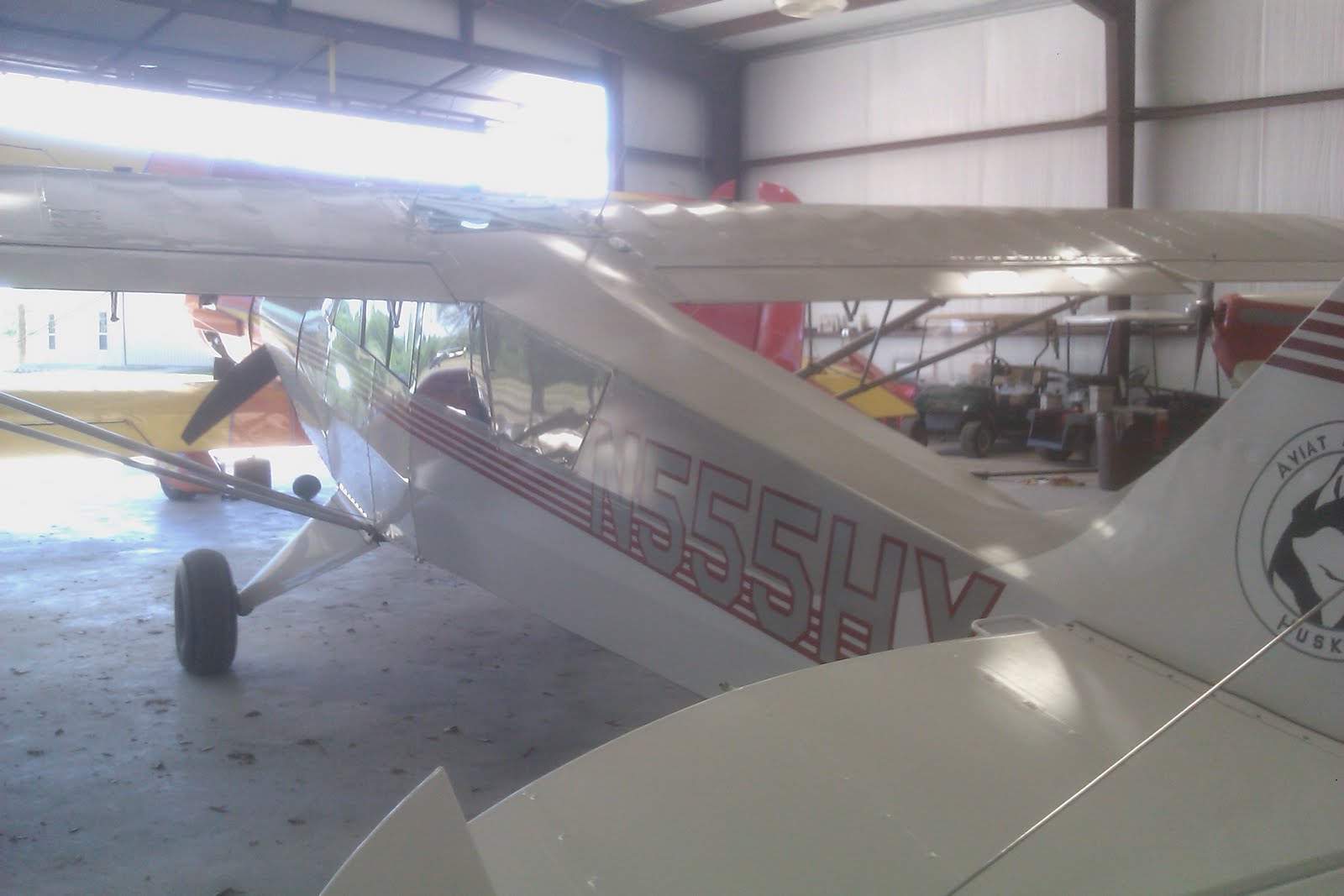
Dianna's Husky
Back to the phone call. Dianna asked me if I was able to complete my CFI, as I had sworn to do before I left Alabama and Florida to come back to Cleveland. No, I hadn’t, and looking at Cleveland's 10 day weather forecast for practicing what I had learned in Jasper, AL, did not look encouraging. Rain, more rain, and for a change of pace, thunderstorms. So, she made me an offer I couldn’t refuse.

“Come down here (to Port Lavaca, TX) and I give you a place to stay. You can fly my airplanes, teach at my flight school (with that brand new Advanced Ground Instructor certificate in my pocket) and get that CFI knocked out.” I was literally speechless.

I called my friend Sara in Alabama, who had been teaching me at her flight school and who I had expected to go back to. She said, “Do it, girl! You know the maneuvers (she and her husband Glen taught me well); all you need to do is get out there and practice them! And the best way to learn that CFI stuff is to teach it! What a great opportunity!” Sara talks in exclamation points, especially about aviation.

All I needed to do, in a few days time, was to prepare myself to leave town for a month. Not easy when you’ve just been gone for more than two weeks, and have a small business to run. Besides rescheduling pretty much the whole month of April (and some of May), I had a day long Girl Scout/NASA event to attend. And a car to unpack and repack. And two cats who I will miss terribly needed a home. But I made it happen. Two loooong driving days later…

I show up at the Wolf Point Ranch. I had received instructions on how to enter the ranch and park in their garage, but it still came as a surprise when I pulled up to a hangar and pulled in behind a sweet Benz, which was parked behind said Eurocopter mentioned above. Any doubts I might have had about this being a “real deal” quickly evaporated. My place to stay is an apartment in the hangar with a full gym next door (I’ve been needing an excuse to get back into shape).

They're really quite friendly
This morning I met Dianna and her husband Al for a walk. For the record, their two Giant Schnauzers make horrible guard dogs. We strolled past their newest camel (they have three), the rabbit cages and the Watusi Cattle, sheep and horses. Lots and lots of horses. This is an amazing place to stroll around in the early morning hours.

Rhinos prevent hot cyclics
The walk was nice, but it was even better when Dianna told me to meet her in an hour on the helicopter pad. She ran her errands today. In. Her. Helicopter. Being a helicopter pilot myself, I was amazed at how fast the before start checklist was on this thing. The blades were turning within a couple of minutes. The interior hardly resembled the Huey I was used to. Heck, Dianna was wearing white shorts and sandals so I had a feeling this was not going to be reliving my Viet-Nam-era-aircraft-flying, army-green-nomex-flight-suit-wearing experience. It was a beautiful day for flying.

Dianna's Premier Jet
First we flew to the airport, KPVK. She had ordered wheel pants for the Husky she’s flying in the AirRace Classic which we were picking up to fly over to her mechanic. But first I met the crowd, including Eric, my new flight instructor. I also got a peek at her WACO and her Premier. Yes, hers. And a really sweet Airstream Camper that she had customized for her when she did her horse shows (well, I'm into camping, too, you know!). At this point, I don’t care who you are. You can play it as cool as you want but you, even you, would be green with envy at this point.

Note the GWW Keychain!
We got back in the helicopter and flew across to the mechanic’s place. He’s got a 2600 foot grass strip where he hosts fly-ins every summer and restores Stearmans (I have a not so secret goal of getting rides in ALL of these other aircraft before I leave). Here I saw Dianna’s Husky with its amazing panel. I've seen jets without all of these toys. And this is a taildragger! Fellow racers: you should be nervous. Dianna aims to win. I’ve only just met her and she seems the determined kind.

Helicopter Parking in the Grass
Then we flew on over for lunch. Embarrassed, I told Dianna that I hadn’t brought my wallet for us to eat out, but she said if we ate at the Shellfish that would be ok. As we approached the restaurant, she said “our” restaurant. Yup. Our. We landed right outside the parking lot, and again, I don’t care who you are. You get out of a HELICOPTER and walk toward a restaurant with a crowd on the deck watching your arrival and not strut your stuff. Go ahead, just try. As one of the observers remarked, “THAT’S the way to make an entrance.”

Wolf Point Ranch
And we flew back to the ranch. I was SO impressed with that helicopter. And Dianna’s flying skills. [She flies that helicopter with a comfort level similar to that which most folks drive cars.] And especially her generosity. Part of my deal with her is that I’ll be flying discovery flights for her – which I am so excited about. This is my chance to totally immerse myself in General Aviation. It’s sometimes hard for folks to understand that I have gone from the military to the airlines with so little exposure to flight schools, and flying for fun, flying different aircraft and introducing people to aviation – by flying them – that I expect this to be an amazing month. And challenging. I’ve still got a lot to learn. And a checkride to take!

Wednesday, April 06, 2011

Sun n Fun n Fun n More Fun

Well, I'm back in town, if only for a little while. I drove back from Florida on Sunday and Monday - did you know that Lakeland, FL, to Lakewood, OH, is over 1000 miles and more than 18 hours of driving time? Yikes. I was so ready to get out of that car!

I was returning from the Sun n Fun Fly-in, also known as "Spring Break for Pilots." I first went to this airshow (founded in 1974) two years ago which I blogged about - mostly about Arty's journey there - and also about the folks I got to meet there. That's always the best part of this event, getting to know people that I have met and/or stay in touch with only via cyberspace. Though the Lakeland Airport is open year round, the most activity at this airport is definitely seen during the Fly-in taking place in either March or April.

Although I could barely afford the time or the money to attend the event, I was urged by several people behind the scenes that I should go to reconnect with folks I don't touch base with at Oshkosh (EAA AirVenture) in Wisconsin. Like Dave Allen, or @DaveFlys on twitter. Dave terms himself "The most underutilized guy in aviation social media," but I just think of him as one of the most helpful and knowledgeable guy about aviation, [being] social, and media. He urged me to come on down months ago, and then as circumstances were conspiring against me, convinced me again. As I tweeted a few days before the show: "I think the gods are telling me to take off my calendar." Dave tweeted back "@ Well I'm telling you to leave it there. That is all."

I was in Alabama training for my CFI - Certified Flight Instructor - and hoped that I could knock it out before SnF. Weather, however, was not cooperating. I didn't get to fly as much as hoped and it soon became clear that I would need to return, either after SnF or even later in the month. Additionally, my 13 year old car was making this odd noise. It almost sounded as though I needed to shift but I drive an automatic. It was some noise that increased in pitch as I accelerated, though I was at a loss to know what it was. Luckily, the friends doing my flight training also knew a reliable mechanic, who agreed to bring my car in and check it out. His determination, the right front wheel bearings. He worked on it til 7pm the night before I'd hoped to leave. Third, the friend I was going to stay with in Tampa, not far from Lakeland, received orders to deploy to Bahrain. Sigh. But then Dave offered his spare tent. Problems solved!

Unfortunately, the day that I was driving the 600mi/12 hr trip from Jasper, AL, to SnF was the day that Lakeland was hit by a tornado. According to this article, "Tornado sweeps through Sun 'n Fun and leaves destruction in its wake" on FlightGlobal.com, battering the exhibition site and causing damage to around 70 aircraft - many of which were written off.

A Cessna 172 dumped on top of a Beech Bonanza by the tornado.
Anything loose was whipped in to the air, tie-downs were largely ineffectual, the sandy soil moistened - about 6in of rain fell in several hours. Flooding occurred in some parts, with hail and torrential precipitation hitting the area.

Aircraft large and small were affected. A Cessna Grand Caravan was dumped on its back, a Douglas DC-3 moved about 30m (100ft), Lockwoods and Rans display exhibitions were annihilated, and had there been more visiting aircraft on the field, the devastation would have been far worse. 

On that day I had stopped about four hours out and called Dave, who assured me the weather would clear up by the time I got there. But as I got closer I saw storm damage, it was still raining, and frankly, it was starting to get dark. I was not looking forward to stumbling around in the mud trying to set up a tent (frankly, I was a little grumpy after a 4am wakeup). Thankfully, the next hotel I saw was a Hampton Inn. And they had rooms! So I got a good night's sleep in preparation for going in early for the cleanup.

But alas, my car had other plans. Now, whatever was making the noise in my car was not fixed by the mechanic. He repacked the wheel bearings but the sound was still there. I took comfort in the fact that he searched high and low to find the source and couldn't. So I reasonably sure I was safe. Then, as I was departing the hotel in the early morning hours I heard that screeching noise your brakes make when the pads are gone. Just in case, I got out and looked around the car to see if, I don't know, I was dragging a piece of aluminum siding. Nope. So at the next light, the sound stopped as I braked. Then it came back. And went away. Finally, it didn't go away and I started contemplating the damage I could be doing to my car as I practiced the "denial method" of car repair. Warped rotors, maybe fire, etc. I looked to my right and saw a Midas offering free brake inspections. Four hours and four hundred dollars later I was back on my way to SnF. Boy, was I thankful this hadn't happened on all of those back country roads I had been on the last couple of weeks!

So Dave marshaled me in to the camping area, where I got to meet his wife, Heather, and their four beautiful children. A woman in the campsite next to them looked at my GWW t-shirt and said, "hey, I just bought something for my granddaughter with that logo!" So I got to pitch the company to a bunch of folks there, showing off the Penelope Pilot book and other offerings from the Pilot Shop. One of the first people I hooked up with on the airshow grounds was Rob Riggen, owner of Flying High Coffee, who is donating a portion of his profits to the Girls With Wings Scholarship.

I spent a lot of time at Sun n Fun Radio, hanging with @SnFRadioDave, who interviews a variety of interesting pilots, builders, aviation enthusiasts, and SUN 'n FUN exhibitors, sponsors & advertisers, as well as weather updates, traffic reports and major news stories, streamed live on http://www.liveatc.net/snf Also there, Rod Rakic of myTransponder, which makes aviation more social: "Join the community and connect with fellow pilots, aircrews, maintainers, controllers, instructors, owners, and enthusiasts."

Plus, I spent time with @Juliewillfly, @TwiliteFlyer, @PilotDamon, @SASadvantage, @Holdridge, @Pilot2b, @AceAirSpeed, @efha_president, @larryoverstreet, @davidfieldsNWA and more (please forgive me if I've neglected to mention you personally)!  Everything from the morning balloon launch from the nighttime airshow as seen from the announcer's stand (thank you, Walt!) was just top notch. I am so glad I was talked into going. What an amazing trip.

And of course, all of this originated with a presentation I did in Mobile, AL, which will be the terminus of this year's AirRace Classic. The picture here is two girls who chose to do their collage with the photo from the AOPA article on Girls With Wings taking center stage (the logo is in the lower left and Penelope is in the lower right!). Terry Carbonell, the organizer of a series of events for the Girls Club of Mobile leading up to the AirRace, has done an incredible job educating these girls about flying. I am proud to take part in her efforts.

Clearly, at the end of this 3000 mile trip, I am exhausted and overwhelmed with unanswered emails and snail mail. My main priority has to be getting back into the air so I can finish my rating. Problem is, I live in Cleveland. Did I really think the weather was going to be any more cooperative here?!?

Saturday, March 19, 2011

Breaking Through the Clouds

At the terminus of the 2010 AirRace Classic, in Frederick, MD, I attended the premier of a documentary about the first women's national air derby, which took place back in 1929. I remember being blown away by it then and I was so happy to be asked to review "Breaking Through the Clouds" for the producer Heather Taylor (and stock it in the Girls With Wings online pilot shop, too).

I was no less impressed with it the second time around and didn't need a theater-full of Air Racers to influence me. With still only 6% of licensed pilots of the female persuasion, aviation is still a male dominated profession in the 21st century - so you can imagine what it was like over 80 years in the past. Woman pilots are often amazed they are still considered pioneers nowadays, so imagine just a generation or two ago. I believe we women pilots have an obligation to study and be inspired by those who came before us paving the way. These are the groundbreakers, the "firsts" like these women racers, the WASP (Women Air Force Service Pilots), the Mercury 13, and more.

[...It's similar to being an United States citizen. They didn't let you graduate school (or pass your citizenship test) without knowing all about the founding fathers, right? We can show respect to these women's accomplishments by keeping them fresh in our collective mind. We cannot let them be forgotten!]

A little history. The Cloverfield, CA, to Cleveland, OH, event was promoted by Elizabeth McQueen, the founder of the Women's International Association of Aeronautics. Back then, there were only 75 women pilots and women had only had the right to vote for a few years. The women-only race was sponsored by the National Exchange Club, an organization still in existence today, but whose first half of history concentrated on promoting the new technology of aviation.

What's so funny is many aviation companies who came around to support the race did so because they wanted to prove that even a *gasp* woman could fly an airplane (so, heck, guys, no reason for you not to buy one!). Originally, though, the women had to band together to oppose a rule that male mechanics had to ride along. They were afraid that the perception would be, obviously, that a woman couldn't do it alone.

These ladies were so awe-inspiring. Louise Thaden had Travel Air build an airplane just for her. She observed it at the factory being manufactured, took a turn in the pattern once it was put together, and then just flew away in it! Can you imagine? Of course, she did get a small case of carbon monoxide poisoning, but I digress....

You can read about the race online, and in books, but the great thing about this documentary is the way it all comes together. There are interviews by some aviation rockstars, Patty Wagstaff and Julie Clark, as well as amazing footage of beautiful vintage airplanes to give you goosebumps. The cinematography, paired with the historic footage, put to a beautiful soundtrack, brings forth feelings you can't get from paper and ink. To understand and relate to the history of women in aviation, you MUST watch this. If you are a pilot, your chest will most likely swell with pride.

Many of the diverse women who participated in the race are covered in detail because of appearances by Louise Thaden's daughter, Pat, and Barbara Schultz, the author of a biography of Pancho Barnes. The years of research were obvious in the details. Actual historical documents were used when available. By the end of the documentary, I was quizzing myself on who appeared in each photo and trying to commit facts to memory. I felt like I owed them that.

I won't go into all of the details of the race. For that, you can watch the DVD yourself! But I was struck again and again about how these women bonded with each other. Despite the Derby being a competition, the women showed a spirit of camaraderie that was wonderful to witness. I could not watch the TV without cheering inwardly for each aircraft as the participants began their takeoff roll. And, of course, I longed to have been with them.

Ok, yes, I did race in 2009 (my series of blog posts about it start with this one), but we had advantages these women did not. For example, these women many times fixed their own airplanes. While we flew in comfort, they flew in oftentimes open cockpit airplanes (imagine riding a motorcycle cross country) with only a map (no GPS) to guide them. We didn't have the controversy and the sabotage either. Nor the damage to our airplanes from onrushing crowds. Nor, for that matter, the exhausting banquets and social events. One racer perished in the race, which threatened to prove "conclusively that they cannot fly," from one headline, but many crossed the finish line with much more than a score card. They had made history.

The 9 day race proved conclusively that women could fly and do so with courage, honor and poise. These women and others eventually went on to form the Ninety-Nines, an organization intended to have all women pilots support each others struggles and victories. An invaluable mission, unfortunately, still called into service today.

A recently added trailer of the film: 

Sunday, March 13, 2011

A new reason to love coffee

This morning, as usual, I sprung out of bed in anticipation of enjoying that first cup of coffee. Ok, so "sprung" may be an overstatement. But still, I was pretty psyched. If you're anything like me, your coffee gets you going in the morning. You're more productive with a cup of fresh brew in your hand first thing in the am. If you can't have that java fix in the morning you may suffer from headaches, or worse - your whole day may be shot. I'm right there with you. I think I'm addicted. And you may be too.

But never fear. I bring you the best reason ever to be a slave to a mood altering substance...

...It's the relationship Girls With Wings, Inc., just formed with a company called Flying High Coffee, LLC. I shouldn't probably use the words "addiction" and "high" in the same blog post, but there it is.

Rob Riggen, the Owner of Flying High Coffee, is offering to be the one "providing your daily lift." Provide it he did by providing me with a sample of Sumatra coffee. Oh, yum. As described on the website, "Our organic Sumatra coffee is earthy and full-bodied with very low acidity. It has a wonderfully heady aroma that hints at its boldness and complexity. The low acidity leaves no bite and allows for a lingering finish of intense flavors. This is a popular coffee and for very good reason." I completely agree.

And here's the best part. That relationship that I was talking about? If you buy some of Rob's yummy coffee, he will provide 15% of his profits to benefit Youth in Aviation. Specifically, the Girls With Wings scholarship. Now THAT, folks, is the kind of lift I can get behind. Er, uh, under. Well, you know what I mean.

Rob's innovative method of paying it forward in aviation is getting big press lately, including the Twin & Turbine March 2011 issue.  According to his research, 75% of aviation people are habitual coffee drinkers. If half of just the 400,000 AOPA members alone spend $200/yr on coffee, that's $40 mil spent on roasted beans. "Now imagine if each time someone in aviation drank a cup of coffee we could direct a few cents into scholarships." Even if you don't need an excuse for downing your steamy mug of brew, it's still nice to have an incentive.


Flying High coffee provides home, office and hangar delivery of its always fresh-roasted ground or whole bean coffee made in Essex Junction, Vermont. Please  visit http://www.flyinghighcoffee.com for more information.

And while you're there, buy some coffee to help Girls With Wings make dreams take flight!

Wednesday, February 02, 2011

Barnstorming Review

At the AOPA Aviation Summit last November I had the pleasure of meeting so many people with fascinating projects to energize and grow the General Aviation (GA) community. One of those people was Suzanne Brindamour, who wrote the music for Barnstorming, a documentary film.

Subtitled "friends really can drop out of the sky," this chronicle of two guys who landed in a farmer's field to get photos of their vintage airplanes with a tractor launched a decade old tradition.

Barnstorming was a popular form of entertainment in the 1920s in which stunt pilots would perform tricks with airplanes, either individually or in groups called a flying circus.The term barnstormer was also applied to pilots who flew throughout the country selling airplane rides, usually operating from a farmer's field for a day or two before moving on. "Barnstorming season" ran from early spring until after the harvest and county fairs in the fall.


Due to safety issues (competition to thrill the audiences called for more and more dangerous maneuvers), regulations were put in place that severely curtailed this practice by the 1940s. The Airport Facility Directory published every 56 days by the National Aeronautical Charting Office, FAA, states the following AIRCRAFT LANDING RESTRICTIONS:

Landing of aircraft at locations other than public use airports may be a violation of Federal or local law. All land and water areas are owned or controlled by private individuals or organizations, states, cities, local governments, or U.S. Government agencies. Except in emergency, prior permission should be obtained before landing at any location that is not a designated public use airport or seaplane base.

Of course, all regulations go out the window in case of emergency, which is why the pilots had an excuse ready for landing in a field should the owner be less than welcoming. It turned out that this particular farmer and his family had no problem with the interruption to their busy life on their farm. The Dirkson's accepted the offer of free rides and invited the pilots back for a BBQ the next year. It was, as they said, an opportunity for a new experience, as they can't get away much when running a dairy farm.

Call me a cynic, but what struck me most about this documentary was its tribute to the ways things used to be. Or at least how we imagine them to have been. And how we wish they still were. Simple and unselfish. Friends sharing what they have purely for the enjoyment of others. In the years since the two group's introduction, the annual event has become what they call an "airshow," bringing in about 100 locals and attracting classic cars in addition to the handful of vintage airplanes.


The pilgrimage to the Indiana farm begins with flights from all over the country to a staging base allowing them all to reach the destination at the same time. Since many of these airplanes don't have an electrical system, meaning no radios with which to communicate, this in itself is an accomplishment. The majority of the planes have open cockpits and no instruments to navigate through the clouds, so weather is a huge variable (not to mention the risks of landing in a sloppy, muddy field).

Locals say kids start asking when the planes are going to arrive in March, though they have months still to wait. The nine year old neighbor, Solana, that I was watching with, marveled at the effort involved to prepare for their arrival, and said, "I can't wait to see them land." The event brings a crowd out for the potluck so the Dirkson family sets out numerous tables and folding chairs out in the front yard. And then the kids sit out there to wait... Even I had goosebumps when they finally came into view.

The show's events feature a "Ribbon" Cutting (that's toilet paper to me and you) by one of the planes, balloon popping, candy dropping, and a contest to see who can bomb the tractor (using bags of flour). And of course, rides for the kids.

The cinematography in the film was amazing and the accompanying music transports you to a romantic place filled with the best parts of aviation and America for span of only 48 minutes. If only life were this pretty and simple more often.


Barnstorming - A Documentary Film is for those folks who would like to visit such a place. If only for a little while.

Sunday, January 16, 2011

Encouraging Girls to be Pilots

Two things happened recently to prompt this blog post. First, I exhibited at the Great Lakes Aviation Conference last weekend with my 9 year old niece, Delaney. Second, I received an email asking me about the role models on the website. More about that later.

So, first off, the Great Lakes Aviation Conference (GLAC) was held at Eastern Michigan University Student Center in Ypsilanti, Michigan. I'm not sure for how many years GLAC has been put on, but this was my second year having a booth for Girls With Wings.  The purpose of the conference, taken from their website, is to offer a variety of opportunities to interact with the Midwest's aviation community. Besides 150 exhibitors there to answer questions, it was possible to shop for the best in avionics, pilot gear and training aids, and experience the latest products on the market.  Additionally, informational and instructional breakout sessions offered a wide variety of topics presented by expert speakers from all over the country. Session topics range from simple VFR to real-world IFR flight issues. Other seminars address weather information, aircraft ownership opportunities, FAA issues, flying destinations, and the latest and greatest of everything in aviation.

For $30 (less $5 if you preregistered on the website), pilots could attend the following sessions:

    • PIC Responsibilities - Steve Hoogerhyde, FAA Safety Team Program Mgr., Operations, Rapid City, SD
    • Flying to Alaska - Joe Kuberka, Blue Goose Aviation, Peyton, CO
    • Safety Management - Tom Leahy, Aviation Safety Inspector, Cleveland FSDO, Cleveland, OH
    • Test Flying the Airbus A380 - Terry Lutz, Experimental Test Pilot, Airbus S.A.S., Blangnac Cedex, France
    • Aircraft Accident Investigation - Naji Malek, Asst. VP, General Aviation Claims Dept., New York, NY
    • Contributions to Aviation Safety - Mike McKinley, Deputy Dir., Office of Audit Evaluation, Washington DC
    • Wilderness Survival - Mike Millard, Aviation Safety Inspector, Cincinnati, OH
    • Aviation Medicine Update:  Holding on to Your Medical - Dr. Greg Pinell, Senior flight Surgeon, Freeland, MI
    • Digital Training to Analog Flying:  Is there a Problem? - Bill Rantz & Geof Whitehurst, Western Michigan Univ., Battle Creek, MI
    • Bird Strikes - Tom Seamans, Wildlife Biologist, USDA/Wildlife Services, National Wildlife Research Center - Ohio Field Station, Sandusky, OH
    • CSC DUATS - Leon Thomas, CSC DUATS, Chantilly, VA
Additionally, every IA, A&P, Director of Maintenance, Parts Manager, and Parts Purchaser was encouraged to attend, as the Professional Aviation Maintenance Association (PAMA) has recognized the GLIAC as a sanctioned regional event. While renewal requirements have changed for all IA's to every second year, the training requirements have not changed. A/P Mechanics with IA privileges may obtain eight hours of FAA approved instruction per year for renewal.  Twelve seminars enabled attendees to get a full eight hours of instruction in one day at the GLIAC.

Not bad for $25. However, I was disappointed to see such low attendance for a regional aviation event. Last year the conference was two days (if I remember correctly) and in a bigger facility. I don't have any figures on attendance, but this year we were in a smaller room and for only a day and there were large blocks of time where the exhibitors were only talking to each other (which was a worthwhile exercise in itself).


So, I admit ignorance. Is this a sign of worsening times in aviation? Are these seminars not of interest to people? The admission? The topics? Was it the location (I know I felt a little old walking around a Student Center where college students could biologically be the age of my children)?

Speaking of children, I saw two. In addition to my niece, aged 9, I also saw a boy her age, but that was it. It wasn't really a child friendly event, so I'm not criticizing. Perhaps I should clarify: "child-friendly" depends on the kid. My niece had a blast. I picked her up after school on Friday and we drove the three hours there to set up that night. The resident dog of the friend I stayed with woke her up at 6am, and she was raring to go and "sell stuff" that day. We got there entirely too early for the opening at 10am so we took some time to walk around the other booths.Which brings me to my point.

Delaney has helped me at numerous shows in the past, mostly at local airports during the summer. She memorizes her script: "Girls With Wings is a nonprofit organization encouraging more girls to have an interest in aviation. We are doing fundraising for our outreach activities such as presentations to girls' groups, an interactive website and scholarships for flying lessons." I absolutely love to see most people's willingness to take the time and bend down to hear her (she has a very soft voice). She loves to make suggestions for people and to decorate and rearrange to booth to her specifications (and for the most part I'll let her). She's been an instinctive marketing agent from about 5, her age the first time she helped me out promoting GWW.

Before and after every show, Delaney and I talk about the "behind the scenes" of having a business - like gross v. net, shrinkage and breakage, the hard work before and after the show, how to approach people, making a good impression, etc. I even let her ring up sales, with a little supervision. She has heard me talk about flying since birth, but yet.... She has no interest in being a pilot.

Yup, that's right. The Founder of an organization to encourage more girls [yadda yadda] cannot even make her own niece inspire to be a pilot. Egads. Does that make me a failure? I don't think so. Delaney wants more than anything to own her own restaurant some day. She checks out cookbooks from the library and bugs everyone with a kitchen to let her cook something for them. She is completely serious and wants the "hook" of her cafe to be that mothers will feel welcome coming with their kids to hang out for a while. She's got the whole thing planned out. Well, just about as well as a pre-teen could.

So I'd like to think what Girls With Wings is offering her is 1. lessons in owning a business and dealing with the public, and 2. a chance to build her self confidence. The mission of GWW is to use women in aviation as role models to inspire girls to achieve their full potential. And that is whether their dreams are to be a pilot, a mechanic, an engineer, etc., or something totally unrelated to aviation.

Therefore, I was a little taken aback when a woman at the GLAC asked Delaney whether she wanted to be a pilot. Delaney gets this all the time, and is accustomed to answering, "no, I'd like to own my own restaurant." Most people recognize that this is a valid, ambitious goal (of course, subject to change) and let it go. However this particular woman kept asking Delaney why not? "You can be a pilot" she says. "It's easy." "You want to drive a car some day, right? Well, flying an airplane is as easy as driving a car." And on and on. Poor D didn't know what to say and so therefore the woman turned to me and said, "Well, you have Girls With Wings, right?" To which I just nodded. What could I say? We encourage, not insist on, an interest in aviation.

My point is that I am fully aware not all girls are destined or interested in becoming pilots or other aviation professionals. Our presentation introduces them to flying, but the lesson I want them to walk away with is they can comprehend anything, achieve any feat, and even fly a plane if they just put their minds to it.  Perhaps their future is not in aviation, but this still is a fantastic tool to help them to understand the true meaning of this lesson: doing what they love may require hard work and study, the results of which can be great rewards and personal satisfaction.

Which brings me to point two. Many people have asked if Girls With Wings is just to encourage girls to be pilots.  I have admitted before that GWW is a little pilot heavy, but this is mostly because of who has submitted a bio. However, a recent email asking this question prompted me to look at the 87 role models we currently have on the site.

A little number crunching reveals so far that 75 of the role models are/have been pilots (only 19 with the airlines); and further, 8 are helicopter qualified, 4 each have glider and balloon ratings. One is a Ultralight/Light sport pilot, 2 do aerobatics regularly. Thirteen have taught people how to fly, 21 have their own planes. Six role models are aviation mechanics, 4 are air traffic controllers. Four are/have been dispatchers, 3 are Flight Officers/Navigators. Eight perform or speak about aviation, including one wingwalker; three are engineers. Twenty one have military experience, one is a Civil Air Patrol Commander and one was a Women Air Force Service Pilot. Five are/have been flight attendants. We've even got a shuttle flight controller and a Teacher in Space. Two are Girls With Wings scholarship winners and eleven are authors. It's important to note that twenty eight are moms since we need to let everyone know that a woman can do these things and still have a family. Further, eight women have their own businesses (two are non-profits), plus two attorneys, a filmmaker, a police officer, an aerial firefighter, a hairstylist and an artist.

Wow. That's an amazing group of women!

Thursday, January 13, 2011

AcroCamp Trailer

The first trailer from the upcoming documentary, starring yours truly:

Acro Camp Trailer 01 - Final Final Version from Steve Tupper on Vimeo.

Tuesday, January 04, 2011

Taking my sister for a ride (literally)

In my new life as an unemployed multiengine turbine jet pilot training to be a single engine piston instructor, there are a few harsh realities I have had to come to terms with. First and foremost, the 40 or so hours I have logged in Cessna 172s/182s over the last 15 years did not make me proficient in class (the airplane category, in which I do profess competency, is divided into single-engine land, multi-engine land, single-engine sea, and multi-engine sea classes), no matter how much experience I had in other aircraft. Let me count the ways....


In recognition of nearly everyone's New Year resolution: weight. Not mine (although now that you mention it,  that IS a factor), but the airplane's. My most recent ride was a Citation X with a maximum weight of over 36,000lbs. The Cessna 172, dependent upon model, may have a max weight of not much more than 2000lbs. p.s. I'm not telling you mine.


Since the Ten is the fastest civilian jet with a maximum cruising speed of 525 knots (972 km/h), or .92Mach (nearly the speed of sound), it should be noted that its approach speed, or the speed to which you slow in preparation for landing, is not much less than cruising speed of a 172, around 120 - 130kts or so (172 model specific, of course). The approach speed of a 172 may be less than 80kts. A CE750 (the FAA model designation for a Ten) would be in serious trouble at this speed (the wings unable to produce enough lift). Moreover, slow flight in a 172 can be 40 to 50kts. The airplane is held aloft, in part, by the clenching of gluteal muscles.
  

Slow flight is the name given to a training maneuver where a pilot flies to a safe altitude and then deliberately slows the airplane to a speed just above its stall speed. This maneuver is valuable in that it teaches the pilot to maintain control of the aircraft in adverse conditions; it requires coordination between hands and feet in order to maintain and it reminds the pilot of the signs and symptoms of a stall, attuning the pilot to recognize them should they occur in an emergency. 

I was kidding about the gluteal muscles. Not that they're not clenched, but that they hold the airplane aloft.
  
Note the above definition mentioned feet. In a multi-engined aircraft, pilots don't use their feet on the rudder pedals so much. Unless they're using the brakes, which are activated by applying pressure to the top portion of the brakes. A rudder is a control surface on the "tail fin" that controls yaw in the vertical axis, i.e. change the horizontal direction in which the nose is pointing.  Pilots let their heels touch the floor so they're not tempted to burn the brakes at high speeds, risking a blown tire. I have done this. Once you've endured the derision of  your coworkers for delaying an international VIP mission for the US Army for this reason, you will make it the last time you commit this error. Trust me. But rest assured, a pilot flying a single engine airplane (with some exceptions - I always feel like I need to make disclaimers!) is usually working those rudder pedals to maintain coordinated ("streamlined") flight.


Rudder shown deflected right
There are two other reasons pilots flying multi-engined airplanes use the pedals less often than a single engine pilot. The first is that with two engines the thrust produced by each engine tends to "balance" the turning tendency the airplane would have from each engine. Whereas with a single engine we have what's called P Factor: an aerodynamic phenomenon experienced by a moving propeller with a high angle of attack that produces an asymmetrical center of thrust. [I am way oversimplifying, go to Wikipedia for a more indepth definition.] In other words, right pedal. And in right and left turns, right and left pedal. Well, let's just say, a lot of pedal. Often. In multi-engine airplanes, the ones I have flown anyway, we also had Yaw Damper, which also meant as soon as it was engaged the pilot's feet go to the floor. And stay there. A habit I am trying very hard to unlearn...

So, to recap issues thus far. Weight, speed, controls... all of which is a bit different than what I'm used to. It's going to take a little practice. Practice in the maneuvers, as mentioned above, to become comfortable again in this unfamiliar airplane.

The panel in the Ten looks like this
Which brings us to instrumentation. 


Whereas in a 172, you'll often find this
 I bring this up because I am going to embed a video (hopefully), of some of the maneuvers that I have been practicing to refresh my skills. The video was produced by Rick Felty, a huge Girls With Wings Supporter and prolific YouTube poster of flying footage. [Read how the panel evolved in this blog entry from Aviation Mentor.]


How do I know he supports Girls With Wings? He's been known to sport our Definition of a Pilot tee in his videos. However, as you can see, he's a bit spoiled, with an instrument display more like the one in the Ten! The airplane panel I am now using looks more like the picture on the bottom, with round "steam gauges." (BTW, I took this opportunity to query the WWW about why the round dials are called this, and it seems the consensus is because they look like the gauges in steam engines - which doesn't have anything to do with the operation of an airplane. There's no shoveling coal to become a pilot that I know of. Several are gauges that use pressure, though, so maybe that's the link...?) Note that Rick does a few other maneuvers, like steep turns and falls - I mean, stalls - to increase his skills handling the airplane.


Ok, now that I've given you a list of excuses as long as my arm - oh wait! there's more! I am also accustomed to flying at a very high altitude for very long distances under IFR, or Instrument Flight Rules. To oversimplify yet again, I am used to filing a flight plan and being under positive control of the Air Traffic Controllers all the time. In the Ten I could fly in any kind of weather, or in many cases over it, whereas in the 172 one has to be more concerned with weather hazards and regulations, especially when flying under VFR, or Visual Flight Rules.

To explain why this matters, please forgive me, but I'm going to chop and slap down a big bite of text from Wikipedia:

To put instrument flight rules into context, a brief overview of VFR is necessary. Flights operating under VFR are flown solely by reference to outside visual cues, which permit navigation, orientation, and separation from terrain and other traffic. Thus, cloud ceiling and flight visibility are the most important variables for safe operations during all phases of flight.[3] The minimum weather conditions for ceiling and visibility for VFR flights are defined in FAR Part 91.155, and vary depending on the type of airspace in which the aircraft is operating, and on whether the flight is conducted during daytime or nighttime. However, typical daytime VFR minimums for most airspace is 3 statute miles of flight visibility and a cloud distance of 500' below, 1,000' above, and 2,000' feet horizontally.[4] Flight conditions reported as equal to or greater than these VFR minimums are referred to as visual meteorological conditions (VMC).

Visual flight rules are much more simplistic than IFR, and require significantly less training and practice. VFR provides a great degree of freedom, allowing pilots to go where they want, when they want, and how to get there.[5] Pilots are not required to file a flight plan, do not have to communicate with ATC (unless flying in certain types of "busier" airspace), and are not limited to following predefined published routes or flight procedures.
VFR pilots may use cockpit instruments as secondary aids to navigation and orientation, but are not required to. Instead, the view outside of the aircraft is the primary source for keeping the aircraft straight and level (orientation), flying where you intended to fly (navigation), and for not hitting anything (separation).[6]


I love the sentence that says, "Visual flight rules are much more simplistic than IFR, and require significantly less training and practice." This may be true, but it is possible to get out of the habit, or, as I have done little VFR flying, to never become comfortable with it.

So I finally get to my point. I had a couple of recent single engine airplane flights under my belt when I decided to go for one of those $100 hamburgers I had blogged about - with me the only pilot at the controls! [Nearly everything I've ever flown, from the Huey to the Ten, has required a two pilot crew.] My sister, a ground-pounder, believe it or not, agreed to go with me. I only say believe it or not because other family members, especially those who used to change my diaper, have refused. Even though I have been a professional pilot for 17 years and potty trained for more than twice that long. Tracy is younger than me so she doesn't have that particular bias.

I ended up, because of marginal VFR weather (yes, this is what the weather briefer issued), going to the same airport I blogged about recently to enjoy another Gorgonzola pizza. Only... I couldn't enjoy it. I reference the definition of VFR flying above when I tell you that I flew low. Yeah, completely legal, but lower than I have ever flown so I could stay below the clouds. The Federal Aviation Regulations state:
§ 91.119   Minimum safe altitudes: General.
Except when necessary for takeoff or landing, no person may operate an aircraft below the following altitudes:
(a) Anywhere. An altitude allowing, if a power unit fails, an emergency landing without undue hazard to persons or property on the surface.
(b) Over congested areas. Over any congested area of a city, town, or settlement, or over any open air assembly of persons, an altitude of 1,000 feet above the highest obstacle within a horizontal radius of 2,000 feet of the aircraft.
(c) Over other than congested areas. An altitude of 500 feet above the surface, except over open water or sparsely populated areas. In those cases, the aircraft may not be operated closer than 500 feet to any person, vessel, vehicle, or structure.

So I more than complied with this, but in addition, I wasn't talking to Air Traffic Control! It was awfully quiet in there (actually, my sister was asking a bunch of really great questions, like "can you fly with the window open?" I had to ask someone later why you'd want to, and he said aerial photography. *facepalm*) and I missed the reassuring voice of the controller giving me traffic alerts and frequency changes.

And then, this is the worse part. I got lost. Ok, maybe just disoriented, but I am used to programming an FMS, or flight management system, and having the airplane practically land itself at my intended destination. I was trying to use a combination of looking outside at the natural and man made features and inside at my instruments to find my way, but when push came to shove I hit "direct" on the GPS. At such a low altitude, I wasn't giving myself a very good angle at which to recognize the airport environment. My sister, a pretty smart cookie, was the one who called my attention to the fact that the distance to the airport on the GPS had started counting UP. Luckily I needed to go that way to enter the traffic pattern anyway....

Obviously we survived the flight because I'm still blogging. But I could hardly eat any pizza imagining what I could be missing. My stomach was in knots thinking I busted some regulation and would received a letter with a return address of the FAA with information on which one. When I got back to the airport I conferred with my flight instructor and he assured me I was fine. As did his student, a pilot so new he'd not gotten his license yet, but more recently familiar with this type of flying.

But this experience reinforced in me how much I still had to learn. The principles of flying are universal, the regulations apply (and therefore should be known) to everyone, but that doesn't mean I was comfortable - or confident - in flying a 172 just yet. As I state in my CFI to CFI article, I, like most women I have met, need to feel confident in their abilities to be able to progress in their training. I will blog next about how I was able to find more, if not most (yet) confidence. So that next time I can enjoy that $220 pizza. Yes, that's how much it cost to rent the airplane for the trip.


Confidence, btw, was the theme of this month's Penelope's Page, a Girls With Wings publication for the younger set!


Wednesday, December 15, 2010

Training to standards

You would have to be hiding under a rock to not have heard about all of the fuss going on about flight training. Most notably, you've probably heard that the FAA's Aviation Safety Bill has been passed, dictating, among other things,  that First Officers for commercial airlines must have a minimum 1500 hours of flight time (in reaction to the horrific plane crash over Buffalo, NY, last year).

The problem is this flight time (logged as actual hours flying not just training and studying) is really hard to come by. For example, I spent 7 years in the military flying Hueys and King Airs and got barely over 1200 hours. I was "lucky" in the sense that I wasn't paying for my flight training (albeit the Army was squeezing work out of me in other ways). The estimated cost these days for a private pilot certificate is anywhere from $3000 to $10,000. [I only put the $3000 figure in there because I saw it advertised. If you believe that, I have heard you can make this amount in one week working part time at home on your computer. No, really, I just got emailed this information.] When one gets that private pilot designation, he or she may have approximately 100 hours. Only 1400 more to go.

But there's more training to do. After you get your private, there's the instrument, commercial ratings, and then, most likely, your flight instructor certificate, which is what I'm working on now. Pilots can work up to 1500 hours of flight time by buying it, if they have a trust fund, since hourly rentals of small single engine airplanes are at least $100/hr. Or by slowly working at it, instructing, banner towing, etc. Anything that doesn't involve flying passengers for money. Because I did all of my initial training in the Army, I went a little different route. I now have over 4000 hours of flight time (having left the military and flown for both the commercial and fractional airlines), but no instructor time.

So, did I feel that I was a competent enough fresh out of the military pilot with 1200 hours flying a Beech 1900 in the busy, weather intensive Northeast US? Well, not always, at first, but I flew for the most part with a heck of an awesome captain, Mike, who taught me a lot as did just flying the airplane getting more experience. After completing the airline's training course, I went to Michigan to fly routes into and out of Pittsburgh. The airline, which is out of business now (no fault of mine, I should state) ran a pretty shady operation, trying to patch things together with duct tape and super glue as much as possible to keep the planes going. However, they had some great pilots. You'd have to be, flying an old, beat-up turboprop through the weather to such small, out of the way airports. For all of these reasons, the eye of the FAA was upon us. Because the FAA is always watching...

The FAA can sit in on just about anything in the airlines, and that includes your jumpseat (usually an actual seat in the cockpit, but in a 1900 it was seat 1A which had a headphone jack). They're there to make sure the pilots are running a safe flight. They can also do a "ramp check" to make sure the airplane is airworthy and legal. I remember asking Mike that if, gasp, the FAA, who takes your license away first and then asks questions, came to inspect us what we should do differently (or what wasn't I doing that I should). And Mike confidently replied, "Nothing. Everything you're doing every day is exactly how it should be done."

That's what I liked about flying with Mike. Without being anal about it, he ran a by the book operation. Other captains, ones that were not so particular, might ignore regulations, or operate in "gray" areas or be a little more forgiving of potential safety issues. When a first officer flies with such a captain, they never know what they're going to get. Heck, I had flown with captains that refused to use the checklists (so I would read them to myself - I couldn't help it!).

My point to this post is that you fly the way that you're trained. IF you care enough to continue this training into the way you conduct yourself as a pilot. Does it take any longer to do things by the book? Not really. But when the eyes of the FAA are upon you, it sure makes it easier to have those good practices ingrained. Plus, as I'm sure I've mentioned before in this blog, I never want my actions to result in the loss of the lives of others.

This is the attitude I want to convey to my students as a flight instructor. There are tons of stories about "Never Again," "I Learned from This," and other lessons pilots have learned in hindsight (I've got quite a few of them myself), but we're better off limiting the number of errors we introduce into our flights.

By the way, the new legislation also:

• Requires the FAA to strengthen regulations governing pilot training programs at airlines. The NTSB has urged airlines to provide remedial training for pilots who make errors or have difficulty on tests of their flying.
• Gives the FAA three years to impose new regulations requiring airlines to establish pilot mentoring programs and professional development committees, as well as modify existing training programs to include leadership and command training.

Tuesday, December 07, 2010

Jet Age Book Review

One of the cool things about having a presence in the aviation world is that people are quite often willing to send me their books to review, as in the case of a book about Amelia Earhart or one on Flying Above the Glass Ceiling. These are two recent blog entries made easy by the fact that I liked the books. I don't usually say anything when I don't. Go ahead. Call me a wimp. But I'm a nice, non-confrontational wimp.

So I kind of figured when I got an email from a marketing agent within a publishing house asking me to review their newly released book that I wasn't going to be all that thrilled with it. Ok, first, it's kind of a stretch that as the founder and Executive Director of a non profit organization (that just received it's 501(c)(3) designation by the way, for any of you thinking about year end donations...) using aviation to inspire girls to achieve their full potential, that I would have a tie in to a book subtitled "The Comet, the 707, and the Race to Shrink the World."

Initially I viewed this request in the same light as vague requests from unknown persons suggesting they do guest posts on the blog about "how to travel with kids," or "how to develop online educational resources." I suppose those topics apply more than "how to drain spinach for a prize-winning veggie quiche," but I usually pass on such offers.

Additionally, the email emphasized, "Sam Verhovek’s Jet Age (on sale 10/14, $27) offers an intimate view into the minds of pioneer aviators – the men [my emphasis] who helped shrink and connect our global village. Jetsetters, pilots, and history buffs alike will receive an invaluable framework for evaluating the current airline industry and appreciating the evolution of astonishing commercial aircraft models."

Not exactly a Girls With Wings niche.

And of course, there's the time issue. Now that I'm simultaneously working on my CFI (Certified Flight Instructor) rating and GWW, there just isn't a lot of free time. Not that I'm complaining, thanks to the recent AOPA article on GWW and the subsequent VERY successful trip to the AOPA Aviation Summit. It's due to this lack of extra time that I haven't been promoting my own book, Penelope Pilot and her First Day as Captain, as much I should. Insert thought cloud above my head, "Oh, to have such an expert staff of people for Girls With Wings...."

And a book tagged with "How Boeing's Gamble Changed the World: Airline Triumphs and Challenges," sounded a bit like a text book.

How wrong I was.

I actually found a space to fit the book into my carry-on luggage to California for the Summit. I was able to crack it open on the trip back, hoping it would act as a sleep aid on my first leg to Charlotte. Well, I never did get to close my eyes, reading the book cover to cover on the four hour flight (I have always been quite the speed reader, too).

Far from a dry narrative of the scientific development of aircraft engine technology, the book is more of a social commentary into the transition from propeller driven passenger airplanes into the standard we hold now for our commercial airline conveyance: jet aircraft. Just ask anyone who finds themselves facing the set of stairs into a "puddle jumper."

Airline travel in its beginning stages was loud, bumpy and, um, prolonged. The airplanes utilized big heavy turbine or piston engines with propellers that caused noise and vibration in the cabin. Plus, un- or under-pressurized airplanes can only fly as high as the body can handle, leaving it down low in the turbulent air currents and often storms. The flights were also slow, taking quite often days to fly across the country, but, let it be said, faster than it took to drive. And there wasn't much in the way of regulating the environment for the passengers. Recommended items to pack were warm clothes, face-masks (no air purification) and sick sacks.

So the 1952 appearance of the de Havilland Comet was a welcome addition to the "glamorous" jetsetting life style - only now it was literally, "jet-setting." The British airplane featured a cabin for 36 passengers, "ensconsed in seats covered with a blue herringbone-weave, wool-faced tapestry," and a library, seperate bathrooms for men and women, and, most importantly, a special Comet Cocktail served only aboard the jetliner (presumably not served to the pilots, as well). The airplane's sleek design incorporated four engines enabled speeds of 500 miles per hour, seven miles above the earth, and a fuselage with a fatal flaw. No one at the time was able to determine why three Comets exploded while in flight. You could google the answer right now, but I would suggest that the process as laid out in Jet Age is much more interesting and detailed and worth the read.

Far from shutting down the development of other jet airliners, the competition to build a better mousetrap led to the expansion of the R&D divisions at Boeing, Douglas, Lockheed, et al. And the procurement departments in the commercial airlines of the day, such as Pan Am, Trans World, and Eastern, among others who actually still remain in existence. I won't go into depth into these areas, nor with the insertions of historical factors (like, of all things, ballooning, and the Messerschmitt jet fighter built by the Germans in 1944), but know that the contributing facts put forth by the author seamlessly blend in to the comprehensive retelling of how the jet engine was conceived, built, refined, and then put into generally accepted practice, and the people, some quite famous, who made it possible.

I therefore can confidently recommend this book, especially because you won't learn just about the jet engine, but also the businesses and personalities of the day, how politics and finances have shaped the airline industry and how women have come to play a part in it. Ok, yeah, first as stewardesses but also, eventually, as pilots (there IS a Girls With Wings tie in!). Jet Age, by Sam Howe Verhovek, is really a educational and entertaining book telling the story behind the story in how airlines and their airplanes have evolved.

I'm so glad I was contacted by their "people."