Sunday, April 25, 2010

Lessons from Amelia

I recently got a lesson in life from a woman named Amelia. No, not THAT Amelia, though I do find it a remarkable coincidence that this muse had the same name as the first president of the International Organization of Women Pilots. I was attending a section meeting of the Ninety Nines at the time. This Amelia served me breakfast.

The Amelia you most likely are familiar with is undoubtedly the most famous aviatrix in our collective consciousness. Though her pilot skills have been accused of being overstated - especially in light of her failed round the world flight - her numerous accomplishments have had an overwhelmingly positive effect on the efforts and subsequent achievements of women in aviation. My biggest criticism, btw, of the movie "Amelia" is that they glossed over so many of them to focus on her love life (!) instead of a few more of these:
  • Woman's world altitude record: 14,000 ft (1922)
  • First woman to fly the Atlantic (1928)
  • Speed records for 100 km (and with 500 lb (230 kg) cargo) (1931)
  • First woman to fly an autogyro (1931)
  • Altitude record for autogyros: 15,000 ft (1931)
  • First person to cross the U.S. in an autogyro (1932)
  • First woman to fly the Atlantic solo (1932)
  • First person to fly the Atlantic twice (1932)
  • First woman to receive the Distinguished Flying Cross (1932)
  • First woman to fly non-stop, coast-to-coast across the U.S. (1933)
  • Woman's speed transcontinental record (1933)
  • First person to fly solo between Honolulu, Hawaii and Oakland, California (1935)
  • First person to fly solo from Los Angeles, California to Mexico City, Mexico (1935)
  • First person to fly solo nonstop from Mexico City, Mexico to Newark, New Jersey (1935)
  • Speed record for east-to-west flight from Oakland, California to Honolulu, Hawaii (1937)
Wikipedia has a very thorough biographical entry on Amelia Earhart, and in the Legacy section calls Amelia a widely known international celebrity during her lifetime.

"Her shyly charismatic appeal, independence, persistence, coolness under pressure, courage and goal-oriented career along with the circumstances of her disappearance at a young age have driven her lasting fame in popular culture. Hundreds of articles and scores of books have been written about her life which is often cited as a motivational tale, especially for girls. Earhart is generally regarded as a feminist icon."

More important to me in the context of this blog entry is the impression she left on others. For example, C.B. Allen, the aviation editor of the New York Herald Tribune once said of Amelia, "Being men and being engaged in a highly essential phase of the serious business of air transportation, they [airline mechanics] all naturally had preconceived notions about a woman pilot bent on a 'stunt' flight - not very favorable notions either. It was, undoubtedly, something of a shock to discover that the 'gal' with whom they had to deal not only was an exceptionally pleasant human being who 'knew her stuff,' but that she knew exactly what she wanted done, and had sense enough to let them alone while they did it. There was an almost audible clatter of chips falling off skeptical masculine shoulders." From the official website of Amelia Earhart.

Trust me, I'm getting back to the breakfast. Stay with me.

So, I went down on Friday to attend the section meeting, spending that night at a hotel near the airport. As a fellow pilot friend and I were checking into our room, a man in line was complaining about the hour and half wait for their food at the restaurant as well as the inedible food, the inability to get their drinks refilled, and, once they decided to leave, the disappearance of the waitress making it impossible to get the check. My friend commented on his mention they had spent 10 hours on a bus and said she believed anything could seem bad after that.

But then WE went down next morning to get breakfast before we went back to the meeting. We sat down at one of the tables and waited more than twenty minutes without even a menu. Despite at least two waitresses on site, one of the other maybe six tables took that long to get coffee... and then ...orange juice... At that rate, we'd wait all day to wait for breakfast, so we got up and grabbed some granola bars from the sundry shop in the lobby. When we brought them to the front desk to pay for them we told the clerk it was because the wait was going to be too long in the restaurant. He sighed, as if this was not the first, and unlikely to be the last, time he had heard a complaint about the dining option within the hotel.

We still had enough time to go to the Waffle House right next to the hotel where the section meeting was being held, so we drove over there. As soon as we walked in the door one of the waitresses welcomed us and told us we could either have a seat or waited til she could bus one of the tables. We certainly hadn't been been spoken to at the last place, much less acknowledged with a smile. So my friend and I chose to sit down at one of the booths to wait since it was obvious they had just had a rush of people leave.

We had hardly settled in before the same waitress was there cleaning up the remnants of the last customers' meal. She came back with a wet rag and I had visions of other experiences where this procedure had resulted in a lap full of crumbs and a wet sloppy table. Nope, the waitress even took the time to go get a dry rag and go over it again.

When she came back with two glasses of ice water, our first request was for coffee, for which we were a bit desperate. We didn't get to drink any in our hotel room because the housekeeper had left TWO decaf coffee packets and of course we didn't wait long enough in their restaurant. Our waitress here, who had since identified herself as Amelia, let us know there might be a delay because they had just brewed some fresh coffee. We had to wait like, I dunno, two minutes? During which time she apologized again.

On a return trip she took our order and within ten minutes of hitting the Waffle House door we were digging into some pretty good eats. The whole time Amelia kept an eye on us. We didn't have time to think of something we needed before she was there. She offered us to-go cups of coffee, cleared our dishes, brought our check while engaging us in friendly conversation as well as her other tables. Always moving at mach speed.

Are you getting my point?

I should add at this point that in addition to Amelia there were five other people working at the WH. Two were working the grill and three other waitresses were behind the counter. Not once did I see any of the others speak to or help the few other tables. Amelia was working it all. She even was answering the phone. We were out of there in the twenty minutes we had left.

I made the comment to my friend that it would be so easy to imagine this woman being a single mom with kids at home trying to make ends meet - a la the "She Works Hard for the Money" woman from Donna Summer. Instead, this woman was taking a menial position some would consider beneath them doing a phenomenal job. She could have been bitter and sullen and probably no one would be too surprised, since many people convey an attitude of "my job sucks, my customers suck, ergo, my life sucks." I looked at her and thought she easily did the work of four (and I plan on sending this blog to Waffle House so they know what a valuable employee they have), all with a pleasant attitude and real attention to detail.

So to wrap up, I saw six waitresses that day doing basically the same job. Only one of them had decided she was going to CHOOSE to have a good day doing it - and be good at it. The others, well, I think about the many times I've been treated rudely by someone and had the thought, "Why don't you just quit and find something else to do? Life is too short to be this miserable."

So this was my life lesson from Amelia. If it's worth doing, it's worth doing right. Take pride in your work and find the enjoyment in it, whatever it may be. Maintain your professionalism and your positive attitude and that will be what you attract in your life. As Amelia (Earhart, this time) said, "The most difficult thing is the decision to act, the rest is merely tenacity. The fears are paper tigers. You can do anything you decide to do. You can act to change and control your life; and the procedure , the process is its own reward. "

This is to be continued. See the next post, "your attitude determines your altitude."

Monday, April 19, 2010

CFI Supplies (confession included)

I have no news to report. No good news, that is. I had hoped to write this week's blog entry proclaiming my perfect score on the CFI written, but as I studied the CFI test prep last week it became ever more clear that I was not prepared to take a $150 test that I might fail. Heck, even if I didn't fail (you only need 80% - less than that necessitates another $150 payout), that I would be in the high 90s - where I understand you need to be to give the examiner a good first impression when you go in for the practical test for the CFI rating (which includes an oral portion - friends have said their orals were 8 - 10 hours long!).

So I need to study again this week and get the test done by Thursday since I am going to Columbus to attend the North Central Section Meeting for the local 99s. I again need to get some of this training done before I go off to camp. AcroCamp. As if I needed a reminder of this impending aerobatic training, Steve Tupper, director and organizer extraordinaire, posted this video of some of the maneuvers we'll be doing (they were working on how to best capture the video).

Airspeed Video Episode: Don Weaver's Acro Sequence from Steve Tupper on Vimeo.


So with that incentive in mind, it's back to studying this week (tomorrow at least). Late last week I discovered that an electronic E6b makes some of those test questions much easier - the device made by Sporty's and ASA, which is just a step above a regular calculator, will ask relevant questions to find crosswind components, endurance range, and ground speed calculations, among others. It is really handy, but at $70ish when new, not a purchase to be taken lightly. I found a couple of used ones on eBay for a little less money, so I'm keeping an eye on them. My friend of the previous Mooney posts has let me borrow hers in the interim.

So this little unforeseen expense (I've never used one of these in my 17 years of flying) made me wonder what other items I should be trolling around for on eBay in preparation for becoming an instructor. My unofficial survey, conducted via Facebook, resulted in these suggestions:

Lynda Meeks

Lynda Meeks Remember when I asked everyone to suggest books for my CFI training? I am now looking for more suggestions, but this time for equipment; electronic E6b computer, whiz wheel, plotter, etc? What else do you (or do you not) recommend?

Ana Mendivil
Ana
I have the metal E6B that's got some red and green markings, I highly recommend it. I was told the metal ones are more accurate and this one has some color so its easier for me. Also when you get frustrated with training you can sharpen the edges and use it as a ninja star :)

Debi Rodriguez
Debi
I know you are asking for other things but I don't remember you asking about books so I'll just give you my suggestion now if that's okay. Jonathon Livingston Seagull. It's not technical or anything like that, and it's not just a kid's book, it's a fantastic book about soaring thru life (for you and all pilots) and never giving up. Enjoy!

Jaclyn Vanderhoef Baker
Jaclyn
Oh Debi, that's an excellent book. Also by Richard Bach is a REALLY fun book for pilots, Air Ferrets Aloft. I have read it a few times for light entertainment. It's a great story and fun to share it with older kids. Actually, it could be really great addition to Girls with Wings, as the heroine is a talented female pilot.

Here it is at Amazon... See More: http://tinyurl.com/ya2hy6a

And, I shouldn't assume, so I'll say that if you haven't already read Fate is the Hunter by Ernest K. Gann, you're missing possibly the SINGLE BEST aviation novel ever written.

Sylvia Fletcher
Sylvia
I started out with a metal E6-B, and understand it's functional abilities, yet I have since been learning how to get the same results with the CX-2 (electronic) and find it simpler and more accurate. Also, I would not have purchased the CX-2 if Transport Canada did not allow it on the exams.

Sarah Tobin
Sarah
buy a Jiffy IFR hood, better than foggles, esp for students with glasses. (For you nonpilots, this "hood" is a device that you put over your eyes to simulate flying through clouds, i.e., no reference to the horizon. Even if you didn't want to cheat, your peripheral vision gives you many clues.)

Kent Shook
Kent
Second the metal E6B. One of those "buy it now or buy it later" things. If you want electronic as well, just get an iPhone app - The purpose-built ones are too expensive for as little as you'll use them. IMHO, mechanical is better anyway for visualization. If u want accuracy, a regular scientific calc or spreadsheet will do the trick.

Kent Shook
Kent
As far as hoods - most of them suck. Francis Hood is the only one that'll keep students honest, but they'll have to move their head to scan engine gauges. Viban is very good, especially with a post-it or other shield attached to the left side, and has allowances for glasses as well.

Charlie Morgenstein
Charlie
Get some of the covers for failed instruments. Once the student has identified the failure, have him or her cover the instrument. Also good for preliminary partial panel work to prepare the student for handling the failure.

Heather Ford
Heather
A note book that you can keep in your top shirt pocket with all the key points for each lesson so if you need a reminder you have it. Also with the key speeds on the aircraft you fly. Just make sure you take it out of the shirt before you wash it!!

Christi Yong
Christi
A well organized flight bag, know where everything is so you don't have to dig around for it and put everything back in the same spot where you got it. Think like a Private Pilot taking a check-ride again and keep every tool you'll need for your exam.

Kent Shook
Kent
Great suggestion, Charlie - Law of Exercise! I'm gonna have to remember that one for myself!

Aren't I fortunate to have such a great pool of pilots to gather information from when I need it? Any other suggestions?

Sunday, April 11, 2010

CFI References (or, Can I just put them under my pillow?)

As many of you know, I am not only prepping for AcroCamp, I am also working on my CFI. Like most big projects we have to work on as well as all of the other stuff we have to do, it is going much more slowly than I wanted. However, I do want to get some serious studying done, and some flights in, before I head off for Camp. AcroCamp.

One of my biggest challenges, believe it or not, is figuring what to study. I started putting out requests for the books I would need and someone said I should already have most of them from my initial training. Well, my initial training was in the Army in a helicopter. Doesn't really apply since all my stacks of stuff from the Army still in my basement have to do with transverse flow and effective transitional lift. [Don't ask.]

But here's a really helpful email I got right off the bat:
Get through the written tests first just to get them out of the way. Do your FOI, and AGI but also do your Flight instructor written (I did not realize at first this was a different test than the AGI so I had to go back another day to get the FI test - it's all the same test just with different names.) Once that is out of the way, get the FAA books - Fundamentals of Flight, Fundamentals of Teaching and Airplane Flying Handbook. Also get the private, commercial and CFI PTS books - you will need them all along with a 2010 FAR/AIM. Tab the FAR/AIM so when you hunt for questions, you can find them easily. It was handy for me.
BTW I did take my FOI, Fundamentals of Instruction, but not the other written for Advanced Ground Instructor. And by now, as you may know, they are up from $100 to $150. Procrastination costs, people!!

In addition to the books mentioned above, friends in the twitterverse recommended the following:
@mike_miley Gleim for the written. Kershner for the practical.

@FlyWithMikel FAA-H-8083-3a and private pilot PTS.

Then I posted on Facebook: OK, CFIs, I'm compiling a list of books to order in preparation for my instructor training. I'll start 2010 FAR/AIM, what else?
Cheryl replied: Coffee! [Good idea.]

Gabriel said: Jepp CFI Manual. Flight Instructor PTS. CFI Oral Exam Guide. Gleim CFI / FOI Test Prep Books... I think that's it.

Ana suggested the ASA Instructors handbook.

Amanda added the
-CFI Oral Exam Guide
-CFI PTS (Reference page has list of books/AC's that will be tested on.
-Aviation Instructor's Handbook

And Sylvia said:I've taken a look at the referenced Aviation Instructor's Handbook. I was specifically looking for Human Factors and Behaviors, Psychological Issues, Motivation, Communication techniques etc., and was happy to see these subjects are addressed in the first three sections. You're going to do very well, Lynda.

Robert: The FAA's Airplane Flying Handbook and Handbook of Aeronautical Knowledge.

Rodger joked:If I ever wrote a book about my CFI days, I'd call it "Right Rudder, Right Rudder....." :)

Jenny offered to hire me: Yeah! When you are a CFI you can give me a lesson.

and Heather added these tips: I use the ASA instructors hand book down here in oz, very worth while having!!! Also keep a small note pad in your shirt pocket for writing down handy things!!

Are you confused by all of the above acronyms? Frankly, I was too. I have a very good friend that is a CFI that I took shopping with me (On amazon). I ended up ordering the Oral exam guide and Practical Test Standards (PTS) for the Private, Commercial, and Flight Instructor. Also: The Airplane Flying Handbook. A new FAR/AIM. Pilot's Handbook of Aeronautical Knowledge: FAA-H-8083-25A (FAA Handbooks). Aviation Instructor's Handbook and The Savvy Flight Instructor: Secrets of the Successful CFI.

So I am of the opinion that getting the books was half the battle. I had another friend lend me the CFI study guide, so that is what I am trying to work through now so I can take the tests on Friday (I've sent a message to my CFI to let him know I want to schedule it - this procrastination thing needs a kick in the pants). Another battle is fighting the fact that my neighbor ground down a tree stump and was giving away all the mulch. Instead of studying yesterday, I worked on my lawn (c'mon, I couldn't beat the price and it was a limited time offer!).

Again, a lot of this stuff in these books I knew YEARS ago, and have forgotten. Some of it, like the maneuvers, I never learned. But I don't think the book work will be that tough if I just hunker down! So I also let my instructor know that I want to start flying next week after I take the writtens. I have, effectively, three weeks until AcroCamp, and there's no way I want to show up there without some proficiency in a single engine. The last thing I want to have to worry about is basic SE aircraft knowledge.

And of course, the build up to Oshkosh is only going to make things busier. I am still targeting a rating or two before then (CFI and II, perhaps - maybe not MEI).

This is a good time to mention that I have launched a membership drive (yes, in addition to all of this other stuff!); I want to get 1058 members of Girls With Wings by Oshkosh on July 26th - our booth number is 1058. Please visit http://girlswithwings.com/Membership.html to sign up. The memberships start at free, but the other levels support our educational programs and scholarships. Thank you.

But all of this blogging is not getting me closer to studying - not by a long shot. So I must close this blog post and hit the books. As always, comments and tips are appreciated.

Sunday, April 04, 2010

Aerobatics at Acrocamp.

Last time on the blog I covered the airplanes that will be used at Acrocamp. And although I admitted the reason I wrote the post might have been because I was also educating myself, the same does not hold true for this post. I am familiar with all of the maneuvers that Steve Tupper of the Airspeed podcast tells me I'll be doing. [Pause while the laughter subsides.]

Part of our homework was to read Basic Acrobatics by Geza Szurov and Mike Goulian. My copy of the book arrived last week and I just sat down last night to read, study and learn it. So I'm going to cover some of what I've learned about the maneuvers I can expect to do at AcroCamp over subsequent posts. It is, actually, a really interesting book which takes some, but not all, of the mystique out of aerobatic flying. It's still awesome, but proves these aren't magic tricks, after all. More like science. Elementary, my dear Watson.

The podcast I refer to was done before the campers were announced, so it covers some of the considerations in choosing the campers, like that we should be less than 220lbs, which thankfully doesn't disqualify me. I also had to prove I have long enough legs to reach the pedals. This IS sometimes an issue for me, so fingers crossed that parachute behind me helps... The producer was also looking for campers that represent different minority groups, because, as he says, "the fact that you are a woman doesn't matter. Gravity in aerodynamics is color and gender blind." That definitely applies to me and my co-camper Michelle.

Ok, so now that I'm in, what can I expect to be doing? The first order of business once we get to the AcroCampGround, Steve says, is for us to get the feel of the airplane and then move on to "Energy management concepts" and maneuvers: wingovers, stalls, pitch oscillations, unusual attitude recoveries. As the sorties go on: loops, rolls, hammerheads, and spins. The other aerobatic maneuvers are simply variants or combinations of those. Toward the of middle of camp we'll be designing our own aerobatic routine in consultation with the instructors. They're even talking of possibly judging and awarding trophies for best executed, bravest, most improved, and my favorite, who scared the instructor most. Ha ha. Lots to accomplish in just four days!

To get all of this done, we're expected to do three sorties of 1.3 hrs on the first two days, then 2 1.7 on days three and four for a total of eight hours on the Hobbs. [No, not this Hobbes, silly, the Hobbsmeter that records elapsed time for purposes of logging flighttime in an airplane.] That's a lot of flying when you consider the strain of flying upside down and sideways on the body. Motion sickness, everyone says, usually improves in subsequent flights but weather, the health of the aircraft and the people are all factors that will affect susceptibility to nausea. I've been ramping up my workouts (to increase ability to process oxygen and improve muscle strength) in preparation hoping it will help.

The reason for this is Steve says there's three types of pilots, those who have hurled, those who will and those who lie about it. My biggest fear is getting sick during maneuvers and not being able to continue the flight. We were advised if we get sick, there's no shame. We are just expected to head back to the airport and most likely practice tailwheel instruction. With all this to accomplish, I want to make sure I don't get sick right off the bat and have to quit. If the weather's too bad to accomplish aerobatics, at least we should be able to get a tailwheel endorsement. There's nothing we can do to guarantee good weather.

This has been a massive undertaking for Steve - and we haven't even started yet - AcroCamp is May 12th thru 16th (although it is coming up quickly, now that I think about it). Thankfully Steve has worked out the best prices for us to basically take over a flight school for four days to do the camp. I appreciate this since I'm furloughed and this is a rather pricey endeavor considering my current financial situation, but I have outlined some of the reasons that I feel like it was worth pursuing - and I'll keep discussing it over the course of the next few weeks. Steve is covering all of the costs of actually producing the documentary, which has got to be significant, so all of you readers will be expected to purchase a copy of it when it's made available (I'm making sure you're reading til the very end). While Steve works out all of the camera angles and such, I'll work on my closeup. Makeup!

Sunday, March 28, 2010

NASA, Girl Scouts and Girls With Wings

Last Saturday I went to space. See?

Ok, ok. I went to the Space Station Science Day at NASA Glenn Research Center in Cleveland, OH, that was put on for about 200 Girl Scouts. Close enough? Trust me, at the end of the day I FELT as if I had completed an intergalactic trip. These girls have serious energy! Girls With Wings was invited to teach the girls about becoming a pilot because one of the requirements of commanding the spacecraft is having experience piloting a jet.

Because of the set-up of the day, we did not do our usual presentation, shown here. Instead, we fell into the different stations that were set up around the room. This way, the 120 2nd and 3rd graders there from 9 am to 12 pm and the 80 4th and 5th graders from 1 pm to 4 pm could go around the room and visit the stations they found interesting.

I had the help of members from my Lake Erie 99s chapter, who are so supportive of Girls With Wings. (Thanks, ladies!) We set up our five stations to progressively teach the girls about being a pilot. It was amazing to see the looks on the Girl Scouts' faces as they were told that, yes, all of the women working at these tables were, in fact, pilots!

Alice had the first station. She explained to the girls why we were there and showed them some of the tools we use to get to where we are going. They got a kick out of looking at the VFR (visual) charts around Cleveland and tried to figure out where their house was on the map. Then we talked about the charts we used when we couldn't see the ground and how you would the charts to navigate from one point to the next using the instruments in the airplane until you got to your destination. [A station is tuned up into the navigation radios and directs an arrow for the pilots to follow.]

Nancy (wearing her Civil Air Patrol flight suit) then talked about the other instruments in the cockpit. We used a glass display for this one. I like to tell the girls that I have to ask them ONE question, and if they can get the one question right - I know they have the potential to become an pilot as well. I point out the display right in front of the pilot's yoke and ask them why that screen is colored blue on the top and brown on the bottom. They always get it (well, maybe with one more hint or so) and I congratulate them on their obvious intelligence. Then I ask them what it means if one of their wings is shown below the horizon and the other above? Usually at least one girl out of every crowd gets it, no problem. Some times I have to demonstrate with my wings, otherwise known as arms, to show them we'd be turning. We try to get the girls to talk as much as possible with us instead of just talking to them. This method allows them to figure concepts out, building their confidence, and keeps them engaged. You'd be surprised what a seven year old knows. Even if she doesn't know that she knows it.

At the next station, Meigs discussed with the girls about Air Traffic Controllers and how to talk to them on the radio. I'm telling you, the girls always love to learn the phonetic alphabet!

At each table the 99s also asked the girls whatever questions they might have, so a lot of other subjects were covered. I had the next station, where I tried to recap to the girls what all they had learned. As I did, I pointed to each station and asked them what was discussed. The answers were interesting, to say the least. You just never know what is going to make an impression on someone!

After we summarized the lessons from the previous stations, the girls got to put what they learned into practice. We filled their engine with fuel (otherwise known as a balloon with air) and sent their airplane down the course to Florida. Sarah took a break from helping the girls try on uniforms to help these girls take flight. One girl would act as the pilot while another was her Air Traffic Controller. I was the mechanic, attaching the "engine" to the "airplane" with scotch tape. I made sure to point out that this was not standard operating procedure on a real airplane, where duct tape was more often used. Good thing girls have already developed a sense of humor by this age.

As I was walking down the hallway during the lunch break I heard some girls asking each other what their favorite station was. The answer I heard was, "the one where you got to try all the clothes on!" The parents took pictures with cell phones and cameras - which I hope end up on their facebook pages and in the girls' photo albums (or whatever suffices for albums these days).

Whatever we can do to leave a lasting impression was well worth it. It's very inspiring to know that these girls got excited over trying on my old uniforms.... Trust me, I don't give the appeal of the uniforms themselves that much credit. As my five year old niece watched me put on my airline uniform one day, she laughed uproariously at my "dressing like a dad!"

Later in the day, Lori, an employee of NASA herself and a pilot, took over Alice's table. I just met Lori at this event but already she assures me that she can hook me up with an astronaut to be on the Girls With Wings role model page. Sweet!

I didn't get a picture of the last volunteer, Darlene, but I will put up a picture that she took of this troop of girls sporting their GWW "Yes, Girls Can Fly!" tees available in the online GWW pilot shop.

All in all, as a first time attempt at setting up such tables, I think it went really well. I really appreciate the help from my fellow 99s and the effort that Dennis from NASA put into getting this event off the ground. I would also like to recognize the parents who made the effort to bring their girls to the Space Station event on a beautiful warm sunny Saturday in Cleveland (a pretty rare occurrence).

One note, though. Apparently the 2nd and 3rd grade slots were filled quickly, but the 4th and 5th graders took longer to register (and never made it up to the goal of 100 attendees). I wonder why that is? It seemed to me the older girls had just as much interest in the stations as the younger girls, so was it the parents who had lost interest in bringing their girls to such events? What do you think?

Tuesday, March 23, 2010

Acrocamp Airplanes

An obvious facet of this Acrocamp is the aerobatic airplanes, which I'll briefly explain in this post. [I'm going to pretend I'm educating you, but really I'm teaching myself. I told you I have like no small airplane experience! Just play along, ok?]

From the Acrocamp blog:
"Three aircraft will serve as the training platforms for the project. The first two, an American Champion Citabria and an American Champion Super Decathlon, are aerobatically-certified light aircraft that seat two pilots in tandem (the student in front and the instructor in back). Each is commonly used to teach basic aerobatics and to teach pilots how to fly a tailwheel airplane."

First, an American Champion Citabria:

The Citabria is a light single-engine, two-seat, fixed conventional gear airplane which entered production in the United States in 1964. Designed for flight training, utility, and personal use, it is capable of sustaining aerobatic stresses from +5g to -2g. Its name, "airbatic" spelled backward, reflects this.

If you're interested my google search for this airplane brought up a story in AOPA's Never Again. A good little read about checking the weather and how ATC can help a pilot out.

Next the American Champion Super Decathlon.

The Super Decathlon is a two-seat fixed conventional gear light airplanes designed for flight training and personal use and capable of sustaining aerobatic stresses between +6g and -5g. The Decathlon entered production in the United States in 1970 as a more powerful and stronger complement to the Citabria line of aircraft.

Interestingly enough, Steve Fossett was flying a Bellanca-built Super Decathlon when he went missing on September 3, 2007. He took off from an airstrip at William Barron Hilton's Flying-M Ranch, about 70 miles (110 km) southeast of Reno, Nevada. Remains of the plane were found 13 months later near the town of Mammoth Lakes, California, just south of the original search area.

The Acrocamp blog continues:

Most small airplanes in use today are so-called “tricycle-gear” airplanes because they have two main wheels and the third wheel is on the nose, in front of the mains. Tailwheel airplanes have the third wheel far behind the mains, on the tail, and are often referred to as “taildraggers” for obvious reasons. It’s much harder to take off and land in a taildragger (in fact, the FAA requires that a pilot have a special endorsement in his or her logbook before acting as pilot in command of a taildragger). Most aerobatic airplanes are taildraggers.

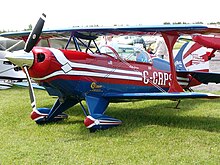
The third aircraft is slated to be a Pitts S-2B normally operated by Berz Flight Training (www.berzflighttraining.com) at Ray Community Airport west of New Haven. The Pitts is a taildragger like the Citabria and the Super Decathlon but, unlike the other two, it is a biplane that has two sets of wings – one on top and the other below. The Pitts is purpose-built for aerobatics, it can perform more extreme maneuvers, and it will serve as the advanced training platform beginning on the third day of the camp.


The Pitts Special is a light aerobatic biplane designed by Curtis Pitts. It has accumulated many competition wins since its first flight in 1944. The Pitts Special dominated world aerobatic competition in the 1960s and 1970s and, even today, remains a potent competition aircraft in the lower categories.
Specifically an S-2B is an Aerotek-built S-2A with a 260 hp (194 kW) Lycoming AEIO-540-D4A5 engine, and upper wing auxiliary fuel tank, the landing gear and upper wings were moved forward six inches; 196 built. The aircraft is out of production but is supported by Aviat Aircraft.


I found a YouTube video of Aerobatics in a Pitts S-2B to Pink Floyd's "Learning to Fly"


I've been joking about practicing for this Acrocamp by standing on my head. I think I might actually have to do it; couldn't hurt. We were told to read Basic Aerobatics by Geza Szurovy and Mike Goulian as homework. Maybe there will be tips in there that'll help... though I'm relatively sure you can't scream and throw up at the same time [I'm also sure which one will win out].

Saturday, March 20, 2010

I'm going to Camp. Acrocamp.

I've been alluding to some the many great things on the horizon for Girls With Wings, and one of those things is Acrocamp. Although admittedly I'm the only GWW going, this event is going to be made into a documentary featuring yours truly, the Executive Director of GWW. So any publicity arising from my upside down exploits benefits the organization, no?

I know... you're confused. In the words of Inigo Montoya, "Let me 'splain. No, there is too much. Let me sum up."

A couple of months ago I heard about a project a guy I had met at Sun n Fun was working on: Acrocamp. [I just love this name. It deserves to be said with the same kind of flair as Bond. James Bond. IMHO.] As it was announced, "Four pilots from different walks of life and around the country gather in Michigan in May or thereabouts to take over a Part 61 flight school for four days and fly aerobatics for the first time."

I was hoping I was a shoe in for several different reasons, not the least of which is that Steve Tupper, the man behind Acrocamp, has a beautiful daughter Ella who I also met last year in Sun n Fun. According to Dad, I am her second favorite person in the whole world - obviously the Girls With Wings tattoo made a great impression on her.

Steve also loves my sense of humor (which is a rare but admirable quality in a person) and thinks my enthusiasm will play well on the camera (I hope he feels the same way about my regurgitative abilities). Additionally, although I am a 5000 hr pilot, I have very little experience in small airplanes and other than my spin training for my initial fixed wing license - no aerobatic training.

A couple of definitions for you non-flyers. According to the FAA: a spin in a small airplane or glider is a controlled (recoverable) or uncontrolled (possibly unrecoverable) maneuver in which the airplane or glider descends in a helical path (shaped like a helix) while flying at an AOA (Angle of Attack) greater than the critical AOA. Spins result from aggravated stalls in either a slip or a skid.

Because that is such a convoluted definition, I'll give you the Wikipedia definition of a stall, which is a bit easier to understand. Stalls in fixed-wing flight are often experienced as a sudden reduction in lift as the pilot increases angle of attack and exceeds the critical angle of attack (which may be due to slowing down below stall speed in level flight).

And as long as I'm there:

Aerobatics is the practice of flying maneuvers involving aircraft attitudes that are not used in normal flight. Aerobatics are performed in airplanes and gliders for training, recreation, entertainment and sport. Most aerobatic maneuvers involve rotation of the aircraft about its longitudinal (roll) axis or lateral (pitch) axis. Other maneuvers, such as a spin, displace the aircraft about its vertical (yaw) axis. Aerobatic flying requires a broader set of piloting skills and exposes the aircraft to greater structural stress than for normal flight. In some countries, the pilot must wear a parachute when performing aerobatics.

I know, sounds like fun, right?

Well, heck, I'm not doing this for the fun of it. No, I'm doing this for three reasons.

1. I'm 41 years old and haven't lived life on the edge for a while (some might say dedicating yourself to running a nonprofit when furloughed from your job is pretty risky, however). I have been known to skydive, rappel, etc., but not for some time. This is a great way to get my hair to stand on end again (literally). This is the kind of stuff that keeps us young!

2. I'm scared. Oh, heck, yes, I'm scared. When I did my spin training referenced above for the first time I scuh-reeeamed the whole way. And not just the first time. I'm pretty sure my instructor and I were on our fourth iteration before I could calm my vocal cords (hyperventilation ceased to be an issue on the second). Of course, we did them until I could enter and recover on my own, but still. And as I referenced in my post about Going Flyin' I'm going to be a flight instructor to some folks that just might try to kill me. I need the confidence of knowing I can recover from any, ahem, unusual maneuvers the students might attempt.

Which leads me to 3. Promoting Girls With Wings. I want to be able to show people who are considering getting into aviation that even though I'm scared (did I mention I am afraid of heights, too? Most pilots are.), I'm going to do this anyway. GWW is all about inspiring girls to reach their full potential and I want people to know that even if they're scared they should give it a go anyway. You might not succeed, but at least you you gave it a shot.

I am hoping not to fail during my aerobatics training, but just in case, they assure me I'll have a parachute.

Friday, March 19, 2010

Women Fly (Guest Blog)


>

This Girls with Wings Guest Blog: Women Fly, comes from GWW Role Model and Scholarship winner, Kam!

On March 6, I attended Women Fly at The Museum of Flight in Seattle’s “annual special event for young women interested in aviation and aerospace careers. Girls are invited to participate in a day of motivational and career-oriented activities that will allow them to meet and learn from professional women working in a variety of flight-related careers.”

How the day works out:

Dozens of middle and high school aged girls spend the day at the museum first attending, hour long career oriented workshops in the morning. Topics range from Boeing Field tour, FAA accident investigation, to helicopters. Followed by a panel discussion, lunch with mentors, small career and college fair, and an optional tour of the museum.

Facets of Aviation:

This year’s theme is international women pilot. The capstone of the event was a 6 person panel discussion:

Michelle Bassanesi (Italy) – Bassanesi is the founder of Aviation and Women in Europe. Bassanesi is a flight instructor with experience flying paragliders, hang gliders and airplanes.

Kajuju Laiboni (Kenya) - Co -founder of Women Aviators in Africa

Refilwe Ledwaba (South Africa) – A co-founder of Women Aviators in Africa, in 2006 Ledwaba became the first black woman helicopter pilot for the South African Police Service Air Wing.

Harumi Sato (Japan) – Sato is a flight instructor and has flown as a commercial pilot in the United States and as an airline pilot in Japan.

Fran West (Australia) – West is the first woman pilot to circumnavigate mainland Australia in a light aircraft. She is also an author, photographer and motivational speaker.

Jennie Steldt (United States) – Capt. Steldt is a United States Air Force pilot who flew the first C-17 Globemaster airdrop on Antarctica.

Karina Miranda (Chile) - Lt. Miranda is the first woman to fly for the Chilean Air Force. (Karina was unable to attend due to difficulty leaving Chili after the recent earthquake.)

The panel included young women in their 20’s and 30’s at the beginning of their aviation life, which surprised me. A younger crowd was a refreshing change, most panels I’ve attended have participants with decades of experience. No offense to our “mature” mentors, I’m simply jazzed at concept that one does not need decades of flying experience before being valued enough to share wisdom. Student pilot Kajuju Laiboni hails from Kenya and South African Police Service helicopter pilot, Refilwe Ledwaba , showed much enthusiasm over the budding organization, Women Aviators in Africa. Learn more about them at www.wafric.org.

The panel represented a wide range of pilots, from general aviation to military, to civilian commercial pilot, displaying a colorful array of women aviators in various roles. I can tell you that as a teenager, I did not know that flying is available to anyone outside the military. Common misconception.

*As a side note, my opinion is that panel discussions should never exceed 4 guests, ideally there should be 3. With six people plus a moderator, even with abbreviated introductions, there left little time for individual questions. I would have loved to hear more about each pilot, 6 minutes each was not enough to explore such a distinguished group of women. Group dynamics naturally defaults to one or two vocal speakers who field all the incoming inquiries.

New Role for Me

As a past employee and continuing volunteer at The Museum of Flight, I’ve worn many hats at Women Fly through the last decade. Registration table staff, workshop facilitator, Xerox girl, “next slide, please” girl, you name it, I’ve done it. 2010 marks my first year as a mentor. Even as a student pilot, I have a way to give back to my community. I’m glad I didn’t fall into the thinking that I need to be “accomplished” before becoming a mentor.

During the lunch portion, girls and mentors are assigned to tables. My table had three mentors, two seven graders, one freshmen, two college students. It was awkward at first, trying to draw out reserve young women into conversation. It took a bit of work to break the ice, but eventually they opened up and our table stayed together well after lunch in deep conversation, giving guidance to the girls with their dreams. The general theme I felt from the middle and high school crowd was their strong drive and desire for science and aviation, but lack of direction in applying their energy. They all wanted to “do something” but don’t know how to start. We were able to point them to opportunities in Young Eagles, local internships, job shadows, and NASA programs. We shared an empowering day inspiring one another. I treasured my chance to assist girls who mirrored my younger self, passing on the words of encouragements that I received from members of my community.

I look forward to next year’s Women Fly when I can return as a certified private pilot (fingers crossed!) If you have a chance to attend Women Fly, I highly recommend it. Please see The Museum of Flight’s website for more information.

Picture of Kam with her daughter, India.

Wednesday, March 17, 2010

Gone Flyin'

Yesterday was another painfully beautiful day in Cleveland. I say "painful" because we Clevelanders are used to cold, gray, miserable weather [How miserable? We made #1 on Forbes Most Miserable City list. Go CLE!]. The sun forces us to come out from underneath our rocks, squinting at its brightness, delaying the evolutionary eventuality that we will soon breed offspring here with no eyes at all.

However, I have a friend with an airplane. [If you have not invested any time in doing the same, I suggest you block off time in your calendar to cultivate such a friendship.] She is studying for her CFI (Certified Flight Instructor) and is ready to take the test, but the poor weather, referenced above, keeps causing her to put it off. I also want to get my CFI, so I told her anytime she goes to fly to please call me so I can ride along.

I've received to invitations to drag myself away from my rock (which curiously resembles a desk) to fly with her in her (dad's) Mooney. It's parked on the other side of Cleveland at Cuyahoga County airport, the headquarters of my previous employer, Flight Options. The first time I drove out there to meet her I hadn't realized there was even another side to the field!

Again, my aviation background has been military to the airlines, so all of this GA (or General Aviation) flying is completely new to me. I had about 30 hours in a single engine airplane to transition from rotor to fixed wing aircraft with a few flights I had taken on my own in the interim. However, I do not consider myself a proficient GA pilot. But I'm working on changing that. To the left is the hangar where we've parked our cars after getting the airplane out.

My airplane of choice recently has been the Citation X (I mean, I would choose to fly the X if I hadn't been furloughed), the cockpit of which is pictured at right.

Compare and contrast to the cockpit of the Mooney, at left. It's hard to say which one looks more complicated. However, I am used to the X, so it is going "back to basics" to see the steam gauges on the Mooney. My friend Jenn let me sit left seat, the PIC (Pilot in Command) seat, for the first leg of the trip. It took me a long while to get my "crosscheck" back.

From PilotOutlook.com: Cross-checking, sometimes referred to as scanning, is the continuous and logical observation of instruments for attitude and performance information. In attitude instrument flying, an attitude is maintained by reference to the instruments, which produces the desired result in performance.

After I taxied the airplane out to the runway, Jenn handled all of the radios. I was concentrating on getting a feel for the airplane (note my death grip on the controls). Jenn allowed me to do the takeoff (while I'm sure sitting at the ready to take the controls if needed). This brings up an interesting point. I am a very experienced pilot, and though I may not be familiar with this airplane I am familiar with airplanes in general and know how they work (basically). I kept reminding myself that soon I will be allowing someone with no experience to fly (as a CFI). Just something to keep in mind. And to keep me up at night.

The takeoff was different than what I'm used to. Took us almost no runway, and the takeoff rotation speed of 71mph came really quickly. Leaving the ground was accompanied by a couple of burbles (the ones in the airplane were matched by the ones in my stomach - but I have a plan to fix that nervousness) and I had a heck of a time keeping my heading and desired airspeed. Jenn reassures me that the Mooney just wants to fly fast and it's my job to make it do what I want. This reminds me of occasions in my flight training where my training partner would complain the airplane wasn't doing as they wanted. Well, if it's not, make it. Who's in charge here?

We didn't fly too far away, in fact to an airport that I used to do training flights to in the Huey when I was in the National Guard. I, of course, wanted to fly the landing like I did in the jet. Wrong. Jenn kept warning me that my speed was too high. The principals in landing were the same, though, so I kept the greasy side down (Jenn handled all of the flaps, gear and power controls for me). It was all quite a blur, to be honest with you. I was glad to move into the backseat for the ride home.

On the way back, Jenn had a friend newer to flying at the controls. It was interesting to watch her play CFI. Each of us learned something from each other. I learned that a good reason to insist that people taxi at a reasonable speed (which I had always done additionally for passenger comfort) was the important safety factor of leaving yourself options if the brakes failed. There are often dropoffs at the end of the taxiways and if you're going too fast too make a turn you better be going fast enough to takeoff. I told her something that I had been taught. When you rotate the yoke to check the flight controls, your thumbs should be pointing in the direction of the "up" aileron.

So it was a rather quick re-introduction to single engine flying which has illustrated that although it will take some time for me to get back into it, I'm not a lost cause. My "cone of understanding" or the extraneous items that get included into my crosscheck, increased by the minute. I especially noticed this on the second flight yesterday. I had the presence of mind to bring reinforcements in the shape of a pillow to get my feet closer to the pedals. Remind me never to complain about how small the X cockpit is (if I ever get back into it).

This second time I asked a lot of questions because, as you may know, we women like to understand everything! What is carb heat? What's the reason for exercising the prop in that manner? My takeoff was smoother, I was more forceful on the controls to get the pitch attitude I needed on climbout. I still went off course a little - probably because I'm so used to having the autopilot do it for me, but I also held my altitude spot on, instead of holding twenty feet off my altitude like I did the first flight.

So a wonderful way to spend the rare sunny day in Cleveland. Still Jenn stated the mantra of all of us cave-dwelling Clevelanders: "I hate the sun." Only she was referring to how it got in her eyes during her maneuvers. Trust me, we'll take it over the clouds any day.