Thursday, January 21, 2010

Showing improvement

This morning I scored in the 90s (finally!) on my FOI practice exam. With a nod to all of you that have been sending me tips and advice, I have been cycling through emotions ranging from sheer terror at my ineptitude to a calm feeling of, like other achievements I have attained in my life, that I'll get there eventually....

All right, ineptitude may be too strong a word. I just know that I have a lot to do before I can (should) instruct students - after all, they're paying a rather sizable chunk of their hard earned money on their flight training. And then there's that whole, "screw up and die" factor in aviation. I want my students to fly safely, too.

I have been reminded that passing the writtens is more than memorizing the correct answers - there is a reason for this test and that is to check an instructor's comprehension of the concepts referred to in it. I guess that's why it's called the Fundamentals. Of. Instruction. I get it.

Another issue I'm dealing with is referred to in this question:

When a person has difficulty recalling facts after several years, this is known as

poor retention.
repression.
disuse.

I'm not sure, but don't show this question again
I'm sure, don't show this question again

The fundamentals of flight training that I received so many years ago have definitely gotten a little dusty. So yesterday, just for "fun," I started to take the Private Pilot written exam. Out of 54 questions, I got 36 correct. I know, I know, I shouldn't be bragging about that. But c'mon, that was walking into that completely cold!

Some of the topics were things I didn't think about any more, perhaps because of automation? The Flight Management System figures out the landing distance for the Citation X given various information about the aircraft and it is also printed on our dispatch release the company provides. I did get this one right, because we do need to know how to do it anyway (just in case the computer goes down).

One question about takeoff distance I got wrong because the number I got seemed so tiny. I just didn't trust myself.

Here's another question about a topic that I haven't had to deal with in ages - and even then it was only briefly. I was in a single engine airplane only to transition from helicopters to the King Air (a multi-engine turboprop)...

While cruising at 9,500 feet MSL, the fuel/air mixture is properly adjusted. What will occur if a descent to 4,500 feet MSL is made without readjusting the mixture? The fuel/air mixture may become excessively lean (I was right, but only because I guessed the longest answer - that's an insider's old trick, btw).

This one brought up an old memory.

Which would most likely result in hyperventilation?


The excessive consumption of alcohol.
An extremely slow rate of breathing and insufficient oxygen.
Emotional tension, anxiety, or fear.

I'm not sure, but don't show this question again
I'm sure, don't show this question again

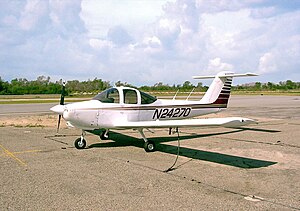
Although excessive consumption of alcohol was definitely present during my flight school training my first year in the army, the answer is emotional tension, anxiety, or fear. I was able to answer this one from experience, because that's exactly what I did when an instructor in the army took me out for spins in a Tomahawk (sometimes referred to as a traumahawk).

According to Wikipedia: The Tomahawk was Piper's attempt at creating an affordable two-place trainer. Before designing the aircraft, Piper widely surveyed flight instructors for their input into the design. Instructors requested a more spinnable aircraft for training purposes, since other two-place trainers such as the Cessna 150 or Cessna 152 were designed to spontaneously fly out of a spin. The Tomahawk's NASA[1] GA(W)-1 Whitcomb airfoil addresses this requirement by requiring specific pilot input in recovering from spins, thus allowing pilots to develop proficiency in dealing with spin recovery.

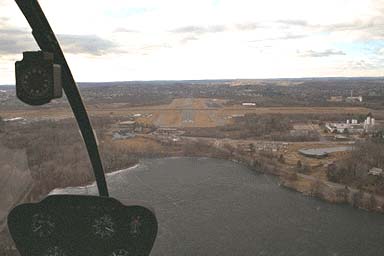
After the first spin, we leveled out and I could not catch my breath. Huh. Huh. Huh. My instructor (the one who used to chuckle if we messed up) said, "Lynda, c'mon breathe. Stick with me here."

Once I caught my breath, we did it again. Only a tiny bit of hyperventilating. Then again. No hyperventilating. Then again, and again, and again, until I could enter the spin and recover on my own with no interference from the instructor.

I am *really* looking forward to spins again.

Next post we'll talk more about the advice I've been getting. As always, comments are appreciated. Keep 'em coming!

Wednesday, January 20, 2010

Student Responsibilities

Ok, I have to tell on myself here. I've spent two days focusing attention on my Army instructors for their performance, but we students have a responsibility, as well, and that's to let our instructors know what's going on in our heads. This question brought back a memory...

Which statement is true regarding the achievement of an adequate standard of performance?

A flight instructor should devote major effort and attention to the continuous evaluation of student performance.

Flight instructors can affect a genuine improvement in the student/instructor relationship by not strictly enforcing standards.

Flight instructors fail to provide competent instruction when they permit students to partially learn an important item of knowledge or skill.

The answer is C. I thought about a concept in my primary training (the first phase of Initial Entry Rotary Wing - IERW) that I didn't grasp initially that haunted me in subsequent training. And I mean for a long while. Even to this day I can't remember what the name is for this technique, so any of you instructors out there are welcome to comment below with the correct name.

This integral knowledge that I never fully grasped was that concept of being able to see where you were going to touch down in the helicopter and maintain a constant angle of descent to it, achieving a stabilized approach. I remember it being explained to me that it was some kind of "cone of action" or movement or something or other.

The idea was that you were supposed to be able to look at your intended landing point ( end of a runway or section of a field, etc.) and see no movement at that particular point. However, everything around that point should be moving (albeit minimally). Things in front would be moving forward, things to the side should be moving farther out, and things behind should be moving backward. If you got this concept, which I hadn't, you would be able to maintain a constant descent angle through out your approach and landing, preventing you from under or over arcing from the straight line that could ideally be drawn from your point of initial descent to your touchdown point (possible action for under arcing= add power, over arcing = subtract). Pictures (and a more thorough explanation) at http://www.copters.com/pilot/na_picts_jpeg.html

Obviously, this is a purely visual maneuver and would take, for example, just small corrections in power if the target settings were hit straight off. But, if you (or me, in this case) never understood this concept, too large corrections would be made too late and increase the possibility that I talked about in my last post, where the instructor got back to the table and said, "you were too high on the first one, too slow on the second," etc., and never a stabilized approach would be achieved.

I was working way too hard trying to cover up my ignorance when I should have just admitted my confusion. I'm not sure when the light bulb went on in my head, but once it did, it solved a multitude of problems and let me focus on the real subject of the lesson at hand.

FoMI, pt. 2

This morning I did another iteration of the Fundamentals of Instruction exam. [And to answer your question, I am still far FAR from getting 100%.] When I read the question: "When an instructor critiques a student, it should always be..."

Unfortunately, the online test was being difficult and wouldn't let me easily copy the choices, so I'll just jump ahead and tell you that the answer was, in effect, to conduct the critique immediately following the lesson. One of the results of that experience with my first Army flight instructor I told you about last time is that I was switched to a new one after my original instructor went on vacation.

What led to this change? Because when I didn't have his presence in the left seat (the primary flight position in a helicopter is in the right, remember?) and an instructor over there who didn't scream at me, I did great. We flew with this substitute instructor pilot for a week and I not only caught up with everyone else, I exceeded the standard for that phase of instruction.

The day my instructor got back, I was supposed to FINALLY solo (in a helo that means you fly with your stick buddy in the other seat - technically not really alone), but the winds exceeded the limits. So Screamerman instructed me to fly back to our home airfield. I picked up to a hover, departed the traffic pattern, flew back to home station, made an approach, came to a hover, taxied onto the ramp, and set the huey down in a confined space and shut 'er down - without him saying a word. I will never forget the slack jawed look my instructor gave me, and the disbelieving praise he then offered.

The next day, however, as I had been conditioned, I flinched every time I knew I had done something wrong, even though the instructor wasn't (had promised not to) yell. Too late. Flinch, quake, fumble. Fail.

So, again, Marty the stick buddy to the rescue. I was too cowardly to "give up" and demand another instructor so he went to bat for me. Again, it was the Army. Tough it out, soldier! The funny thing was, the NEW instructor I was assigned had adopted a technique of not immediately offering a critique. He would remain silent the whole flight session until we returned to the table and then say, "You were too fast on the first approach, too high on the second, didn't put enough wind correction in on the third," etc. How useless was that information? Not only did I have no recollection of these individual approaches, it also wasn't allowing me to make the corrections when I could have seen the results! I eventually soloed, which it seemed I would never do, as you can see in the photo to the left.

What a struggle. Yet I made it through and learned a lot in the process. The instructors I had in later phases were just fine, but I probably still would have been reluctant to request a change. Doing so the second time might have labeled me a "troublemaker." Don't want to make those waves... Luckily, in the civilian world, you don't have to worry about that. It's your money, take charge of your training! Get what you pay for!

What else did I learn from my flight training? Not just how to be a pilot, but also some real world applications (which I will continue to share) for some of these concepts in the test.

Except for questions like this:

Affective domain relates to

O
attitudes, beliefs, and values.
knowledge.
physical skills.

I'm not sure, but don't show this question again
I'm sure, don't show this question again

You're darn tooting, I'm not sure. What in the world does this have to do with anything?!?

Tuesday, January 19, 2010

Fundamentals of MY Instruction

As I begin studying for my CFI written, I am reminded of my experiences with my own training to be a pilot. I dreamily read the Fundamentals of Instruction (FOI), a 193 question test that I must complete before the flying portion of the training. I imagined myself guiding my students to great heights and achievements as I molded their willing minds. And then I took a practice test on www.webexams.com. I scored a 74 out of 100. Well, ok, I can't expect to be perfect first time around. So I took it again today. 72 out of 100. Either I'm regressing or I'm hungry. I'll take the second option, as I have learned from the FOI that students must have their basic needs met first and I really need to go get some groceries.

Anywho, I read with interest question #99: A communicator's words cannot communicate the desired meaning to another person unless the
a. words give the meaning that is in the mind of the receiver.
b. listener or reader has had some experience with the objects or concepts to which these words refer.
c. words have meaningful referents.
Any guesses? I'd rule out the one with the word "referents." I've never even heard of that word before. And if the receiver already had the meaning in their mind, they wouldn't need an instructor, would they? So that leaves b, which is pretty obvious anyway.

This reminded me of my flight training days back in the Army. My instructor (a Vietnam vet, now Department of the Army civilian) was a screamer who was not satisfied unless I left the helicopter crying (I'm pretty sure the FOI would say this would have been needed to be stated in the learning objectives, but I digress).

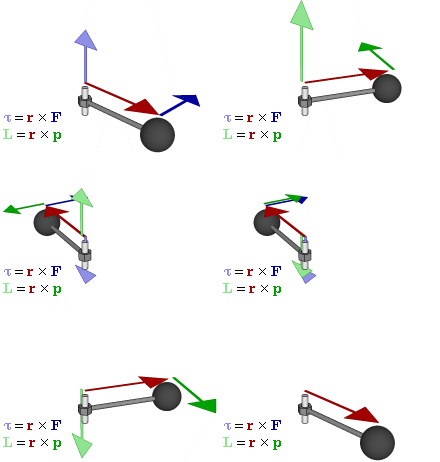
The briefing table was not much better. The prebrief consisted of introducing new concepts of rotary wing flight that we would see demonstrated in the Huey. Sounds fair, right? I still remember one day that we sat down at the table and first thing my instructor says to me totally out of the blue, "A pound of torque equals five knots or 100 feet per minute." I stare back blankly. So he says it again. "A Pound Of Torque Equals Five Knots Or 100 Feet Per Minute." I got nothing. So he asks my stick buddy (as we called my training partner in those days - love ya, Marty, wherever you are), "do you understand me?" "Yes," says Marty, "but I majored in Aeronautical Engineering (or something similar)." [I can only assume my degree in History is why the question was directed toward me in the first place.] Screamerman wasn't listening. So, again, he repeats, "A POUND OF TORQUE EQUALS FIVE KNOTS OR 100 FEET PER MINUTE." This time so the whole room could hear how much trouble he was having getting through to me. [visual aid (the use of which is highly stressed in the FOI) from http://en.wikipedia.org/wiki/Torque]

I finally said to him something to the effect of "You know, you could be speaking Greek for all the sense those words are making to me. And saying it louder is certainly not going to make it any more clear." There was probably a sniff in there too. Then, and only then, did he explain that the power applied to the main rotor was measured in pounds of torque (force rotating around an axis) and an increase in this force could either manifest itself as an increase in airspeed (measured in knots) or a climb (in feet per minute). Or something like that.

Now. Wasn't that easier? Less hostile? Much more effective?

The good thing is that I made it through flight training. Yes, I struggled with the basics, but by the time we were in the practical application phase (Basic Combat Skills) I had no worries whatsoever. The residual effect of this method of training, though (yeah, I know, it WAS the Army), was that when I messed up in the helicopter, I would scream at myself. My first airplane instructor (also ex-military) chuckled every time we students messed up. Laid back, calm, constructively criticizing. I much prefer the latter, wouldn't you? My students won't have to choose; I don't have much of a voice for screaming anyway.

Sunday, January 03, 2010

Furlough is now official.

I started this blog entry on what was officially my last day as a pilot with NetJets. I know that I used that designation a couple of times, but I previously was referring to my last day flying with them, then the last day of my tour, then January 16th, which was my official furlough day (I will have another 'last day' - that day that my pay and benefits end).

This has been a rough time. I've never been furloughed before so I am wading through a bunch of paperwork - trying to figure out all of the ins and outs of "pausing" employment, like getting my vacation days and PTO (personal time off) paid, filing my last expense report, updating my standing bid and contact information (when we get recalled I only have 7 days to respond - don't want "undeliverable mail") and sending my stuff (like my crackberry and ID) back to the company. Sunday I registered for Ohio's unemployment benefits - surprisingly a not too difficult task. I only wish that my unemployment check would exceed the amount of my mortgage - government doesn't want us to get too comfortable sitting on the couch eating bon-bons I guess.

That being said, I am so lucky in that I am being furloughed instead of my company going out of business. If they had, I would not have access to COBRA, which will allow me to continue medical and dental benefits during this time and I would not have the job to look forward to going back to. Any pilot will tell you, now is not a good time to be looking for a flying position, so I expect to be able to have quite a bit of time working on Girls With Wings -- and there is a lot to do!

One of the projects I am working on in this new venture with Girls With Wings as a non profit is to gain tax exempt status with the IRS. This is the infamous 501(c)(3) status will allow tax deductible contributions to the organization.

But just like any IRS form, it is long and convoluted. I am having to answer questions like: "Have you ever or will you ever, act, think, or plan to do any of the following activities or anything resembling such actions as it pertains to a past, present, or future endeavor your organization undertakes or is even remotely considering participation? If so, who will be responsible for these events and in which way are they qualified? Include any publicity methods and materials along with the specific criteria under which you will take part in said activities...." Or something quite similar to that. Sheesh. They do not make it easy. But then again, no one wants a impostor organization skimming funds for vacations to Europe, either. I would love to hand this off to my assistant, but.... I don't have one. [Applications for this unpaid position are being gratefully accepted.]

Another top priority? Getting my CFI/CFII/MEI. More on that next time...

Saturday, January 02, 2010

Should that be "Life on the ROPES as a Pilot?"

For those readers of this blog that haven't heard yet: I am going to be furloughed this month from NetJets. Boo. I am completely bummed about this because I do believe that NetJets is about the best flying job out there to be found (and I've been a military, commercial airline and fractional pilot). However, in addition to working my 7 day tours earning my living, Girls With Wings (which sucks that salary back out again) has always kept me so busy on my days "off" that after 7 days at home I was ready to go back to "work" flying my beloved Citation X.

Frankly, I'm pooped.

In a way this furlough is very timely. There is so much potential with Girls With Wings - now a non profit organization officially (though it hasn't made a dime in its six years anyway) with 501(c)(3) status pending (or at least whenever I can finish that bleeping IRS paperwork) that I can finally take advantage of!

And so, as of mid January, I will be shaking the trees to find sources of revenue for Girls With Wings in the form of grants, sponsorships and donations so I can pursue the many many ideas for GWW. Meanwhile, I have to also be covering my mortgage because very few people will give money to homeless people. I mean, they do... but panhandling has never been my forte.

And though I could try to find another job and still work on GWW in my spare time, I just don't see my being able to grow the organization - as the situation seems to demand. Already I think people may be getting frustrated with thinking about the mission of Girls With Wings: "using women in aviation to inspire girls to achieve their full potential," and think yeah, but HOW are you doing that? I know I do. So many ideas; so little time.

Already I have had some amazing women(and men) raise their hands to help out. Folks are compiling events for the Penelope Pilot Project and resources for the presentations, asking for scholarship donations, creating informational multi-media materials, writing for the new Penelope's Page, etc. I know people out there want to assist me in our mission, but it takes time for me to get them into a position to be able to do so. Hours that right now I don't have.

So, what am I going to do to keep Mr. Ci T. Mortgage off my case? Start flight instructing. Yeah, I know, I know. There's, like, NO money in instructing. Plus, you're talking to (or reading about) a woman who went right into the Army's Flight School and flew helos and King Airs for seven years. Then went right into the regional airlines flying Beech 1900s and then got jet jobs with Flight Options and NetJets. So even though I have approximately 5000hrs (time to update my logbook, I should think), I have barely any single engine time. And even less flying around the pattern, flight following, VFR cross-country time. Which is what I'm going to be instructing in. Ha.

I am a curious case for sure. Most people get their basic certificates: private, instrument, commercial, and then instruct til they can get an airline job. I've had the airline job, now I have to turn around and get training as a student pilot. No kidding. How in the heck am I going to land an airplane that can't fly as fast as the speed my current airplane lands at? Chandelles? Lazy 8s? Uh... what?

p.s. am totally NOT looking forward to spins again.

Luckily I met up today with a highly recommended local instructor who is willing to take on the challenge of teaching me. He also, strangely enough, has more confidence in me than I think healthy at this point. He has told me what to study and what written tests to take first. Then we'll start the flying portion in order to become a CFI: Certified Flight Instructor, CFII, a CFI that can train students in instruments, and MEI: a multi engine airplane instructor.

I am really excited at the prospect of being an instructor. I don't know how many students are available out there right now, but I think I will bring an unusual perspective to the syllabus. As a pilot who has been out there in the real world flying a variety of missions, I hope to be able to impart some insight to my students. And, truth be told, I'm a little rusty on some of the fundamentals. I could use a little refresher myself. And there's no better way to learn than to teach.

I'm sure some of you reading this are a bit confused by some of the terminology I have used. My goal is to bring you along as I go through my training so you will know by the time I get signed off. [Especially since I won't have stories of my jet-setting lifestyle for SOME time to come.] Then I can share my experiences of flight instructing, too. My deadline is set for May. That's a little vague, but I've got to figure out exactly how much I will be on the road the next few months to fit in the flight portions. I think May is completely reasonable to complete all my ratings. First I have to start studying for the writtens.

I'm also looking into ways to fund this training, which will probably cost about $2000. Some of my options appear to be 1. GI benefits (which I kinda think I'm not eligible for anymore) 2. State Unemployment Funds (I understand Ohio is not too willing to pay for pilot training since, obviously, aviation is not exactly a "growth industry" these days) 3. Sponsorship (from companies and organizations willing to do a little cross-promoting of getting more women interested in pursuing flight lessons).

If you're intrigued with any of this, please leave your comments, questions and suggestions on the blog. I would love to hear them because I would like to know what you'd like to hear about as well.

2010 is going to be great. Happy New Year!

Friday, January 01, 2010

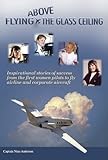
Flying Above the Glass Ceiling - A book review

I was asked to read the book Flying Above the Glass Ceiling and give the author my comments. I always feel under such pressure to do this (what to say if I don't like it?), especially since I'm writing my own book and know that you just can't please everyone. If I'm willing to blog about it, my feelings about the book must be ones I would like to pass along...

Captain Nina Anderson has compiled a book about the women in aviation between the era of the WASP up to the present day. The WASP were amazing in supporting the war effort in WWII but their efforts did not achieve full equality with their male counterparts though they did many of the same jobs - especially since they were only offered jobs as flight attendants instead of pilots by a major airline after they were disbanded by the government. If you don't know the history of the WASP. Stop Reading. This. Now. and proceed to Wikipedia to learn about these amazing women. Then come back. We'll wait.

Ok, so we now know it took thirty three years for these women to get official recognition for their efforts, so there were many years leading up to 1977 - and after - for women to gain acceptance as pilots and equals (some would say we're still waiting...). It was only just last year that the WASP received awards for their military service! But there has been and are so many other aviation careers available - and rarely do we hear stories of the first female major airline pilots, corporate pilots, aeronautical engineers, air traffic controllers, etc., and examples of their struggles to be able to get their turn at the controls.

Well, here, after a nod to the women who blazed the trail before them, is a book that talks about those women who punched through the glass ceiling that the WASP and others in the past could only crack. And Flying Above the Glass Ceiling tells their stories with all the facts - some of them a bit harsher than others. It could not have been easy to be a fully qualified (perhaps even over-qualified) female applicant and told that you weren't going to be hired for the job because there were no bathroom facilities appropriate for the "fairer sex." Or that the wives of the other pilots would be threatened by a woman working so closely with their husbands. Or laughed at as a child when voicing dreams of going into space. Luckily legislation has made some of this, at least, illegal. You'll have to read the book to hear get the stories about ridiculous treatment from the general public.

I found myself inspired by many of their stories. I remember the day in the Army Flight School when a senior officer said to me, "You know the only reason you're here is because you're a female." The wind left my sails with an audible whoosh (though that could have been the lungful of air that escaped when that verbal punch hit my gut). Here I had thought I had gotten there (and stayed there - seemed like a lot of folks wanted to wash me out) through all of the hard work I was putting into my classes.

Although I feel I had a bit of a struggle in my becoming and being a pilot, it was nothing compared to women being outright criticized and rejected merely because of their gender. I appreciate the honesty of the women in this book who share their stories and their frustrations of being hired only to be the only pilot in their flight department not able to do ________, since a woman's place was _______. [This was kind of a recurring theme, feel free to choose your own words to fill in the blank.] It is also an underlying message in all of the stories that everyone is responsible for creating her own success.

Just in case you think this might be a call to burn your bra and scream out an anti man tirade, it is far from it. A couple of the women even submit opinions such as "women who seem to attract harassment or discrimination expect it." I can't agree with this generalization, though I will offer that none of the chapters relate only negative experiences. The contributing authors also share moments where they had people offering an incredible level of support (made more obvious in the midst of some who only liked having female pilots around to hit on). The most important thing we current women in aviation can do is to mentor our successors and offer our support to those following in our footsteps in what is still, obviously and unarguably, a male dominated profession. Ignoring this fact does not make it go away. Encouraging more women into aviation so they can be successful there will achieve the equal acceptance women seek.

I believe this book helps with that goal because it gives wonderful insight into the career progression of all of the women so that people unfamiliar with the different ways of "building time" in a career in aviation will learn about various routes to achieve their goals - whatever they might be. The book closes with some well worded, well deserved tips on being a respected professional in the aviation world (some unfortunately need a little reminding). But mostly it allows us to know the women who wore our shoes first; and though the styles have changed the lessons still apply today. Their frustrations, motivations and inspiration and why they continued to fly against headwinds no matter how strong and gusty because they wanted their dreams to take flight.

If you like what I had to say and would like your purchase of the book to result in a donation to Girls With Wings from Amazon.com click here.

Thursday, December 03, 2009

Part 3 of Changing Gender Stereotypes

Seriously, I receive some of the most wonderful emails. I just have to share this one with you because I think it is a great example to balance out the previous posts about perceived gender differences and attitudes in the cockpit. As I have said before, I have some personal experiences with some of the best male co-pilots ever and then some not so nice. Even the younger guys who you would expect to be more "enlightened" can be a woman's worst critic (just ask the guy trying to get into an airline's new hire class and hear his complaint about how "that one woman" took his spot - ignoring the other larger number of male pilots who beat him out). To have an older guy 1. show this kind of insight and fairness and 2. take the time to write me about it, is pretty darn cool in my book, er, ...uh, blog.

(I only did a slight bit of editing punctuation-wise.)

Lynda

I have followed you and GWW for over a year and really enjoyed your efforts and the blog stories.

I read with interest your latest comments on the Gender thing and females in the cockpit or for that matter, even on the airport, as anything but the "Gal behind the desk."

Having been around the patch a few times in aviation and, yes, from the old school of many moons ago, the changes for women have been a hard fought road in aviation. I am from the days of being in the cockpit and hearing a female voice on center freq and all the comments from the guys about, "another empty kitchen." I have flown with female FO's and have found over all that they are on the same line, ability wise, as the males that hold down the seat cushion in the right seat. Pilots are people and it does not make any difference to the airplane if it is being flown by a guy or a gal. I have had one female F/O that was not worth a hoot but I have had several males that were even worse. Yet I have flown with female pilots that were way above average. So what does it come down tooooo....ATTITUDE!!!

I know what it is like to get a phone call at night and listen to a friend that is an A&P and working as a line mechanic at a very well known LARGE flight school in Florida and listen, console, give advice, and yes, even say "Hang in there," after she went through a day of "girls should not bend wrenches." But on the same side I have had the call from her the first time she was getting ready to fly her first IFR night flight by herself and she just wanted to hear someone say...."the airplane does not know if it is day, night, VFR, or IFR so just get in and fly it." That same person also called on the day she was to take her ATP and Dash 8-400 sim check and we spent 30 minutes on the phone as she paced the parking lot before the check ride. But 3 hours later I got the call that made my day. "Well, they took away my instrument rating". And you know what that means on the ATP checkride.


[An ATP, or Airline Transport Pilot rating, is more advanced than an instrument rating. It's like saying you have your doctorate; you don't need to also say you have your master's degree. It's understood.]

I am 110% for anyone that wants to make aviation their choice, male or female. You're right that attitudes do change and as you know it takes time for some changes. I worked for a cargo airline that had the first all female flight crew on a L-382, (civil version of the C-130), and we also had two female 707 captains.

Just want to add that I think what you are doing is a labor of both love for aviation and also for the younger girls that want to experience what we have both seen and done in airplanes.

Keep up the good work and maybe sometime we will be on the same ramp somewhere and get to meet.

Walt.


...Could not have said it better myself! Thanks, Walt, and everyone else for keeping the discussion balanced and on-going.

Thursday, November 12, 2009

Part 2 of Changing gender stereotypes

Recently I posted a blog entry on Changing gender stereotype, like, 50, 100 years at a time... about a couple of news articles about women in aviation and aerospace that had negative comments published by readers. I then followed with a recap of a conversation I had with an old salt flight instructor that prompted a reader to send me the following message:

I sure hope things are not as bad as you say. My 10 year old daughter is really eager to fly. I'm just an amateur at this flying thing (instrument rated, with maybe 600 hours over too many years).

It would be cruel to see her interest squashed by this sort of stupidity. I often point out all the female voices on the air when we fly.

She's practically counting the days before she can start glider training at age 14.

Let me emphasize, Dad, that "things" are not that bad (and I didn't SAY those things, just quoted them). Some people's perceptions of a woman on the flight deck may be horribly misguided, but this "flying thing" is awesome, incredible, fascinating and something I wouldn't give up in a million years no matter how many stories I could tell you about some Neanderthal who tried to ruin it for me. As a fellow Army helicopter pilot and I discussed not too long ago (ok, maybe in the last decade), I can't believe we women pilots are still considered "pioneers" in aviation. [And my friend is female AND African American.] Instead of being "squashed" by people's ignorance, the journey has made me stronger, more outgoing, more fulfilled and definitely into the person I am today (and I kinda like the way she turned out after all). Girls With Wings would have certainly never come about if I had thought it was going to be easy, just like I would have never become a pilot unless the career track hadn't been presented as a challenge.

As I have said countless times before, nothing of any value in life comes easily. Our male counterparts will tell your daughter, as I'm sure you have, that this flying thing itself is tough regardless of your gender! Yes, you throw in a few knuckleheads who think every woman should have a safety pilot at the controls at all times, but I dare anyone to say that to Nicole Malachowski, the first female Thunderbird pilot, or Jill "Raggz" Long, a military airshow pilot, both one of many women in aviation role models on the Girls With Wings website. Especially if he's the one sitting in the other seat. Without the benefit of holding a sick sack. None of the women on the GWW website have had their interest squashed by someone else's stupidity. I hope those women who have been turned away from aviation have found their passion elsewhere or have been able to resume their dreams of flight.

I believe the attitude of male pilots toward women performing duties in the cockpit could be drawn in a bell curve. There are always those few on one end that can barely contain their contempt for a woman with a pilot's license (or driver's license for that matter) or those on the opposite end to whom it truly doesn't matter what gender their co-pilot is (heck, they may even prefer a female in the other seat). The vast majority of men are somewhere in the middle. Some give a woman the benefit of the doubt, let her "prove her skills" as it were, before she is accepted as a full fledged crewmember, or they might be super critical of every mistake she makes (while ignoring his own) which just encourages her to make more in her self consciousness and prove their unspoken opinion that women make "lesser" pilots. [Trust me when I say I am not the only pilot that sometimes feels judged under this modified standard.] That gender would take precedence over skills, and even factor into the dynamics of perhaps sticking two people who may have never met into a technologically advanced airframe to climb thousands of feet into the air and hurtle at great speeds to a long stretch of concrete hours later on the other side of the country is a issue I hope will evolve in the next few, uh, decades, to where the female isn't subconsciously considered the inferior pilot. But there it is.

So I am still doing this pilot thing after 16 years. Why? Because I love it. Because there is no other way for me to get the same joy I get from accelerating down a runway for takeoff and piercing the big blue sky. I especially love making a turn-out over the airport that I just took off from, but I am now looking down at it over one MILE in the sky. Suh-wheet!

Being a pilot has allowed me to meet some of the most incredible people because of my involvement in aviation. Yes, my fellow women aviation enthusiasts, who always comment how they love to get together with other female pilots to bond by sharing their stories of trials and successes that their other girl friends just don't get. But I have also met some amazing men in aviation who have shown such support to me on a personal level, as their first officer or captain, or for Girls With Wings as a volunteer organization that they can get behind. There are too many to name, but it includes Don, who did so much getting together our GWW training day at Rhinebeck Aerodrome, Keith from Jones Dykestra and Associates, guys I have met on myTransponder.com, Dave and all the folks from Twitter, my 400+ friends on Facebook, companies like ForeFlight, oh, and last but definitely not least, my father, who has been cheering me on from day 1 and who, well, happens to be a man. Any of these people may be assisting behind the scenes or making contributions to our scholarship and other GWW projects. But most of all, a HUGE portion of the emails I get, the folks that come to talk to me in the booth, stay after the presentations to talk, call me to ask how they can get their daughters (or sisters or mothers!) more interested in aviation, are MEN.

So, hopefully I will be dispelling any residual perception of my own stereotyping of men. I try to reserve judgment until I find out the other person's point of view. And that pathetic guy who said he wouldn't "give this silver-spooned neophyte the least consideration for single pilot IFR ops?" I would not waste my time trying to open his closed little mind. "If ignorance is indeed bliss, it is a very low grade of the article." -Tehyi Hsieh Chinese Epigrams Inside Out and Proverbs. I've got more important things to do. Like some simulator flying to study for. So I can go fly again.

So please don't let my discussion of the unfortunate and minor negative realities of this occupation deter your daughter or your support of her reaching her dream. I look forward to talking to your daughter (and you) on the radio soon!

Saturday, November 07, 2009

Changing gender stereotype, like, 50, 100 years at a time...

Sometimes things just BEG for a blog entry...

A Girls With Wings Role Model, Kristine, tweeted this question: "how do guys really feel about female pilots? are we inferior? apparently my entire human factors class thinks so."

Of course my initial reaction was "lemme at 'em!" I've been around too long and talked to too many people, from students, full-fledged pilots to instructors to know that is not the case. Men and women have their different strengths, but it would be awfully hard to prove that one gender is better than the other at flying. Men certainly have been logging a lot more time overall.

It's sparked quite a bit of discussion on twitter and on facebook, where people have been sending and posting links to me about a story about "Pilot wants to inspire other young women."

Malvika Matharoo, 24, is Earhart's heir. A native of Punjab, India, she grew up in the Middle Eastern nation Oman. Matharoo studied aviation at the University of North Dakota and moved to California in December 2007. She lives in Petaluma and works for North Coast Air in Santa Rosa. Read more: http://www.sfgate.com/cgi-bin/article.cgi?f=/c/a/2009/11/08/DD631AFTSK.DTL#ixzz0WUj3miHc

She says, "I just started a program called "Take to the Sky," with North Coast Air and Valley of the Moon Teen Center in Sonoma. It's a flight program where I'm trying to encourage young women to pursue their dreams, hopefully in aviation. To say, "You can do it. I've done it.""

Unfortunately, the first comment on the news story was the following:

"Just inspiring.

We're still rolling on the floor laughing at this one! It is really nice that Daddy BigBucks could finance her flight training to get into an industry where there are NO JOBS available - but as long as she's "pursuing her dreams of being a role model" I suppose it's fine.

I like the opart about your "flight" starting 24 hours ahead of time. So much for on-demand charter operations I guess. Hopefully (if she's lucky enough to land a real flying job the annoying naivete will give way to reality - but i hire anywhere from 10 to 20 pilots a year - and i can assure you I wouldn't give this silver-spooned neophyte the least consideration for single pilot IFR ops.

I'm sure she'll do well in the right seat of a regional airline as long as some guy is sitting beside her telling her what to do. But let's keep the accolades to a rational level please!" (my italics)
I didn't see the part in the story that talked about her silver spoon. I did see where she "even [flew] in temperatures of minus 45 degrees with wind chill." Blech. And did she earn a pilot's license or a co-pilot's license, mister? Who are you to judge?

Of course we women pilots know this attitude is out there. The husband of my best friend, a pilot on furlough from a major airline, currently flies for a major cargo carrier. He has told us both that no matter how bad the things that have been said to our face are, they are nothing compared to what is said behind our backs. *Sigh* [This of course, does not take away ANYTHING from all of those great, supportive, talented male aviation contemporaries (a necessary disclaimer). You know who you are.]

The article, which starts, "Women had the "right stuff," too, back in the '60s. But the data on their performance tests were buried in the Mad Men era, and it was two decades before there was an American female astronaut," talks of "the "Mercury 13" members of the private Woman in Space Program of the early 1960s did about as well as, or better than, male candidates identically tested." Read it here: http://www.usatoday.com/tech/science/space/2009-10-14-astronauts-women_N.htm?csp=usat.me

But also read THOSE comments if you can. There's 156 of them! For example:

citizen99 (0 friends, send message) wrote: 5m ago
The best way to explore space is with Women and Men as co-astronaut crews. That way the women can bake the pies and the men can eat them. The same way it has worked on earth for centuries. Women can do the dishes and the men can put them away, if they are not too busy with their experiments and flying the space ship.

Or: AngryRepublican2 (10 friends, send message) wrote: 1h 37m ago
More radical, socialist / feminist propaganda to make us feel "guilty." Frankly, I doubt the accuracy of these studies. Unless there was some double blind testing, I suspect bias. Second, the studies do not seem to measure temperament. And let's be realistic here: men and women are different. Men are much better at making command decisions -- yes / no in two seconds in an emergency. Women are more deliberative. They like to mull over an issue, consider all the angles. That may be good in household management (should little Jimmy wear his rain slicker today?) or social work, but not when you are hurtling through space at 36,000 MPH and something goes wrong as in Apollo 13. This is why you see so few women CEOs. So few race car drivers. So few pilots. They are not wired for quick reactions.

Of course one guy had to write: The only female astronaut that I can think of just now, is that crazy one that drove cross-country wearing a diaper so she could assault a romantic rival.

...and then I just couldn't read any more. Well, one more, to be fair. Andrewnbham wrote:
"Sure, its possible the neanderthal bigots on this blog are right, without 'double blind' studies as some mention we can't be certain about the qualifications of women compared to men for anything (including being a housewife).

Its also possible that those bigots are just demonstrating the effects of centuries (millenia really) of socialization that taught them to feel the way they do, with no basis in fact for their opinions. There is NO objective, scientific evidence that women are any less able to do virtually anythnig men can do, and frequently do it as well or better. There IS centuries of ingrained prejudice and stereotypes passed down through generations very much alive today (as evidenced by this blog)."

Which brings me full circle back to the reason for this post. Last week was the AOPA Summit. Girls With Wings had a booth, and was assisted by Sara, shown at left, and Mikel, to whom I owe many thanks for their help! It is always so great meeting people face to face, as I talk about often at Oshkosh, to get their feedback on the GWW organization and whether they "agree" with our mission of encouraging more girls to have an interest in aviation.

For example, I had an insightful conversation with a visitor to the GWW booth at AOPA. The older gentleman reluctantly accepted a brochure that we present with the explanation that Girls With Wings is a volunteer organization that uses women in aviation as role models to inspire girls to achieve their full potential. And that we sell items at the booth to raise funds for our outreach efforts, such as the website, our presentations to girls groups, and the annual scholarship. He read the brochure and the part about "6% of pilots are women."

He says to me, "that number seems to be increasing." To which I say, "Yes, 12% of student pilots are women." And just in case he thought I was making those numbers up, "those statistics come from the FAA."

"Well," he says, "I've been seeing more women in the cockpits of regional airlines." (Clearly, since they're just finally starting to filter in enmasse to such professional careers.) But I say, "I've been a military, commercial, and private airline pilot for 16 years and only flown with another woman pilot 4 times."

He tells me he has trained 11-12 women pilots so I ask him how long he's been a flight instructor. He says proudly, "For about 40 years." I ask, "How many male pilots have you trained in that time?" and he says, rather boastfully, "Oh, thousands." I return, "Then, percentage-wise, that's still not very women pilots overall, is it?"

Although a dim light dawns, he just has to get the last word in. "It's not going to happen overnight, you know."

To which I reply, "No it's taken over a 100 years, and we're still working on it."

See a video about Girls With Wings at the AOPA Summit:


http://www.youtube.com/watch?v=McvpS3IoBBo

Saturday, October 03, 2009

Wind Gusts

I haven't posted a long while just about flying stuff. So I've got some things I'd like to tell you about that happened yesterday. Last night we landed the Citation X in South Dakota after taking off from Sun Valley, Idaho, which is a trip of nearly 500 miles straight east. We were doing a "repo" or a reposition leg (this is opposed to a "repossession" - economy isn't that bad yet!) for today's trips with passengers. We flew directly over the Black Hills National Forest. The scenery I enjoy outside of my "office" windows is some of the most amazing ever and it's one of the biggest reasons I enjoy my job as a pilot. The name "Black Hills" comes from the Lakota words Paha Sapa, which mean "hills that are black." Seen from a distance, these pine-covered hills, rising several thousand feet above the surrounding prairie, appear black.

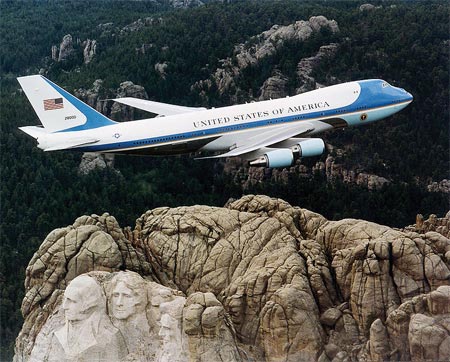
Unfortunately, one of the realities of flying at altitude over famous landmarks is that they just don't quite have the same impact as from the ground. The air traffic controller that was vectoring us around to the airport (I think) was kind enough to bring us close to a very famous location. Unfortunately, he brought us right over the top of this site, Mt Rushmore, so we were unable to see any of it. The picture on the left is obviously not what I fly, and it appears to have been photoshopped. The perspective just doesn't make sense! Check out the official website at http://www.nps.gov/moru/index.htm

Anyway, after we finished our scenic tour it was time to make our long anticipated approach into Rapid City. The reason there was some anticipation was because of this METAR: KRAP 021952Z 32035G42KT 10SM CLR 12/M06 A2988 RMK AO2 PK WND 33048/1926 Translated, this means on October 2nd at 1952Z(Zulu) the winds were out of the northwest (320 degrees) at 35knots, gusting to 42kts. Later in the weather report it says, PK WND (peak wind) 48kts at 1926Z. As a comparison here is a conversion for the equivalent miles per hour:
35
Knots
=
40.3
MPH
40
Knots
=
46.1
MPH
45
Knots
=
51.8
MPH
50
Knots
=
57.6
MPH

What does that really mean? Well, according to the Beaufort Scale:
32 - 38 Moderate gale whole trees in motion; inconvenience in walking against wind
39 - 46 Fresh gale breaks twigs off trees; generally impedes progress
47 - 54 Strong gale slight structural damage occurs; chimney pots and slates removed

So the captain and I discussed the weather before we left Idaho. Although I've been flying the X for a year and a half, the CPT has been flying it for seven. He gave me the option of flying the leg, but we figured that the gusty winds could cause some difficulties as far as the landing would go. It's not that we didn't think I could handle it, but IF something were to happen, it'd be pretty awkward trying to explain why we didn't have the more experienced crewmember on the controls. Especially with all of the bad press the aviation industry is getting lately.

Luckily the winds were right down the runway and turned out to not be an issue. It was kind of funny seeing less than 100kts of groundspeed in a X, and seeing traffic on the highway below almost matching our speed! Once we landed, we had more of a battle packing up the airplane and getting into the van without being blown over! In the van a fellow passenger (not a pilot) asked us if we had to learn to land faster in such high winds. Actually, we explained, that airplanes land INTO the wind, so actually we were landing more slowly. Our low ground speed was our airspeed (about 130kts) - the wind speed (30kts) = 100kts. The airplane doesn't fly in relation to the speed over the ground, however, but the relative speed with which is moving through the air.

From the van I took this picture of a helicopter whose blades were just going crazy with the wind blowing. This is a Sikorsky 58T, a military helicopter originally designed for service in the anti-submarine warfare (ASW) role. It is now often used in construction, like Desiree does and blogs about in The Adventures of Chopper Chick! Not also does Desiree support Girls With Wings but she has also received great publicity for all of the amazing things she's done flying helicopters in many different capacities. p.s. I also love that "Chopper" also refers to her having a motorcycle, which I do as well!

Saturday, September 26, 2009

Getting the word out!

We at Girls With Wings have had so many great opportunities lately to reach out to more people with our mission using aviation to entertain and educate girls about their limitless opportunities for personal growth. For example, we attended the Cleveland Women's Show so that we could talk to folks with little or no experience in the aviation world. It was certainly an educational experience. Usually we are talking to aviation enthusiasts when we attend Oshkosh or Women in Aviation conferences or the like. If you're in aviation, you know we need to attract more people into aviation, and girls in particular. But put a sign up at a Women's Show and you get a lot of "Girls With Wings? (some people even read Girls With WIGS!) What is that??"

So we at the booth had to be a bit aggressive about reaching out to women passing by. In fact, I have gotten a little spoiled by the enthusiasm with which people come to US at Oshkosh. I learned very quickly that the purpose of our booth was going to require a bit of explanation. After the first day, I decided that we would wear our pilots' uniforms (those of us who had them) in the booth so we'd grab attention. And I put up some self made signs that explained that "We inspire girls to achieve their full potential." We had hoped to do some fund-raising here, but it seemed we needed the real estate for better causes than the t-shirt display behind us. A white tri-fold board was placed up on top of the table behind Abby, Courtney, me and Nancy so that people could see the pictures of Girls With Wings representatives doing presentations. And so people started asking us questions and we were able to do what we needed: reach out to the community so we could find more opportunities for outreach with our presentations and website. It offered great insight on how to modify the message of GWW to appeal to the general public. Thank you to all that volunteered that stuck it out and kept those brochures flying out of the booth!

The other opportunity Girls With Wings has had to let others know of our public awareness project was a two day blog entry from Av8rdan's World of Flying. Dan Pimentel is in advertising and specializes in Ad Campaign development, graphics and photography. We've been following each other for ages on Twitter, me as @girlswithwings and he as @av8rdan. We even were able to meet each other in person at Oshkosh - if only briefly (remember, the GWW booth there is crazy busy!). Part one was entitled:

Girls With Wings:
General Aviation's Secret to Growth

and part two is Venus and Mars: GWW's Meeks on Gender Differences on the Flight Deck

Dan had sent me a long list of questions to answer about my background and experience and the history behind and mission of GWW. He also let me know that the GWW material gave his blog the LARGEST BOOST OF TRAFFIC in months...almost twice the number of unique visitors the day it was published as most days. As he says, "I think this validates (in a very small way) what you are doing with GWW since it appears so many people want to read what you have to say."

I also received quite a few emails from people that have read his blog. My favorite was this one:
Dearest Lynda,
Last night, as I was finishing up my homework for Aerodynamics, I really started doubting myself and what I want to be come in the world of Aviation. After spending more time thinking than doing hw, the more sad I grew. Airfoil, boundary layer, viscosity.. I would even comprehend the littlest of words anymore. I dozed of thinking that maybe this Airplane thing isn't meant for you; It's a Dream that I've always had, but not all dreams are meant to come true.

I woke up feeling very discouraged. Thought, "Why am I even going to Aerodynamics class if I'm doubting myself? This is more of a Man's dream anyways.." I then signed on to Facebook. Your status came across my news feed and I quickly and eagerly made my way to your page.

That eArticle I read was literally my INSPIRATION & MOTIVATION to get my engine going again. And for that Ms. Meeks, I commend you. Thank you so very much for your inspiration not only for Aviation, but for GIRLS in Aviation.

I don't know what I would have done with my life after today if I had not read that interview article. Thank you for pulling me back in! I am now off to Aerodynamics class with a positive head and new sense of inspiration and motivation!
THANK YOU!
You are truly appreciated!
I tell you, emails like this just make my day. Again, I thank everyone for their continued support and enthusiastic participation in the Girls With Wings organization.

Sunday, September 06, 2009

The NY (NE US) GWW Club!

The Old Rhinebeck Aerodrome hosted our August Girls With Wings Representative Training session and NY Club Formation (currently covers the NE US). I would like to thank Aerodrome Vice President Don Fleming who went above and beyond all of my expectations to make this possible. Doing a google search on Girls With Wings and the Aerodrome will show you just how much work he did on publicizing the event (while I printed out documents and laminated "game" pieces). This event is going to be difficult to beat!

Pictured are the 11 women who participated in the event Left to Right: Susan (Pilot/Instructor), Rebecca (737 Pilot, Alaska Airlines), Heather (Pilot/Instructor Independent Helicopter, Dutchess County Airport), Birdie (Aerobatic Pilot: Pitts Special), Amy (Student Pilot/ Attorney), Paula (Student Pilot/Film maker), Sheila (Pilot,/ C-130 Navigator USAF), Kathleen (General Aviation Pilot), Lynda (NetJets Pilot, President of Girls With Wings), Amy (Student Pilot, Dowling Aviation College student, 2008 GWW Scholarship Winner), Nancy (Manager Aero Safety Training), and Christina (Student Pilot, FAA Safety Team/ Speaker & Trainer).

Despite the high heat and ENORMOUS humidity (I didn't realize NY shared weather patterns and mosquito swarms with the jungles of Central America), the event was a great success. We were able to meet inside on Saturday night inside the Cole Palen house on the grounds of the aerodrome to run through how the Girls With Wings presentation is structured, as well as our goals into spreading the positive message of GWW through other outreach activities. A lot of what we focus on is sharing our personal stories of our challenges and successes so that we are able to relay them to the girls we meet. Birdie, the GWW Club Leader shown at right helping the girls with their cockpit posters, will be coordinating the meetings and future events of the club.

Sunday morning we set up in one of the antique airplane hangars to present first to girls younger than 12, and another one later for the older girls. The weather was iffy the whole morning (which had caused the Saturday airshow to be canceled), so fewer people than expected showed up at the aerodrome that morning. However, we did have a great time with the girls, teaching them "everything" they need to know to conduct a flight to Orlando, FL, so they could attend Disneyworld. They even put "fuel" in their "engines" so they could see their "airplanes" take flight. [Also, as you can see, the older "girls" - also known as moms - participate in the presentation and learn some new things as well.] The presentation depends largely on the girls' participation, which is facilitated by only having girls in the group (boys at the same age are usually much more assertive and cause the girls to be too shy to offer input). We don't give away any answers here, the girls are given just enough information to figure it out by themselves!

As you can see, the hangar was a bit crowded, but who could complain working so closely with fabric covered aircraft? [Although I have to admit, I was somewhat distracted during the presentation ensuring no one tested the durability of these antiques.] Fortunately, no damage was done to the airplanes (though I did end up with a lot of grease on my uniform pants...) Unfortunately, not one of the girls' airplanes made it to Florida non-stop. [Could it have been the adverse weather conditions creating an unusually high density altitude??] However, the illustration was successful, that these girls, who initially thought they'd NEVER be able to figure out how all of that "stuff" up in the cockpit worked, were able to read their flight instruments and make radio calls, just like the women pilots that were there to help them learn new things (and that includes sharing a little insight into what their opportunities for their future).

During the second presentation for the older girls, we could get a little more in-depth into some of the concepts of conducting our flight. The ease with which the girls pick up the radio transmissions and instruments allow us time to talk more about our background for our careers/hobbies and additional scientific principles in flight. We do the presentations in approximately an hour, which doesn't leave a lot of time to get into aerodynamics or the like. But we feel that it's better to just give the girls a glimpse into the different subjects and allow them to pursue them more later. And yes, the older girls do the balloon "flight" as well. It's a little corny, but it's a great finishing touch ...and all of the older girls had their balloon make it to "Florida," which dispelled my density altitude theory since it was even warmer now than it was for the earlier presentation (I wouldn't have thought this possible). By my expression, you could see I was a little worried how this would come out. At the end of the presentations we also tell the girls about the Young Eagles so they have the opportunity to pursue a real flight. The EAA Young Eagles program was launched in 1992 to give interested young people, ages 8 - 17, an opportunity to go flying in a general aviation airplane. These flights are offered free of charge and are made possible through the generosity of EAA member volunteers.

Lesson learned: August was probably not the best month to hold this event since it was hard to get a hold of Scouting and school groups so I am really grateful for the families that made the effort to come out despite the heat. Having worn a flight suit for the Army for many years, I sympathize with MAJ Sheila wearing her USAF uniform. Her young daughter, Daniella, was also supporting a military uniform (albeit with flowery flip flops, which are prohibited in the regulations). It is Sheila's and other people's enthusiasm for and active participation in supporting Girls With Wings that has made everything we have accomplished possible. Our intent for this and other future Girls With Wings clubs is that members seek out more opportunities to increase awareness of our organization by presenting to girls' groups, as well as to gather new and existing aviation enthusiasts to encourage networking and support for each others' goals and dreams.

The best part of having the event where we did was that after the presentations the Rhinebeck Aerodrome show started. The weekend air shows are scheduled from mid-June through mid-October. On these weekends (weather permitting), the Aerodrome turns back the hands of time and relives the years of early aviation. The colorful era of early aviation is brought back to life amidst the roar of rotary engines and is great entertainment for all ages.

The Saturday Show, which was unfortunately canceled due to rain and a very muddy landing strip, would have chronicled the History of Flight with Pioneer, World War I and Lindbergh era aircraft taking to the skies. If the winds were calm we'd have even seen a1909 Bleriot (the oldest flying aircraft in the United States) take to the air. The Sunday Show featured a World War I dogfight plus Barnstorming Aircraft. Not only is this an incredible visual experience, but the sounds and smells of these antiques are unlike any you'll see at other airshows.

We have been invited back in future years to conduct more Girls With Wings presentations and due to the incredible support from the Aerodrome we certainly intend to! It is a wonderfully central location for the northeastern US and the contributions we received from the entire staff of the Aerodrome was amazing. Keep an eye on the NY Club page to see all of the great things this group of volunteers can accomplish. And please help spread the news about Girls With Wings to your local aviation and educational groups. We have undertaken a task that requires participation on all levels: women to do the presentations, groups to schedule them, donors to provide funding, and volunteers to help with the many administrative requirements. Send an email to volunteer@GirlsWithWings.com if you would like to help.

Wednesday, September 02, 2009

It's The Climb

Today I am going to draw some connections between running and being a pilot. Stick with me, there is a method to my madness!

First, you should know that I've had a long spell of not working out. I haven't adjusted my eating habits, however, and I have instructed my drycleaners to use low heat on my uniform pants so they'll stop shrinking. Of course I know the tight pants are not my drycleaner's fault. It's my fault. Instead of perhaps just cutting down on working out while I've been so busy with the Girls With Wings training event to form the NY GWW Club, I went cold turkey. And now I am paying the price of trying to get back into shape and drop a couple of pounds.

And so this is like the recurring battle we pilots wage with our proficiency evaluations (yes, we are OFTEN tested on whether we are safe. Plus the FAA is always watching, as is the media, should we do something wrong). Now, we could incrementally study throughout the year, so that our semi annual evaluations were a lot easier. But no... the vast majority of us wait until the last minute to cram study time in before we go to the simulator. And so it is with my company's new SOP (Standard Operating Procedures). I have looked over it a couple of times, but have clearly not committed it to memory yet. I am flying this week with a check airman (an individual designated by an airline to ensure standardization between all of the pilots). The check airman has been using the new calls, like "Flaps Zero" instead of the old "Flaps Up" call. The idea with these SOPs is that every pilot in the company can be counted on to use the same call outs and procedures in every case, so there are no surprises or confusion when flying with a new pilot within the same company. That's the idea, anyway, but the adage about old dogs and new tricks lives on. Well, I've been getting *most* of the calls right, but I certainly could be doing better, and must do better by the time my recurrent training comes around in November. There's enough to stress about during a checkride to not also have to worry about "zero" v. "up." I should spend a couple of hours a week reviewing the "everything we need to know to be a pilot" and warming up instead of trying to run the marathon cold during training. (I take some comfort in the fact the check airman has slipped a couple of times, too. Old habits are hard to break.)

So the next analogy to be drawn is the route I decided to take today for a run. I looked really quickly at www.MapMyRun.com and, eureka, there was a 5mi route leading right from the Hampton hotel where I'm staying! I glanced at the road names and went by the front desk to get pointed in the right direction. Unfortunately, this was a bit frustrating as the clerk had no idea. No clue even where this "Lake Washington" was that I intended to run around. So, what the heck, I had three hours before I needed to the leave for the airport. I'll "wing" it.

[Analogy: I could have gone back up to my room to study the online map a little bit better and I chose not to, so I had to live with the consequences of my being unprepared. I get a lot of emails via Girls With Wings asking for advice on civilian v. military training options, or working your way through training v. taking out a huge loan for lessons, etc. If you do only so much research and then take a huge plunge, you might miss out on a lot of collected knowledge from those who have gone before and waste time and money. My running route was winding, not too scenic, and I spent a lot of time worrying about whether I was going to find my way to my intended destination. However, I'm not too afraid to ask for help, and people out walking the same streets are able to assure me I am heading in the right direction. Likewise, there is a message board forum on GWW and we just had a future helicopter pilot ask for some tips. She has done some research, which is a good start. Obviously eventually you must commit to a decision. Just don't do it with too few facts. Or, like me, end up nearly breaking an ankle avoiding discarded sofa cushions while choking on car exhaust (clearly this region didn't get the word on the whole "cash for clunkers" thing.) Do I regret my run, which I give a C-? Nah, but I would have rather had a grade A run!]

So I came out of the hotel and looked for the "least bad" option of where to run. Busy four lane roads in every direction, with scant shoulder room for pedestrians. I picked the direction I thought was best and ended up picking my way through weeds and trash on the side of the road before long anyway. But I saw a sign designating the town of Newburgh ahead, and sure enough, I soon got sidewalks. Well, at least they HAD been sidewalks, years ago. Anyway, the town of Newburgh is on the banks of the Hudson River, and I was running downhill, toward the river valley. It felt pretty good having gravity working in my favor. But it of course occurred to me that what came down must come up, and I was already dreading the return leg.

So I was trying to psyche myself up for it. I mean, really, given the shape I'm in, I already hurt, right? So what's a little more "hurt?" I'll just chug along back up the hill, maybe a little slower, but I can do it! [I think I can, I think I can...] So of all the coincidences, the Miley Cyrus song, "The Climb" came on my portable MP3 player (it has a radio too). There are some great lyrics in here. For example, "Ain't about how fast I get there, Ain't about what's waiting on the other side, It's the climb."

[Analogy #2: Being a pilot is a constant challenge. From flight to flight, there are serious implications found in failure, right? There are degrees of failure, of course. Catastrophic, obviously, but we pilots are constantly grading our landings. There are "greasers" but most landings are, shall we say, "controlled crashes." A big theme in a lot of emails, posts, tweets, etc., from newer pilots is that they are having trouble getting their landings down. Well, an honest old salt pilot will tell you that he or she never gets those landings "down." They should always be a thought process involved throughout this phase of flight (Don't believe me? Watch this video of TWO pilots ignoring the "Gear Up" warning horn and landing on the airplane's belly). That time that you take your mind off your landing, it WILL bite you. In a demonstration of exactly how good those landing gear struts are. And then you get to limp to the gate or parking spot feeling like your passengers are glaring at the back of your head for fooling that examiner into thinking you deserved a pilot's license. And in the middle of that range, there are those challenging weather days, busy airports, checkrides (whether for your semi annual proficiency, a new airplane, a faster airplane, more complex airplane, a new job, etc.) and other tests of your skills, that keeps you moving along on your path of being a pilot. What makes being a pilot most rewarding is how difficult it is. Miley: "Always going to be an uphill battle, Sometimes I'm going to have to lose" There will be checkride failures and frustrations. Bad landings and maintenance failures. If everyone could do it, or do it with little practice, training, knowledge or skill, what would be the point in it? It would never justify the price, that's for sure! ]

So I'm running around heaven only knows where, but I have a good enough sense of direction to know generally which way to go. Sometimes it's nice not to know EXACTLY where I'm going. Because I would never set out intentionally to run a long hilly twisting route (I could have easily talked myself out of this one), but sometimes I get lost and push myself than intended (hopefully not the days where I have to be to the airport at a certain time for a flight). And then surprise myself by what distances I am capable of (mostly because I am so stubborn I just REFUSE to quit). So I was thinking of a Facebook friend, Sarah, who posted that "so they say I'm ready to solo the Warrior here. I say they're out of their minds." I was thinking she needed some advice dispensed by Hannah Montana (if you tell anyone I suggested this, I'll totally deny it). The intro of the song says, "I can almost see it, That dream I'm dreaming, But there's a voice inside my head saying, You'll never reach it." If people told you how stressful it was to be a pilot, how checkride-itis could turn your stomach into knots, how a personality conflict with a flight instructor could set you back hundreds of dollars worth of flight lessons, that a grouchy controller can give you such a hard time after missing a readback, and other setbacks or stumbles, would you still do it? No, but these are such minor bumps in the big scheme of things.

Sarah, like of all us, needs to take that first step on the climb. Like the soccer players on the airplane that crashed in the Andes, if you would have told them they were going to traverse a mountain range, they probably would have given up before they ever even tried. Did you see this movie? There's a scene where they struggle up the side of the mountain, and their expectation, and the viewers', is that the view they'll see from the top is salvation on the other side. But it's not. It's more mountains, as far as the eye can see. But it's a pretty great view and a great accomplishment to get to the top of even one mountain. Now Sarah doesn't have the pressure of her compatriots living off of the remains of those who didn't survive the crash to keep her climbing. If she wants to stop at her solo, that would be a great success in and of itself. Enjoy the view! But know that to continue with new and wondrous views (as I have sitting inside the cockpit - as I always say, "small office, great view), use the first achievement to bolster the next. It doesn't make that next checkride any easier, but knowing you have flown an airplane. All. By. Yourself. should help propel you on to the next step, no?

Full lyrics to the song at http://www.metrolyrics.com/the-climb-lyrics-miley-cyrus.html.